
Released on November 17, 1989, in limited theatrical engagement before wider distribution in 1990, and directed by Zalman King for Triumph Releasing Corporation, Wild Orchid is an American erotic drama film starring Mickey Rourke, Jacqueline Bisset, and Carré Otis. Set largely in Rio de Janeiro during Carnival, it follows Emily Reed, a newly hired lawyer dispatched to Brazil by her employer Claudia to assist in a complex real estate negotiation, who becomes increasingly drawn into the orbit of Wheeler, a wealthy and enigmatic American businessman played by Rourke whose interest in Emily oscillates between manipulation and desire across a film more concerned with atmosphere, heat, and the texture of transgression than with the mechanics of its nominal plot. King, who had previously directed 9½ Weeks and would go on to produce the Red Shoe Diaries series, worked in a mode of sustained erotic languor that prioritized the look and temperature of its locations over narrative momentum — a sensibility that divided critics sharply and built an audience that was drawn precisely to what detractors found enervating. The film is remembered as much for what surrounded its production as for its content: the relationship between Rourke and Otis, who met during filming, became a tabloid fixture of considerable intensity, and the question of whether certain scenes between them were as performed as they appeared exercised entertainment journalism for years afterward. Wild Orchid occupies a specific cultural coordinates in the late-1980s erotic thriller cycle that also produced Basic Instinct and the later work of Adrian Lyne — a cycle in which mainstream American studio and near-studio filmmaking briefly permitted a degree of sexual explicitness that the industry would largely retreat from by the mid-1990s.
Behind the Scenes. Mickey Rourke’s casting as Wheeler came at a moment when his career trajectory was still ascending, positioned between the critical success of Barfly and Angel Heart and the sequence of decisions — including an extended detour into professional boxing — that would derail his mainstream momentum through much of the 1990s before his celebrated resurgence in Darren Aronofsky’s The Wrestler nearly two decades later. Rourke brought to Wheeler the quality of damaged, watchful stillness that had distinguished his best screen work, constructing a character whose power resided in withholding rather than action — a choice that the film’s erotic grammar required but that also reflected Rourke’s own instincts as a performer increasingly drawn to interiority over display. Carré Otis, a model making her acting debut, was placed in an extraordinarily demanding role for a first screen appearance, and the power imbalance between her inexperience and Rourke’s by-then-considerable screen authority is legible throughout the film in ways that retrospective viewing makes difficult to separate from what is known of their off-screen dynamic. Jacqueline Bisset, functioning as a third pole of the film’s erotic geometry, brought a cosmopolitan composure to Claudia that provided the film with its most consistently controlled performance. The Rio locations, shot during actual Carnival, gave the production an authentic visual density that King’s direction exploited with considerable skill, embedding the film’s private dramas within a public spectacle of bodies and excess that rhymed with its themes without illustrating them too literally.
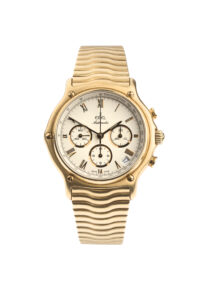
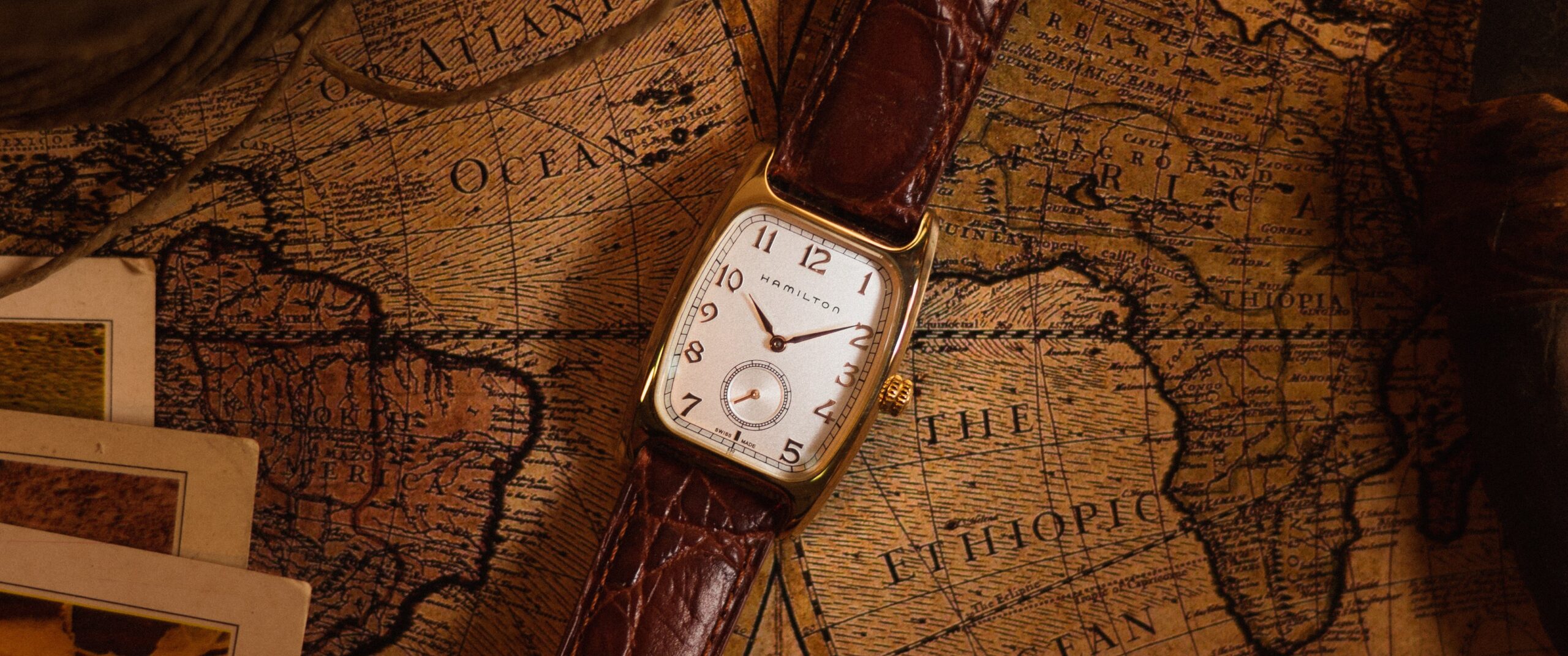
The Watch. The watch worn by Mickey Rourke as Wheeler in Wild Orchid is an Ebel reference 8134901 with a black dial, a piece that represents the Swiss manufacturer at the precise peak of its commercial and aesthetic ambitions. Ebel — the initials standing for Eugène Blum Et Lévy, the founding family name — was established in La Chaux-de-Fonds in 1911 and operated for much of its history as a competent but unremarkable mid-tier Swiss manufacturer before undergoing, in the late 1970s and through the 1980s, a transformation into one of the most design-forward luxury watch brands in the world under the stewardship of Pierre-Alain Blum. The wave bracelet, introduced in the early 1980s and characterized by its sinuous, interlocking links that flow organically from the case into the bracelet without visible transition, became the defining visual signature of the brand’s prestige period and one of the most recognizable watch designs of the decade. The reference 8134901 is a sport-luxe chronograph from this golden era, housing a reliable automatic movement within a case whose proportions and finishing reflect the brand’s then-position as a favored choice of a certain stratum of international wealth — the watch of a man who understood luxury but wore it as infrastructure rather than announcement, which is precisely the register Wheeler occupies in the film. The black dial variant gives the reference a nocturnal authority that the more common white and silver-dialed examples do not quite achieve, deepening the contrast between the luminous indices and the case finishing in a way that reads with particular force on screen in the warm, saturated cinematography of the Rio sequences. Ebel enjoyed significant celebrity patronage during this period — the brand was associated with a cohort of 1980s cultural figures for whom Swiss automatic chronographs represented a specific vocabulary of understated achievement — and the watch’s appearance on Rourke’s wrist reflects the broader cultural positioning of the reference among a certain kind of successful, internationally mobile man of the era. The brand’s subsequent history was less glorious: a series of ownership changes following Blum family control, including acquisition by LVMH and later by the Movado Group, progressively diluted the design identity that had made the wave bracelet era so distinctive, and Ebel today occupies a considerably more modest position in the Swiss watch landscape than its late-1980s prestige would have suggested. This trajectory has had the effect, familiar from other fallen luxury marques, of concentrating collector interest precisely in the period of peak ambition, and wave bracelet chronographs in black dial configurations — always a minority of production — have appreciated steadily as the design distance between that era and the present has grown.
Details
Brand:
Marketplace Price
€10 000
Movie Year:
1989
As seen on:
Movie/TV Series: