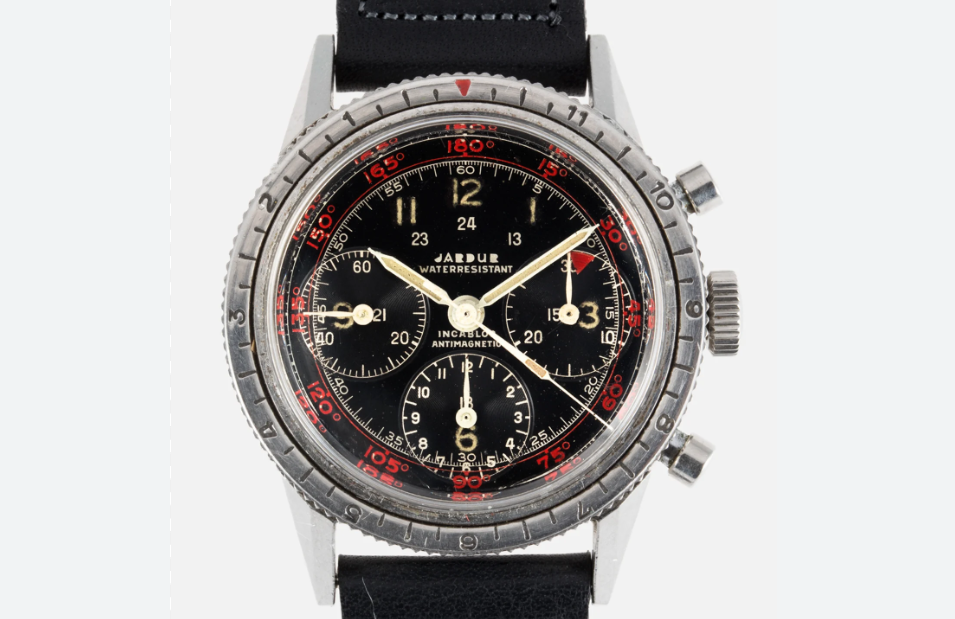
In John Frankenheimer’s 1998 thriller Ronin, Robert De Niro plays Sam, a former CIA operative navigating the murky loyalties of post–Cold War Europe. The film is celebrated for its ferocious car chases through the streets of Paris and Nice, for its cast of mercenaries who trust nothing and no one — and, for the more observant viewer, for the watch on De Niro’s wrist. Partially glimpsed in several scenes, the timepiece has been identified by collectors and watch historians as a Jardur Bezelmeter — the stainless steel version you can find pictured in my book. But today i want to let you know that a rarer gold-plated variant of what was already a rare and unusual chronograph exists: the Jardur Bezelmeter 995G.
Whether the choice was a deliberate prop decision or a personal preference brought to set, the presence of a Jardur on Sam’s wrist feels almost poetically appropriate. The Bezelmeter was never meant to be noticed. It was designed as a professional instrument — precise, functional, self-contained. Like Sam himself, it does not perform. It simply works. That the 995G also happens to be extraordinarily beautiful, in an understated, almost secretive way, only deepens the resonance.
The Klepper Brothers and the Birth of the Bezelmeter
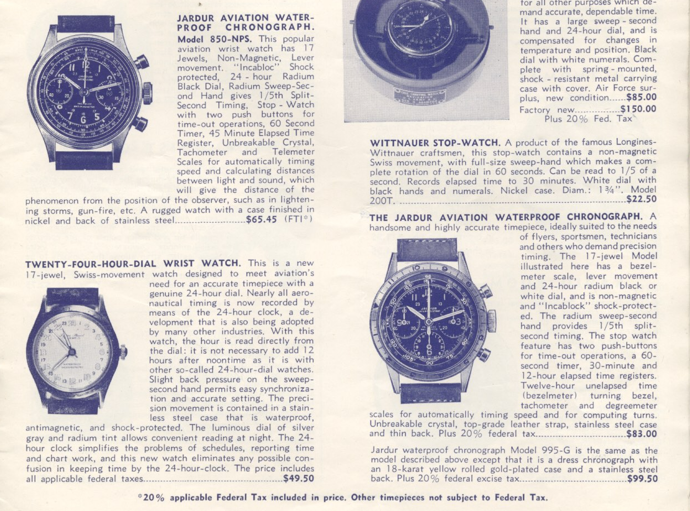
The story of Jardur begins not in a Swiss atelier but in the offices of the Pilgrim Electric Corporation, headquartered in the MacIntyre Building on Broadway in New York City. The company was built by brothers Samuel and Herman Klepper, passionate aviators who had previously worked at the Hamilton Radio Company alongside their brother-in-law Wolf Kalmin. In 1934, the family restructured the business, renaming it Pilgrim Electric — and from this foundation, the Jardur Import Company was born, dedicated to importing precision Swiss-made chronographs engineered specifically for aviation.
From its earliest days, Jardur’s philosophy was radically practical. The brand distributed its watches and navigational flight plotters exclusively through United States Army and Navy Post Exchanges and Ships Stores, making no attempt to penetrate civilian retail markets. This distribution strategy was a deliberate statement: the Jardur Bezelmeter was not a fashion accessory, not a status symbol, but a tool — as purposeful as a sextant or an altimeter. Every Bezelmeter that left its box was, by design, destined for someone who genuinely needed it.
The Swiss cases themselves were produced by Huga SA and fitted with movements sourced from the finest ébauche manufacturers of the era — notably Valjoux. The earliest Bezelmeter reference, the 950, used the Valjoux 71, while the more developed 960, introduced with waterproofing and improved case engineering, was powered by the Valjoux 72. Production numbers were always small: the Bezelmeter was never a mass-market product, and surviving examples in any condition are genuinely scarce. In gold-plated form, they are rarer still.
The brand’s prestige within aviation circles was considerable. In 1946, the Jardur Aviation Company presented General Carl Spaatz with a 995G Aviation Chronograph during the “Aviation Men of the Year” ceremony in Philadelphia. The 995G was the jewel of the range: the same instrument that armed aviators and intelligence operatives trusted, now wrapped in gold. That same year, General Ira Eaker received a 995G as well. These were not gifts chosen lightly.
The 995G: Where Instrument Becomes Object of Desire
The designation is precise: the 995 series represented a later evolution in Jardur’s line, featuring a new type, smaller and thinner case and back, available in two variants — 995S in stainless steel, and 995G in gold-plated form. The G suffix is where rarity becomes acute. While the stainless examples already survive in very limited numbers, the gold-plated versions are among the most elusive American-branded pilot’s chronographs of the mid-twentieth century.
The dial of the Bezelmeter is, at first glance, almost overwhelming in its informational density. A matte black surface hosts Arabic numerals rendered in luminous material, aged now to a warm yellow patina that collectors prize precisely for its untouched authenticity. The hands — known as Cathedral hands, with a distinctive teardrop nose on the hour hand — are among the most elegant in mid-century watchmaking. They echo the instrument clocks made by Smiths for British aircraft of the period: purposeful geometry elevated to something approaching art.
Running along the outer edge of the dial is a red Degreemeter scale, graduated from 0 to 180 degrees. This feature, unique to the Jardur among wristwatches of the era, was designed for aviation turn measurement. Based on a standard rate turn of 3 degrees per second, the scale allowed a pilot to time a 180-degree turn precisely — an operation that in the pre-GPS era was anything but academic. Below this, the triple-register layout of the chronograph subdials creates a visual architecture that is both rational and deeply satisfying: 30-minute recorder at three o’clock, 12-hour register at six, running seconds at nine.
The Case and Bezel: Gold as Statement
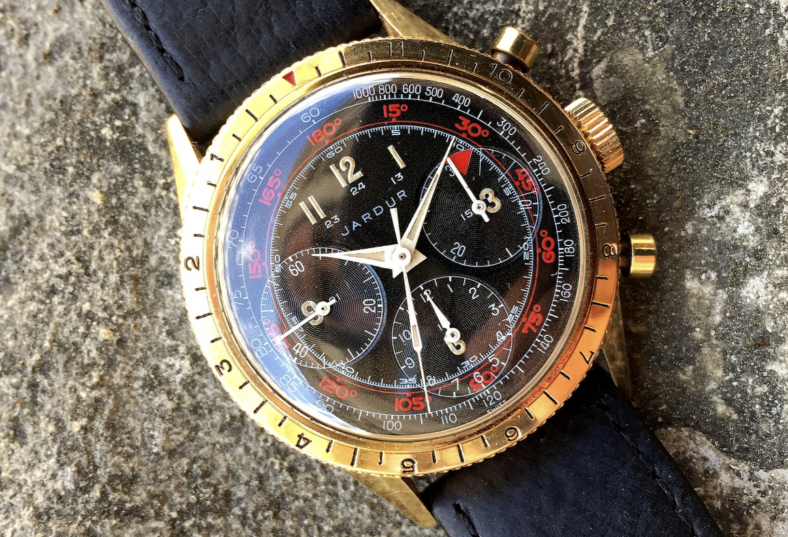
On the 995G, the warm gold plating transforms what was already a compelling object into something singular. The case — trim and compact by the standards of later sports chronographs — carries the gold without ostentation. This is not the gold of Côte d’Azur playboys but of General Staff dining rooms, of something serious dressed finely for a ceremony. The beveled lugs retain their angular precision, and the rotating bezel — an independent chapter ring graduated counterclockwise in hours — sits flush and functional, its purpose unchanged by the luxurious finish.
By the late 1940s, Jardur had introduced the gold-capped case and matching plated bezel partly as a commercial differentiator, a way of acknowledging that some of its customers wanted an instrument that could also pass at a formal dinner. The 995G achieves this balance more successfully than almost any other pilot’s watch of the period: it is entirely at home beside a cockpit throttle, and entirely at home on the wrist of a man in a dinner jacket navigating a cold European city at night — or, indeed, the wrist of a fictional CIA operative in a 1990s thriller.
The Valjoux 72: The Movement That Powered a Generation
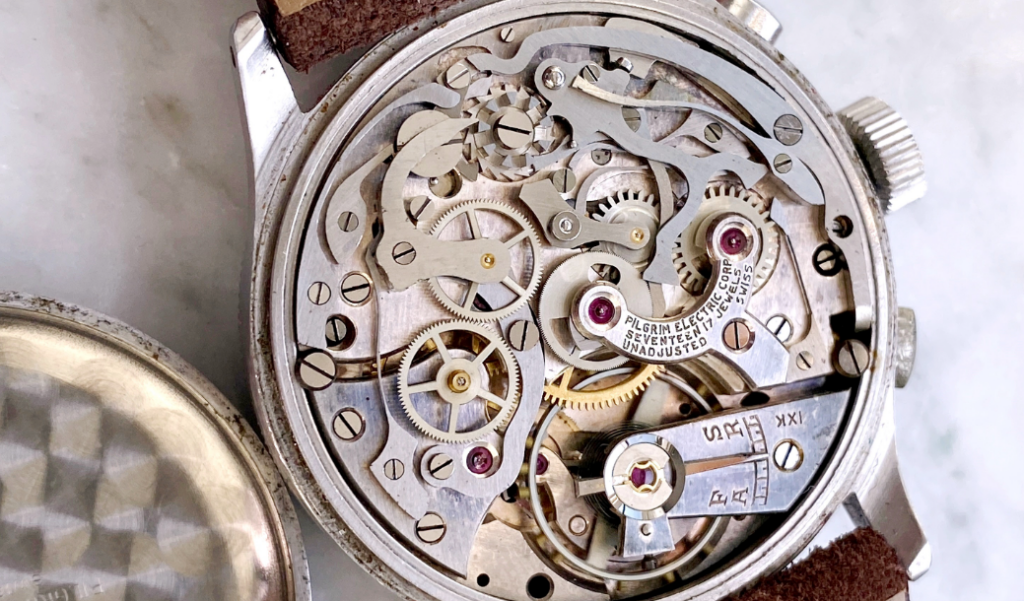
To understand the Jardur Bezelmeter fully, one must understand the engine at its heart: the Valjoux 72, introduced in 1938 and widely regarded as one of the finest manual-wind chronograph movements ever produced. Born from an evolution of the earlier Valjoux 22 and 23 calibers — themselves derived from 14-ligne pocket watch architecture — the 72 introduced a crucial innovation: a 12-hour counter at six o’clock. This third register completed what many horologists consider the ideal chronograph layout, and it is a layout that the Bezelmeter deploys with absolute conviction.
At 13 lignes in diameter and operating at 18,000 beats per hour, the Valjoux 72 is built around a column wheel and horizontal clutch — a combination that represents the classical chronograph architecture in its purest form. The column wheel ensures precise, tactile engagement of the start, stop, and reset functions with no ambiguity in operation. The movement’s construction is notably flat and transparent, with all levers and springs visible at a glance, making it exceptionally serviceable — a quality that mattered enormously to the pilots and military personnel who depended on these instruments in the field.
The Daytona Connection
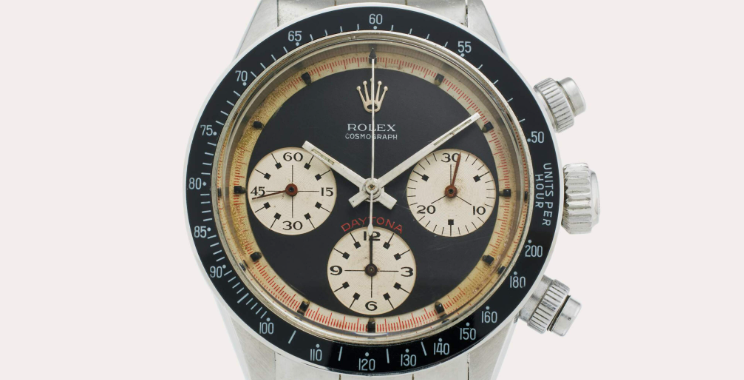
The Valjoux 72 that beats inside the Jardur Bezelmeter 995G is the very same caliber family that Rolex chose for what would become the most mythologized sports chronograph in history: the Cosmograph Daytona. Introduced in its first reference, the 6239, in 1963, the Daytona was powered by the Valjoux 72B — a version refined with a Breguet overcoil hairspring and a free-sprung, variable-inertia balance wheel. Over the following decades, Rolex would continue developing the movement through successive calibers — the 722, the 722-1, the 727 — before the Valjoux-based series powered the Daytona through an unbroken run from 1963 to 1988: twenty-five years of the same essential architecture.
The Paul Newman Daytonas — now among the most valuable wristwatches in the world, with individual examples crossing the million-dollar threshold at auction — owe their mechanical soul to Valjoux. And yet the movement’s association with Rolex, while it elevated the 72’s fame to near-mythological status, also obscures a longer history. When Jardur fitted the Valjoux 72 into the Bezelmeter’s modest case in the mid-1940s, the caliber was already a trusted workhorse: used by Breitling in the early Navitimers, by Heuer in the Carrera, by Universal Genève and Gallet and a dozen other serious manufacturers. It was the movement of choice for people who could not afford mistakes.
What makes the Jardur 995G technically compelling, then, is that it represents an earlier, purer expression of the same horological proposition that Rolex would later package for the world. The Bezelmeter makes no concession to marketing, no nod to status. The Valjoux 72 inside it was chosen because it was the right movement for the job — full stop. In this sense, the 995G is the more honest watch: an instrument before it was ever an icon.
Rarity, Legacy, and the Collector’s Gaze
Today, a Jardur Bezelmeter in any configuration commands serious attention in the vintage watch market. A 995G in clean, unpolished condition with an intact dial is genuinely exceptional — something that appears perhaps a handful of times per decade in major watch auctions or among the handful of specialist dealers who understand its significance. It occupies a curious position in the collecting hierarchy: too rare and too serious to be overlooked, yet still insufficiently famous to have attracted the price inflation that afflicts Daytonas or Navitimers with equivalent movements.
For those who know, that position is part of the appeal. The Jardur was never sold in jewellers’ windows. It was never advertised in glossy magazines. It existed in PX stores on military bases, passed between aviators and intelligence officers who cared about function and trusted the mechanism on their wrist the way they trusted their aircraft. The 995G brought gold to that tradition without altering its essential character — and somehow, without meaning to, produced an object of considerable beauty.
When De Niro wore its little brother in Ronin, the choice, whether deliberate or accidental, was perfect. Sam is a man with a past he does not discuss, skills he deploys without flourish, and loyalties that are real even when they cannot be articulated. The Jardur Bezelmeter is exactly that kind of watch. It tells the time. It measures it. And for those who look closely enough, it tells a story the wearer never intended to share.