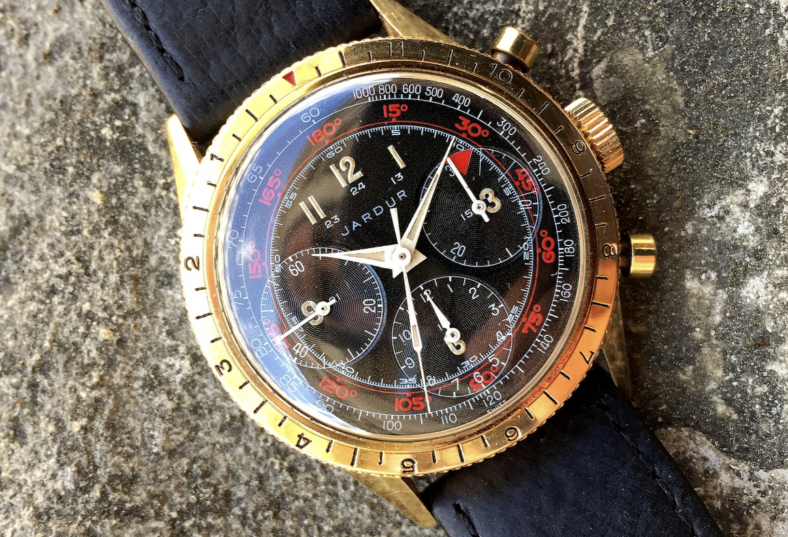

The Croton Nivada Grenchen Chronomaster Aviator Sea Diver: the Swiss super-chronograph that combined more functions than any wristwatch of 1961, worn by Brian Kelly through four seasons of Flipper and a film career defined by open ocean.
Flipper ran on NBC from 1964 to 1967, and for three seasons American families watched Porter Ricks, the widowed chief warden of the Coral Key Park and Marine Preserve in Florida, navigate the complications of single fatherhood and marine biology alongside his sons Sandy and Bud and their bottlenose dolphin companion. The show was broadcast in black and white for its first season and colour for the second and third, and while the plots were formulaic in the way that all mid-1960s family television was formulaic, the underwater photography was genuinely beautiful and the open-sea setting gave the production an authenticity that most domestic-set sitcoms of the era could not match.
Brian Kelly, who played Porter Ricks across all three television seasons and in the 1964 feature film that preceded the series, brought to the role a physical credibility suited to a man who spent most of his working life in the water. And on his wrist, visible in multiple episodes and in the film Around the World Under the Sea (1966), was a Croton Nivada Grenchen Chronomaster Aviator Sea Diver, first generation, fitted on a riveted period steel bracelet with a profile resembling an Oyster. The specific example has been identified by collectors and archivists as a variant with white subdial hands and central seconds, on a dial that has tropicalised to brown. It is, for this reason, known in the Nivada collector community as the Brian Kelly Chronomaster.
Evidence strongly suggests this was Kelly’s personal watch rather than a prop allocated by the production, and the same watch, or an identical example, appears on his wrist in Around the World Under the Sea. The detail is significant: it means that Kelly chose the Chronomaster from the available options of the mid-1960s, at a moment when the Rolex Submariner was the obvious aspirational choice for anyone connected to diving. Other actors on the Flipper production wore Submariners. Kelly wore a Croton Nivada Grenchen.
More on the television series: imdb.com/title/tt0057768 and on Brian Kelly: imdb.com/name/nm0447373
Nivada Grenchen, Croton, and the Problem with Names
The name on the dial of Brian Kelly’s watch is among the more baroque in watchmaking history, and it requires explanation before anything else can be discussed with clarity. Nivada SA was founded in Grenchen, Switzerland in 1926, by Otto Wüllimann, Hermand Schlindler, and Jacob Schneider, in the same Swiss Jura town that housed Breitling, Certina, Eterna, Fortis, and the ébauche manufacturers ETA and A. Schild. The brand produced elegant and functional watches from the beginning, and by the 1930s was one of the first Swiss manufacturers to offer automatic wristwatches, anticipating a category that would define the industry for decades.
When Nivada attempted to enter the American market, it encountered a legal obstacle of surpassing inconvenience: the watch company Movado successfully argued before an American judge that the names Nivada and Movado were sufficiently similar to cause consumer confusion. The ruling required Nivada to add its town name, producing the hyphenated Nivada Grenchen, but even that was not sufficient for American distribution. The solution was a commercial arrangement with the New York-based Croton Watch Company, established in 1939, under which Croton would serve as the American distributor for Nivada products. The same watches that bore the name Nivada or Nivada Grenchen in Europe were sold in the United States under the name Croton, Croton Nivada, or, in the fullest formulation, Croton Nivada Grenchen. The dial on Brian Kelly’s watch most likely bore one of these combined designations, followed by the full model name Chronomaster Aviator Sea Diver, making it among the lengthier inscriptions ever printed on a dial measuring 38mm.
The Chronomaster: The World’s Busiest Watch
The Chronomaster Aviator Sea Diver was introduced in 1961, and contemporary advertising in American magazines including Sports Illustrated marketed it under the claim that it was “The World’s Busiest Watch, has more uses than ever counted.” This was not mere rhetoric. The watch combined, in a single instrument, functions that no competitor of 1961 could match collectively: a full chronograph with 30-minute and 12-hour registers, a tachymeter scale, a rotating bezel for dive timing with a second time zone scale, a sailing regatta countdown on the chronograph subdial, and water resistance to 200 metres. Advertising copy of the period listed the functions methodically: stopwatch, time-out stopwatch, doctor’s watch, yachtsman’s five-minute warning timer, tachymeter, aviator’s watch, second time zone indicator, skin diver’s watch, and regular watch. Nine functions in a 38mm stainless steel case was, in 1961, genuinely extraordinary.
The first-generation models, which appeared from 1961 and bear the inscription “Chronograph Aviator Sea Diver” rather than the later “Chronomaster” designation that Croton had registered as a trademark in 1960 but Nivada did not adopt on the dial until 1965, used movements sourced from the Swiss ébauche manufacturers. The earliest examples were fitted with the Venus 210, identifiable by their small pushers and the distinctive broad arrow hour hand. Subsequent generations used the Valjoux 23, the Valjoux 7733, and the Landeron 248, with the Valjoux 23 appearing in most of the Nivada-branded examples from the mid-1960s and the Croton-branded examples immediately thereafter.
The Dial: Two Subdials and a Coloured Register
The visual identity of the Chronomaster is built around deliberate functional clarity. The dial is black, carrying two subdials rather than the three registers of classical chronograph layout: the thirty-minute elapsed time counter at three o’clock and a combined seconds and running seconds subdial at nine. One of these subdials carries a coloured segment, typically red or orange, which provided the yachting countdown function and gave the watch its most immediately distinctive visual element at a distance. The rotating bezel is wide, with a black aluminium insert carrying dual scales for dive timing and elapsed time, and its profile is substantial enough to grip with a gloved hand. The lume plots and hands are generous, reflecting the watch’s intended use in conditions of low visibility underwater.
The first-generation examples with the Venus 210 are particularly sought by collectors for the combination of the broad arrow hands, the small pushers, and the tropicalised brown dials that surviving examples frequently display, the chocolate transformation of the black lacquer that characterises the most prized examples of 1960s tool watches. It is precisely this tropicalisation that the Brian Kelly variant exhibits, giving the watch the aged warmth that makes it immediately distinguishable from later production.
The Antarctic and the South Pole: The Heritage Behind the Chronomaster
The Chronomaster did not emerge from a brand without credentials. Nivada’s previous flagship had been the Antarctic, a round dive watch introduced in 1950 that achieved genuinely significant real-world validation when examples accompanied Admiral Richard Byrd’s Operation Deep Freeze in the mid-1950s, the American expedition that first established a permanent station at the South Pole. The Nivada Antarctic watches were worn by crew members of the expedition without any endorsement arrangement, simply because they were the reliable and capable watches that the men chose to take with them. The South Pole was perhaps the single most demanding test of wristwatch performance available in the 1950s, and the Nivada’s survival and accuracy through the polar winter established a reputation that the brand carried directly into the Chronomaster’s design brief.
The Chronomaster extended this reputation from pure durability into multi-function versatility. Where the Antarctic had made the argument that a Nivada could survive anything, the Chronomaster made the argument that a Nivada could do everything. It was the right watch for the right decade: the 1960s, when Americans were going to the moon, exploring the ocean floor, and racing cars, and when the aspirational culture of adventure required a watch that could credibly accompany all three.
More on the Chronomaster’s revival and technical specifications: nivadagrenchenofficial.com and on the watch’s collector history: wornandwound.com/review/review-nivada-grenchen-chronomaster-aviator-sea-diver
Technical note: Croton Nivada Grenchen Chronomaster Aviator Sea Diver, first generation, introduced 1961. Stainless steel case, 38 to 38.5mm diameter. Black dial with two chronograph subdials, one incorporating a coloured countdown segment. Wide aluminium rotating bezel with dual timing scales. First-generation movement: Venus 210 (identifiable by small pushers and broad arrow hands). Subsequent movements: Valjoux 92, Valjoux 23, Valjoux 7733, Landeron 248, depending on production year and market. Water resistance 200 metres. Functions: chronograph, tachymeter, rotating bezel with second time zone, yachting regatta countdown, regular timekeeping. Marketed in Europe as Nivada or Nivada Grenchen, in the United States as Croton, Croton Nivada, or Croton Nivada Grenchen. Dial inscription evolution: “Chronograph Aviator Sea Diver” until circa 1965, then “Chronomaster Aviator Sea Diver.” The Brian Kelly variant, first generation with Venus 210 movement, features white subdial hands, central seconds, and tropicalised brown dial.
Details
Brand:
Marketplace Price
€1 200
Movie Year:
1964
As seen on:
Movie/TV Series: