The Rolex GMT-Master Reference 6542: the watch born from Pan Am’s request for a dual-time pilot’s instrument, worn by Honor Blackman as Pussy Galore in Goldfinger , and the reason an entire reference bears the name of a Bond girl.
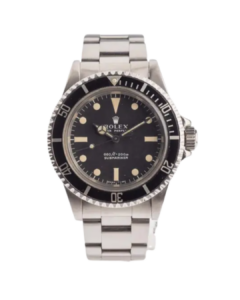
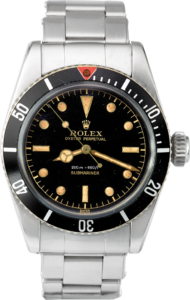
Guy Hamilton’s Goldfinger (1964) is the film in which the James Bond franchise found its commercial grammar, combining spectacle, wit, and a villain with genuine menace in proportions that the series would attempt to replicate for the following sixty years. Sean Connery wears a Rolex Submariner 6538 throughout, as he had in the two preceding films, and the watch is briefly visible in the famous close-up of his white-suited wrist. But the more historically significant Rolex in Goldfinger belongs to someone else.
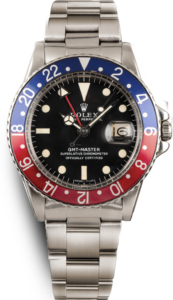
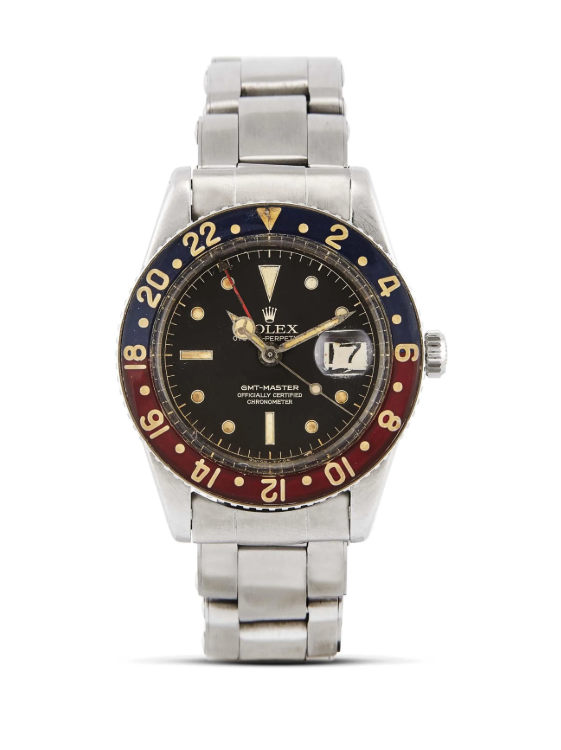
Honor Blackman plays Pussy Galore, the personal pilot of Auric Goldfinger and leader of “Pussy Galore’s Flying Circus,” an all-female aerobatic display team repurposed as a delivery mechanism for the chemical agent Goldfinger intends to use against Fort Knox. She is a pilot, and she wears a pilot’s watch: a Rolex GMT-Master reference 6542, the steel-cased version with the characteristic red-and-blue bezel that has been known ever since as the Pepsi. The effect on the watch’s collector reputation was permanent. The 6542 acquired a second nickname, one that appears in auction catalogues and dealer descriptions to this day: the Pussy Galore Rolex.
It was, as collectors have noted, the first time a woman had been shown wearing a forty-millimetre men’s sport Rolex on screen, and many credit the scene with initiating the now entirely accepted convention of women wearing large men’s sports watches. The character’s status as a pilot made the choice coherent in a way that no other Bond film watch choice of the period matched quite as precisely: the GMT-Master had been designed for professional aviators, and Galore was one.
More on the film: imdb.com/title/tt0058150 and on Honor Blackman: imdb.com/name/nm0000280
Pan Am and the Brief That Created a Category
The GMT-Master reference 6542 was introduced in 1954 or 1955, accounts differ by a year, and it exists because Pan American World Airways had a problem. Commercial aviation was entering the jet age and Pan Am, the dominant American international carrier of the era, was preparing to fly its pilots and passengers across multiple time zones on a schedule that required simultaneous awareness of departure and destination times. Before GPS, before digital displays, before anything beyond a mechanical wristwatch, the solution to this problem was a fourth hand.
Pan Am’s CEO Juan Trippe turned to Rolex. The brief was straightforward: design a watch that could show two time zones simultaneously, with sufficient legibility to be read at a glance from a cockpit instrument panel. Rolex’s answer was elegant in its simplicity. They added a 24-hour hand, making one complete revolution per day rather than the conventional two, and a rotating bezel graduated in 24 hours. By setting the 24-hour hand to Greenwich Mean Time and using the standard 12-hour hands for local time, a pilot could read both time zones without any calculation. The colours of the bezel insert, red for daytime hours and blue for night, were chosen partly to distinguish the two halves of the 24-hour cycle and, according to some sources, partly in homage to Pan Am’s own livery.
The new watch took its name from its primary reference: GMT, Greenwich Mean Time, the international standard of civil time. The reference 6542 was built on the base architecture of the earlier Rolex Turn-O-Graph reference 6202, modified with the new movement and the distinctive bezel. Pan Am distributed the watch to its transatlantic flight crews, and a 1959 advertisement, “Pan Am Flies on Rolex Time,” made the partnership explicit and public.
The Bakelite Bezel: Beautiful, Radioactive, and Gone
The element that defines the first-generation 6542 is its bezel insert, and the element that defines the bezel insert is the material from which it was made: Bakelite. Bakelite is a thermosetting plastic, among the first synthetic resins ever commercially produced, developed in 1907 by the Belgian-American chemist Leo Baekeland. Its use for the GMT-Master bezel was motivated by a specific property: it was less reflective than metal, reducing glare for pilots in direct sunlight, and it could be manufactured in the precise red-and-blue two-tone colour scheme required without paint or coating. The numerals set into the Bakelite were filled with luminous material, which on the bezel of the original 6542 was a compound of radium and strontium 90, both radioactive.
Three problems with the Bakelite bezel became apparent in relatively short order. The first was fragility: Bakelite cracks under thermal stress, and in tropical climates and cockpit conditions the inserts were prone to damage that was irreparable. The second was fading. The third, and most dramatic, was radioactivity. In 1959, the United States Atomic Energy Commission raised concerns about the radiation levels in the bezel inserts, and Rolex conducted a recall of affected watches, retrofitting many with aluminium inserts and, in some cases, scraping out the luminous material entirely. The aluminium replacements were more durable but lacked the Bakelite’s glowing depth: the numbers on the original insert appeared, as one collector put it, to float inside the bezel like embers in a lantern. No replacement could replicate that quality, and no original example has survived entirely intact with the bezel unchanged.
The transition from Bakelite to aluminium occurred by around 1957, making original Bakelite examples the product of an extraordinarily narrow production window. The radium on the dial and hands means that surviving first-generation examples still test Geiger-positive, a detail that is cited in auction descriptions and dealer listings with the matter-of-fact acceptance that the vintage watch market has developed for historical curiosities of this kind. Collectors are warned not to open these watches themselves.
The Case: No Crown Guards, Gilt Dial, and the Aesthetic of the Jet Age
The 6542 case measures 38mm in diameter, modest by current standards but consistent with sports watches of the mid-1950s, and it was produced without crown guards. Those protective flanges on either side of the winding crown, now familiar from every subsequent GMT-Master reference, were not introduced until the 1675 in 1959, which replaced the 6542 after its five-year production run. The absence of crown guards gives the 6542 a cleaner, more open profile than any of its successors, and contributes significantly to the aesthetic quality that collectors consistently describe as the most beautiful of all GMT configurations.
The dial is gilt, a warm gold tone achieved by the electroplating process of the era, with a black background and applied Mercedes-style hands whose luminous plots matched the radium compound of the bezel on first-generation examples. The date aperture carries a cyclops magnification lens in Plexiglass. The printing on the dial includes the GMT-Master name and, at the base, the chronometer certification. The roulette date disc of the earliest examples alternated red and black numerals; later production standardised to black-only.
The movement is the Rolex calibre 1065 (known in earlier production as the 1036 and later as the 1066), a self-winding automatic derived from the calibre 1030 that powered the Turn-O-Graph, modified to drive the additional 24-hour GMT hand from the same mechanism as the standard 12-hour hand. The GMT hand and the standard hour hand are linked, moving together and separable only when the bezel itself is rotated to indicate a different offset.
The Name That Stuck
By the time Goldfinger was released in 1964, the reference 6542 had already been discontinued for five years, replaced by the 1675. The watch Blackman wore on screen was already a vintage object at the time of filming, which adds a further dimension to its charm: Pussy Galore, the most capable aviator in the film and arguably the most capable person in the entire cast, was wearing a discontinued Rolex. Whether this was a costume department choice or a personal watch brought to set is not documented.
What is documented is the effect. A reference that had been produced for five years, discontinued, and replaced, acquired from a Bond girl’s wrist a cultural afterlife that has now lasted sixty years. Original Bakelite examples, when they surface in auction, routinely command six figures. The better examples with intact, uncracked inserts and original gilt dials are among the most expensive vintage sport Rolexes available. The reference that Pan Am ordered to solve a navigation problem has become, through the particular alchemy of cinema and scarcity, one of the most mythologised objects in horology.
More on the GMT-Master’s history: bobswatches.com/rolex-blog/watch-review/reference-gmt-master-6542.html and on the broader Bond watch lineage: en.wikipedia.org/wiki/James_Bond_and_watches
Technical note: Rolex GMT-Master Reference 6542, introduced 1954/1955, discontinued 1959. Stainless steel case (also produced in 18-karat yellow gold), 38mm diameter, no crown guards. Rotating 24-hour bezel, first-generation insert in Bakelite with radium-filled numerals in red (daytime) and blue (night) segments, subsequently replaced by aluminium insert from circa 1957. Gilt black dial, applied Mercedes-style hour markers with radium lume (later tritium), roulette date disc. Rolex calibre 1065 automatic movement (evolved from calibres 1036 and 1066), self-winding, driving standard 12-hour hand and additional 24-hour GMT hand simultaneously. Plexiglass crystal with integrated cyclops date magnifier. Replaced by reference 1675 in 1959. Original Bakelite-bezel examples test Geiger-positive for radium and strontium 90.
Details
Brand:
Marketplace Price
€45 000
Movie Year:
1964
As seen on:
Movie/TV Series: