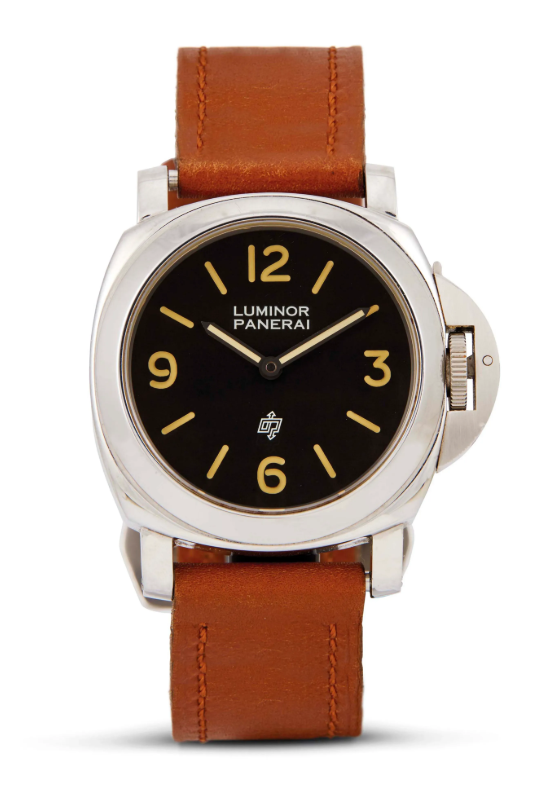
The Panerai Luminor 5218-201/A “Pre-Vendome Logo”: one of 677 examples produced in 1993 for the first civilian release in a company history stretching back to 1860, worn by Sylvester Stallone throughout the filming of Daylight (1996), and the watch that transformed an Italian military instrument manufacturer into one of the most recognised luxury watch brands in the world
Rob Cohen’s Daylight (1996) is a disaster film in the classical sense: a catastrophic event, a group of survivors, a single capable man, and the clock running against them. A series of explosions collapse both ends of the Holland Tunnel beneath the Hudson River, trapping a group of people underground, and Kit Latura, played by Sylvester Stallone, enters the flooding tunnel to lead them out. The film opened on December 6, 1996, to moderate reviews and reasonable commercial performance. What it did for the watch on Stallone’s right wrist was transformative, and the transformation was not immediately visible: it would take a few years, and the arrival of Arnold Schwarzenegger and other action celebrities into the Panerai fold, before the consequence of that appearance became apparent.
On Stallone’s wrist throughout filming was the Panerai Luminor 5218-201/A, case number 0764, manufactured in 1993. The watch is fitted on a rare original sharkskin strap with a pre-Vendome Panerai buckle, as seen in the film. Stallone kept the watch after production and wore it until he consigned it for auction at Phillips in December 2020. The hand-written note he provided with the watch states: “I did a film called Daylight, and I wanted to wear a watch that no one had ever seen. I strapped this on my wrist that day and didn’t take it off until the end of filming.” He later added that it “went through hell in every scene.” The watch sold at the Phillips Racing Pulse auction on December 12, 2020, for $214,200, against a pre-sale estimate of $40,000 to $80,000.
More on the auction: phillips.com/detail/panerai/NY080120/47
From Florence to the Italian Navy: Panerai Before 1993
Officine Panerai was founded in Florence in 1860 by Giovanni Panerai (1825–1897) as a small workshop selling and repairing Swiss watches, with a school of watchmaking attached. Giovanni’s grandson Guido Panerai took over around the turn of the century, and the company evolved into the primary supplier of precision instruments to the Regia Marina, the Royal Italian Navy. The relationship between Panerai and the Italian naval frogmen units is the foundation of the company’s mythology: the watches designed for combat swimmers in the 1930s and 1940s, with their large cushion cases, luminous dials, and crown-protecting devices, became the aesthetic template for everything the brand would later produce.
The Radiomir, commissioned by the Italian Navy in 1936 and named for the radium-based luminescent material Panerai had developed for sighting instruments, was the first watch in what became the brand’s defining line. The Luminor, developed in the late 1940s and formally established by the mid-1950s, replaced the Radiomir’s wire lugs with a more robust integrated lug construction and introduced the distinctive crown-protecting lever, the hinged bridge over the winding crown that prevents accidental activation and became the Luminor’s most immediately recognisable visual signature. Luminor was the name given to the luminescent compound that replaced the radioactive Radiomir material, derived from the same Italian etymology as its predecessor but without the associated health risk.
From 1936 through 1992, Panerai produced watches exclusively for military clients. The Italian Navy, the Egyptian Navy, the commandos of various armed forces: all were supplied, and none of the watches was sold to the public, which meant that by 1993 the company possessed a complete body of design work, over fifty years of military heritage, and zero civilian brand recognition.
September 10, 1993: The First Day of Public Existence
Under the direction of Dino Zei, the company’s CEO and a retired Marina Militare engineer who had acquired the business after the death of Giuseppe Panerai in 1972, Officine Panerai launched its first civilian collection on September 10, 1993. Two watches were unveiled: the Luminor Logo, reference 5218-201/A, and the Mare Nostrum chronograph, reference 5218-301/A. The Pre-Vendome era had begun.
The 5218-201/A is known as the “Logo” model because of the distinctive OP insignia on the dial, an Officine Panerai logo mark in which the two arrows of the letters point in opposite directions: one downward, indicating the naval underwater instruments, and one upward, indicating the aerial instruments the company had also supplied. The logo encapsulates the brand’s dual military heritage in a single graphic element. The total production of the 5218-201/A was 677 examples, manufactured in 1993 and sold over the following years. The series numbers run from 0001 to 0677, though an additional approximately 200 examples were later reworked at Stallone’s request into the “Slytech” configuration, carrying his name on the dial and his signature on the case back.
The 5218-201/A: 44 Millimetres of Reason to Reconsider the Wristwatch
The 5218-201/A is a 44-millimetre cushion-shaped stainless steel watch with a three-body case construction, polished and brushed surfaces, a screwed case back engraved with the Panerai logo, and a sapphire crystal. The dial is sandwich construction: black over a luminous substrate, with Arabic numerals and baton indices in luminous material and baton hands treated to match. The winding crown sits at nine o’clock, protected by the Luminor lever bridge that is one of the watch’s defining visual elements. Water resistance is appropriate to a watch designed for professional diving use.
The movement is the calibre UT 6497, rhodium-plated, 17 jewels, with a straight-line lever escapement, monometallic balance adjusted to four positions, shock absorber, self-compensating flat balance spring, and an index regulator. The UT 6497 is a manual-wind movement of Swiss manufacture, a large pocket-watch-derived ebauche used by Panerai in this period and later replaced by in-house movements as the company grew. Its diameter is suited to the generous case dimensions: the movement fills the case back view generously, and the visible mechanism through the display back of later Panerai models demonstrates why a large movement in a large case is one of the brand’s enduring propositions.
In 1993, 44 millimetres was exceptional. The standard sports watch case was 38 to 42 millimetres, and the prevailing aesthetic of the luxury watch market was towards refinement and smallness. Panerai’s cushion case at 44 millimetres read on a wrist as something from a different tradition entirely, which is precisely what it was: the proportions were set by military functional requirements, not by fashion, and the resulting watch looked like nothing else available to civilian buyers in 1993.
The Consequence of One Man’s Wrist
Stallone did not discover Panerai during the filming of Daylight in Rome, as the story he has associated with the watch implies. Documentation shows he was wearing a Luminor Logo considerably earlier. What Daylight did was place the watch in a widely distributed motion picture, on the right wrist of one of the most recognisable action actors in the world, in a context where the watch was visible and its unusual proportions legible on screen.
Arnold Schwarzenegger followed. Other action celebrities followed Schwarzenegger. Stallone commissioned the Slytech editions, and later the “Daylight” dial editions. By 1997, the Vendome Group, subsequently renamed Richemont, acquired Panerai, recognising that the brand’s combination of military heritage, distinctive design, and celebrity association represented something commercially significant that was being underexploited from a workshop in Florence. The acquisition and relocation to Switzerland, the expansion of the catalogue, the development of in-house movements: all of it follows from the moment when a 44-millimetre cushion case on Stallone’s right wrist caught the attention of an audience in 1996. Phillips estimated the watch’s value at $40,000 to $80,000. The auction room corrected that estimate by a factor of nearly three.
More on the Panerai Pre-Vendome era: watchesbysjx.com/2020/12/sylvester-stallone-panerai-luminor-5218-201a-daylight.html and on Officine Panerai’s history: panerai.com
Technical note: Panerai Luminor Logo, reference 5218-201/A, “Pre-Vendome,” produced 1993, case number 0764 in Stallone’s example. Series of 677 examples. Stainless steel cushion-shaped case, 44mm diameter, 14mm thickness. Three-body construction, polished and brushed. Screwed case back engraved with Panerai logo. Crown at 9 o’clock, protected by Luminor crown-protecting lever bridge. Sapphire crystal. Black sandwich dial with Arabic numerals and baton indices in luminous material. Baton hands. Movement: calibre UT 6497, manual-wind, Swiss manufacture, rhodium-plated, 17 jewels, straight-line lever escapement, monometallic balance adjusted 4 positions, shock absorber, flat balance spring, index regulator. Sharkskin strap with pre-Vendome Panerai buckle in Stallone’s example. Original accessories: mahogany box, additional straps, brass screwdriver. Brand acquired by Vendome Group (now Richemont) in 1997. Stallone’s example auctioned at Phillips Racing Pulse, New York, December 12, 2020, for USD 214,200.
Details
Brand:
Marketplace Price
€15 000
Movie Year:
1996
As seen on:
Movie/TV Series: