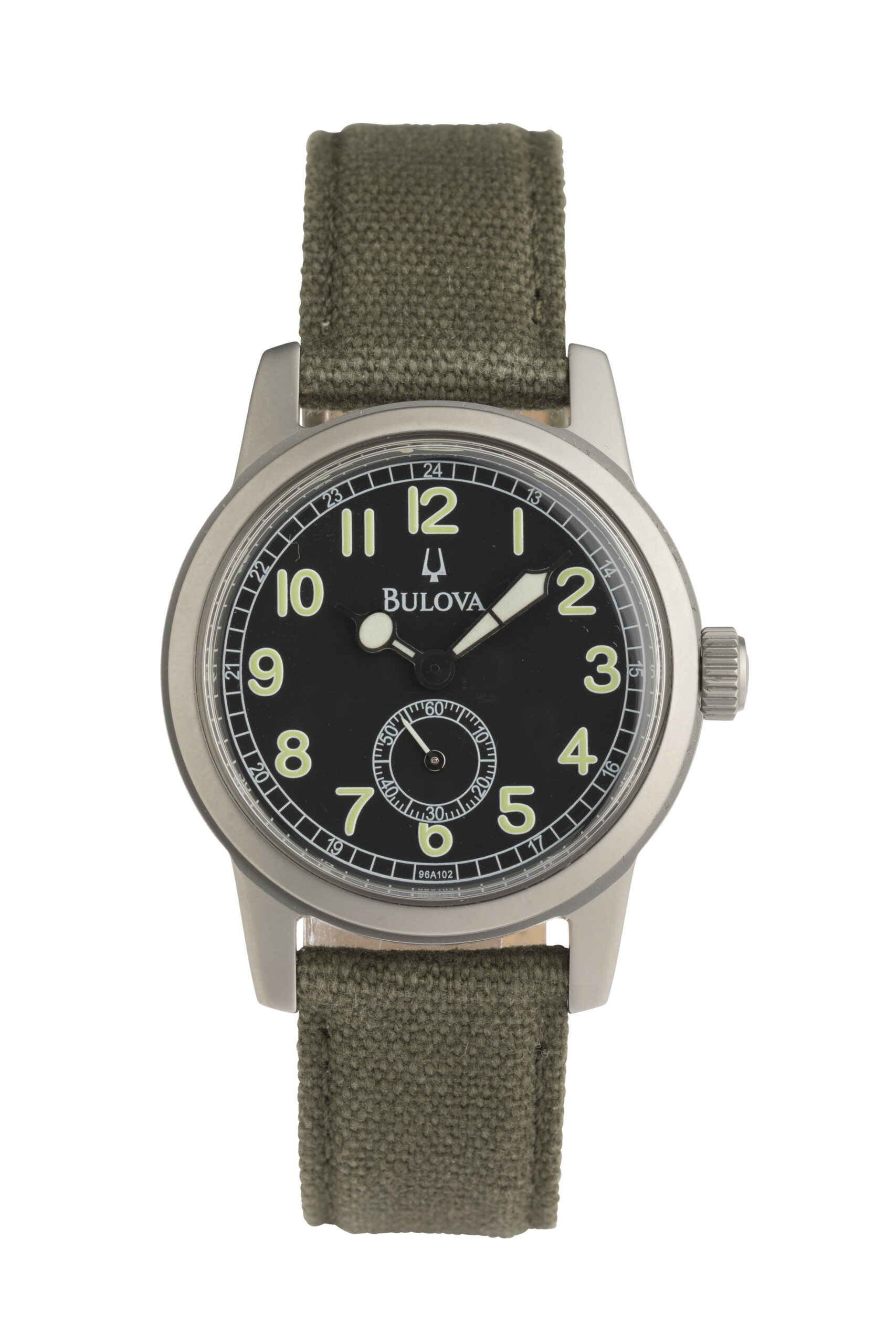
The Bulova Hack 96A102: the quartz commemorative reissue of the American A-11 military field watch, named for the function that allowed Allied soldiers to synchronise their timepieces before going into action, worn by Channing Tatum as Capitol Police officer John Cale throughout Roland Emmerich’s White House Down (2013), where the watch is damaged during the film’s action and worn, broken, to the end
Roland Emmerich’s White House Down (2013) is a film that arrived in the same summer as Olympus Has Fallen, a separate production with an almost identical premise: a paramilitary group seizes the White House, a single capable man inside must stop them. Where Antoine Fuqua’s film treated the premise as a grim, violent thriller, Emmerich’s version reached for something closer to Die Hard, pairing its action with comedy and casting Channing Tatum against Jamie Foxx as a President who turns out to be more physically capable than the situation initially suggests. The two films competed at the box office that summer, and White House Down came second commercially, though it has found a substantial subsequent audience.
Tatum plays John Cale, a Capitol Police officer who has been rejected for a Secret Service position protecting the President, and who is giving his daughter a White House tour when the building is seized. He is the wrong man in the wrong place who turns out to be exactly the right man. It is the structural logic of the action film from its foundations, executed here with the self-awareness that the genre had developed by 2013 and with Tatum’s particular quality of physical confidence worn lightly.
The Bulova Hack 96A102 is on Cale’s wrist throughout. Tatum wears it on the underside of his wrist, the military carry position that provides the watch face a degree of protection during physical work while keeping it legible when needed. At some point during the film’s action sequences the watch is damaged: the crystal is broken, the crown is missing. The watch continues to be worn after it has been wrecked, which in a film about a man who keeps going after the situation has become untenable is not an accidental visual choice.
The Word Hack and What It Meant in 1944
The name comes from the function. To hack a watch, in military terminology, means to stop its seconds hand: when the crown is pulled, the hand freezes, allowing the wearer to synchronise the watch to an external reference, then release the crown at the precise moment, letting the seconds hand resume from exactly the correct position. In a military operation where multiple units needed to act simultaneously, the ability to set watches to the exact second, rather than to the nearest minute, was the difference between a coordinated action and a scattered one. The seconds hand that hacks was the seconds hand that gave soldiers a genuine common clock.
The United States government developed the A-11 specification for military wristwatches during the Second World War, and several American watch companies were contracted to produce watches meeting that specification. Bulova was among them, alongside Waltham and Elgin National Watch Company. Bulova’s A-11 production, and its related A-15 pilot watch with dual internal rotating bezels for elapsed time and GMT functions, constituted the company’s most direct contribution to the war effort in watchmaking terms. It was not the only contribution: Bulova’s manufacturing capacity was also redirected to timing fuses, telescopes, aviation instruments, and jewel bearings adapted from its watch movements. When the war ended, Joseph Bulova’s son Arde founded the Joseph Bulova School of Watchmaking, providing completely free tuition to disabled veterans returning from combat, and securing them employment as watchmakers at jewellery stores across the United States.
The original A-11 dial carried no manufacturer’s logo, a standard requirement for military-issue watches that prevented the dial from identifying the watch’s origins in the event of capture. The hands were luminous. The Arabic numerals ran in a clean twelve-hour sequence. The case was small by contemporary standards. The function was exact.
Bulova: From Tiffany’s to the A-11
Joseph Bulova arrived in New York from the Czech Republic at nineteen, already trained in watchmaking and goldsmithing. He worked at Tiffany & Co. before founding J. Bulova & Co. in 1875. By the end of the First World War, he had recognised that consumer preference was shifting from pocket watches to wristwatches, a transition that the rest of the industry treated as a passing fashion. Bulova committed to wristwatch production and by 1919 was releasing a line of men’s wristwatches, followed in 1924 by the first women’s wristwatch line to come from an American manufacturer. The innovation that defined Bulova’s mid-century commercial identity came on July 1, 1941, when it broadcast what is generally claimed to be the world’s first television commercial: a simple image of a clock face over a map of the United States, with the words “America runs on Bulova time.”
The company became a subsidiary of Citizen Watch Co. in 2008, under whose ownership it continues to operate from New York. The military heritage that produced the A-11 remains the most culturally significant chapter of the company’s history, and Bulova has returned to it repeatedly in commercial form, beginning with a limited edition released in 2005 to coincide with the film The Great Raid, a wartime drama set in the Philippines.
The 96A102: A Commemorative Without Apology
The 96A102 is Bulova’s quartz commemorative reissue of the Hack watch aesthetic, predating the later automatic versions of the Military Collection. It makes no pretence of being the mechanical original: the movement is a Miyota quartz calibre, housed in a 40mm stainless steel case, and the dial carries the reference number across its lower portion as a period detail borrowed from the military specification rather than concealed from it. The sandblasted case is 50mm lug-to-lug and 11mm thick. The domed acrylic crystal contributes to the vintage silhouette but also, as Worn&Wound noted in their coverage of the film, provides less resistance to the kind of damage the watch sustains on screen than a mineral or sapphire alternative would. The case finish in the 96A102 is lightly bead-blasted, carrying the satin grey quality of a working instrument.
The dial is black with large luminous Arabic numerals, Art Deco-influenced sword hands, and a small seconds subdial at six o’clock. The twenty-four-hour inner track is present in some configurations, a reference to the A-15 pilot watch specification that ran alongside the A-11 in the period. The strap is green canvas on 20mm lugs with a steel buckle, the combination that reads immediately as military issue regardless of what the dial says underneath it. The retail price at the time of the film’s release was approximately $150.
Two known dial variants of the 96A102 exist: one with the Bulova name alone, and one with the Bulova tuning fork logo above the name, a branding element introduced with the Accutron in 1960 that became the company’s general commercial mark. The film version carries the tuning fork.
More on Bulova’s military heritage: bulova.com and on the history of the A-11: timeandtidewatches.com/in-depth-the-bulova-hack-watches-and-their-military-history
Technical note: Bulova Hack 96A102, Dress Collection, quartz commemorative reissue. Stainless steel case, sandblasted finish, 40mm diameter, 50mm lug-to-lug, 11mm thickness. Black dial with large luminous Arabic numerals, sword hands, small seconds subdial at 6 o’clock, 24-hour inner track. Domed acrylic crystal. Miyota quartz movement. Green canvas strap, 20mm lug width. Water resistance 30 metres. Dial variant in the film: Bulova tuning fork logo above name. Retail price approximately $150. Worn by Channing Tatum as John Cale in White House Down (2013), directed by Roland Emmerich. Tatum wears the watch on the underside of the wrist. The watch is damaged on screen, crystal broken and crown missing, and continues to be worn in the damaged state.
Details
Brand:
Marketplace Price
€160
Movie Year:
2013
As seen on:
Movie/TV Series: