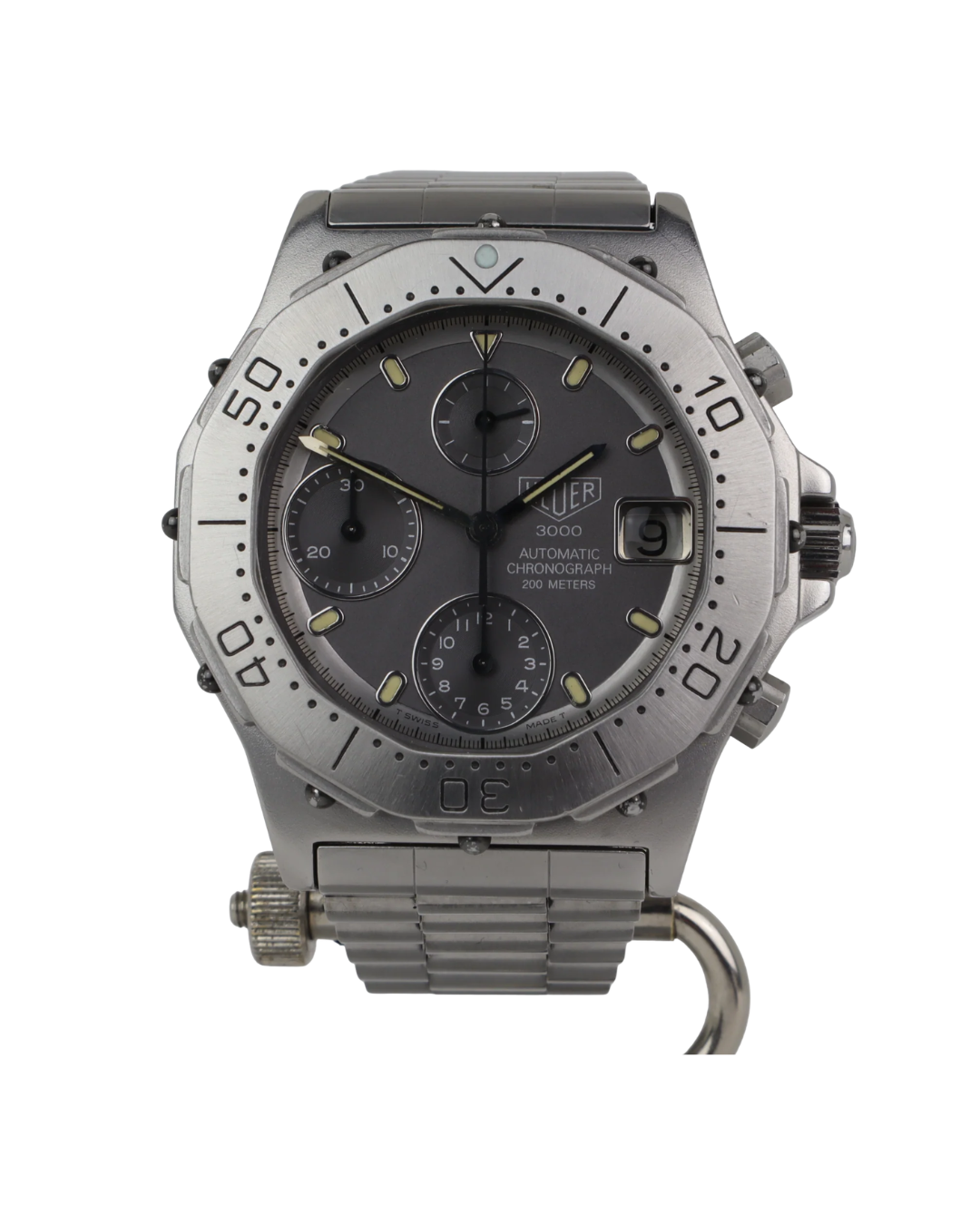
The (TAG) Heuer 3000 Chronograph ref. 232.206: the quartz chronograph with Dubois Dépraz module built by Heuer in 1984 and carried forward under the TAG Heuer name after the 1985 acquisition, worn by Bruce Willis as Detective John McClane on the inside of his right wrist throughout John McTiernan’s Die Hard (1988), where the choice of a two-hundred-metre professional chronograph by a New York cop speaks quietly against the Rolexes and the Cartier Tank worn by everyone around him
John McTiernan’s Die Hard (1988) is the film that defined a genre, or more precisely created the template against which every subsequent one-man-against-a-superior-threat action film has been measured. NYPD Detective John McClane arrives in Los Angeles on Christmas Eve to see his wife Holly, who has moved with their children to work at the Nakatomi Corporation. During the company Christmas party on the thirtieth floor of Nakatomi Plaza, a group of German terrorists led by Hans Gruber, in the role that launched Alan Rickman’s career, seizes the entire building to access bearer bonds in the corporate vault. McClane is the only free man in the building: no shoes, a vest, a Zippo lighter, a Sharpie, and a TAG Heuer on his wrist.
The detail of the watch worn inside the right wrist has been precisely identified by BAMF Style, the authoritative reference for film costume design: the reference is 232.206, the all-steel grey variant on a dark grey leather strap with a 38mm case, which Heuer had introduced in the 1984 catalogue. The actual screen-worn example was offered for sale by Prop Store with the hands stopped at 10:10, the scratches and marks of production, and a strip partially torn from the strap, confirming an object that went through filming alongside the actor.
Functional Elegance for High Performance Instruments
Heuer’s 1984 catalogue described the 3000 series with the phrase “functional elegance for high performance instruments,” and the formula was not empty. The series had been conceived as a premium evolution of the successful 2000 line introduced in 1982, with a distinct design proposal: the soft-cornered rectangular case, the twelve-sided bezel with ball-shaped grip studs at each corner for purchase with wet or gloved hands, and the sandblasted matte-grey of the steel that evoked technical instrumentation rather than conventional luxury. Water resistance was rated to 200 metres, unusual for a chronograph of the period.
The 232.206 is the full-size reference with an entirely grey-steel case and dial, in a colorway the TAG Heuer Enthusiast catalogue documents alongside the two-tone, gold-and-black, and black-and-gold variants. DC Vintage Watches describes the all-grey configuration as the least common colorway of the range. The case is in matte grey steel, 38mm excluding the crown, 41mm including it, 43mm lug-to-lug. The crown is signed Heuer in earlier examples, transitioning to the TAG Heuer signature after the 1985 acquisition.
The movement is the Calibre 185, one of the more interesting pairings of the period: a Dubois Dépraz 2000 mechanical chronograph module mated to an ETA 555.232 quartz base. The automatic variant of the 3000 Chronograph used the same DD2000 module paired instead with an ETA 2892 via the Lemania LWO 283 movement, a significant genealogical connection: Lemania had sold its shares in Heuer in 1984 to TAG, and the LWO 283 subsequently went on to be used by Audemars Piguet in the Royal Oak Offshore and by Girard-Perregaux. The quartz chronograph was, as the Heuerville blog noted, effectively a forerunner of what would later be called the Calibre S architecture, combining a quartz base with a mechanical chronograph module in a configuration that anticipated hybrid movements by several decades.
The 3000 series was produced for just over five years. With Heuer being acquired by Techniques d’Avant Garde in 1985, the 3000 series carried on largely unchanged as a TAG Heuer. Somewhere between 1986 and 1989 TAG Heuer stopped producing the 3000 Series chronograph, leaving only the basic watch in the catalog.
The Question of 1985
The history of the dial McClane wears has a complication that the catalogues clarify. The 232.206 was introduced in 1984, one year before Heuer’s acquisition by TAG, the French conglomerate backed by Guy Léon. The transition happened in 1985, and the existing models continued in production under the updated branding. The TAG Heuer Enthusiast blog documents that the only significant visible change was the relocation of the “3000” text from below the Heuer shield to the lower portion of the dial, along with the addition of the TAG prefix. By 1988, when Die Hard was in production, the 232.206 McClane wears was already officially a TAG Heuer, even though its architecture had been conceived by Jack Heuer and his team. The watch that costume designer Marilyn Vance placed on Bruce Willis’s wrist carries the signature of the transition: an object that belongs to two eras of the same company simultaneously.
The Detective and His Co-Stars
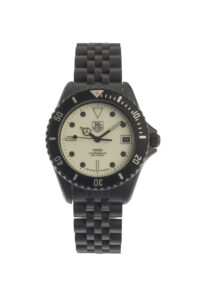
Die Hard is one of the most precisely populated films in terms of watch choices in 1980s action cinema, and the distribution is deliberate in its implications. Hans Gruber, Rickman’s cultivated, anglophone terrorist, wears a Cartier Tank: the watch of the European dandy, rectangular, elegant, conspicuously free of any sporting ambition. Holly McClane and her colleague Ellis, the characters who inhabit the corporate world of Nakatomi, are both wearing Rolexes. The terrorists, as enthusiasts have reconstructed, are likely wearing TAG Heuer 1000 PVDs, the same brand as the protagonist but in its more economical and tactically stark all-black configuration.
McClane wears the professional chronograph a 1988 NYPD detective could afford and would choose: not luxury, not military tactical, but instrumentation. The TAG Heuer 3000 Chronograph was not an inexpensive watch in its segment, retailing around $900 according to period sources and competitive with mid-range Swiss chronographs, well above the Japanese competition. It is not a Rolex, and it is not black plastic: it sits precisely at the boundary between blue-collar and competent, the point at which a serious professional who is not wealthy buys his equipment.
The watch worn inside the right wrist is the film’s most precise character marker. McClane is not the suited action hero that the decade had frequently proposed; he is someone kneeling barefoot on broken glass because he did not have the right shoes at the wrong moment. The two-hundred-metre chronograph he carries on the inside of his wrist, in the military carry position that keeps the dial protected during physical work, describes who he is before he opens his mouth.
More on the 232.206 and the 3000 series: tagheuer.com/us/en/vintage-collection/tag-heuer-3000-series.html and on McClane’s full wardrobe and accessories: bamfstyle.com/2012/12/22/die-hard
Technical note: (TAG) Heuer 3000 Chronograph, ref. 232.206. Matte grey-pewter stainless steel case, 38mm (without crown), 41mm (with crown), 43mm lug-to-lug. Bi-directional twelve-sided bezel with ball-shaped grip studs. Grey-steel dial with three subdials, date at 3 o’clock. Calibre 185: Dubois Dépraz 2000 mechanical chronograph module mated to ETA 555.232 quartz base. Automatic variant: DD2000 module on Lemania LWO 283 (ETA 2892) base. Water resistance 200 metres. Produced 1984 to approximately 1989. Brand transition: Heuer acquired by TAG in 1985; examples exist signed both Heuer and TAG Heuer. The 232.206 all-steel grey variant is the least common colorway of the range. Dark grey leather strap in the film. Worn on the inside of the right wrist throughout the film. Worn by Bruce Willis as John McClane in Die Hard (1988), directed by John McTiernan. The screen-worn example was auctioned by Prop Store with hands stopped at 10:10.
Details
Brand:
Marketplace Price
€2 500
Movie Year:
1988
As seen on:
Movie/TV Series: