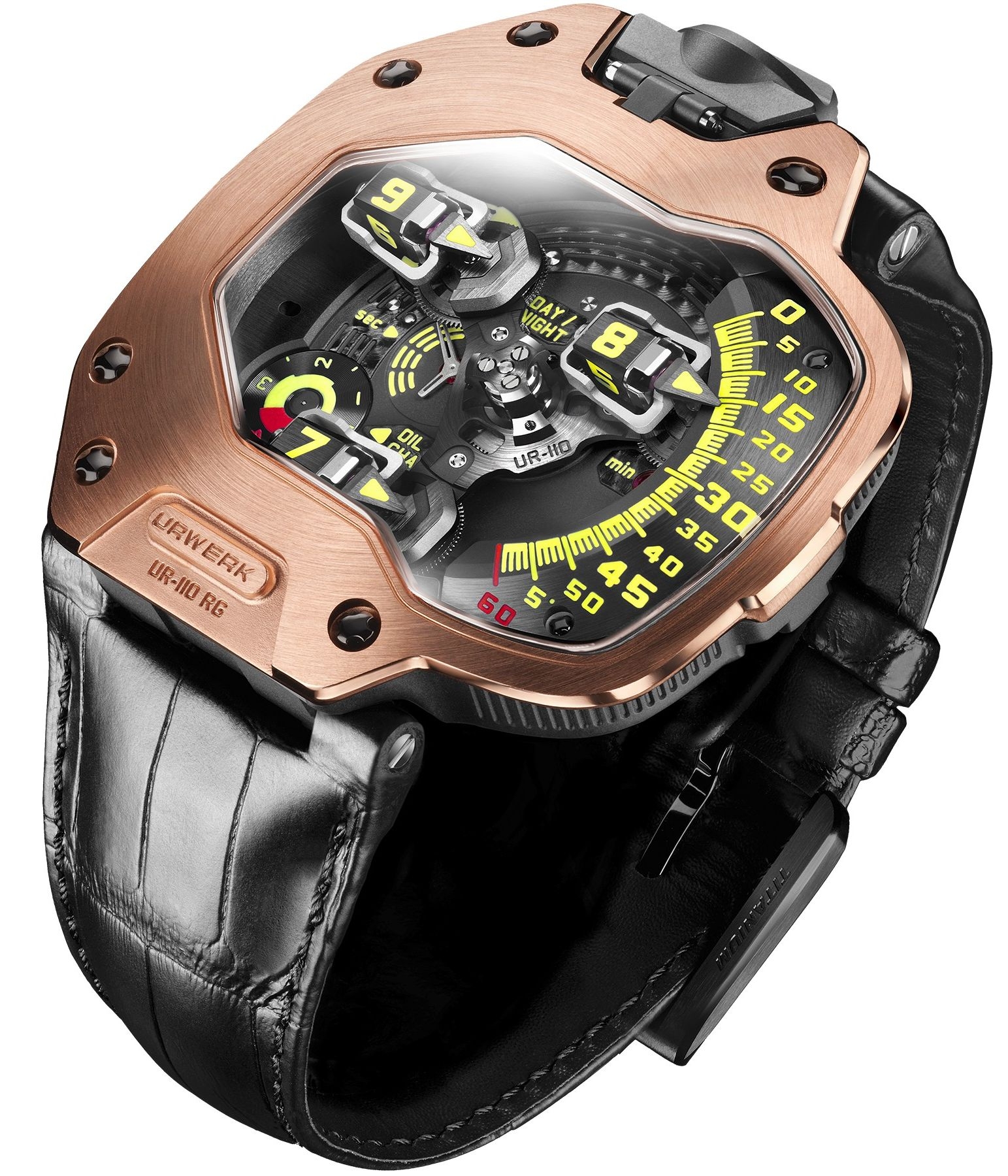
The Urwerk UR-110RG: the satellite hour complication in rose gold, winner of the 2011 Grand Prix de l’Horlogerie de Genève Design Prize, built by watchmaker Felix Baumgartner and designer Martin Frei in a production run limited to very few pieces, worn by Robert Downey Jr. as Tony Stark in Jon Watts’s Spider-Man: Homecoming (2017) following a personal request from the actor himself, after Urwerk had declined the studio’s initial approach as a suspected prank call
Jon Watts’s Spider-Man: Homecoming (2017) is the first Spider-Man film produced within the Marvel Cinematic Universe, and its central dynamic involves Peter Parker, a fifteen-year-old from Queens played by Tom Holland, and Tony Stark, the billionaire engineer and Iron Man, played by Robert Downey Jr., who serves simultaneously as mentor, employer, and reluctant guardian. The film operates within the established MCU continuity following the events of Captain America: Civil War (2016), in which Stark recruited Parker for the airport confrontation in Leipzig. Homecoming finds Parker navigating the gap between his ambition to be an Avenger and his actual circumstances, in a film that borrows its register from the high school comedies of the 1980s and places a superhero story inside them.
Tony Stark is not the protagonist of Spider-Man: Homecoming, but his appearances carry the weight of authority and technical sophistication that the character requires. On his wrist, chosen by Downey himself for the role, is the Urwerk UR-110RG, a rose-gold satellite complication that reads on screen as something from a different world entirely. In one particular scene, the watch functions as an active prop, used as a gadget by Stark in a manner consistent with the character’s relationship to his own equipment. The rose gold was not an accidental detail: Downey specified the colour intentionally, because red and gold are Iron Man’s colours, and a rose-gold Urwerk on Stark’s wrist operates as a civilian echo of the suit.
The Refusal and the Reversal
The story of how the UR-110RG reached the set of Spider-Man: Homecoming is one of the better-documented accounts of a watch arriving in a film through something other than a conventional commercial arrangement, and it is worth telling in detail.
In late 2016, Sony Pictures contacted Urwerk to ask whether the brand would supply a watch for use during filming. Urwerk declined. The brand does not conduct sponsorships or paid product placements; it had no ambassador programme and was not interested in establishing one. Sony’s communication director Yacine Sar was polite but firm. The studio called again, and this time dropped a name: Robert Downey Jr. had personally requested the watch. This information shifted the situation considerably. Sar subsequently flew from Geneva to Pinewood Studios in Los Angeles to hand-deliver a brand new UR-110RG directly to the actor.
Urwerk CEO Felix Baumgartner described the outcome in terms that were direct about what the watch meant to the brand: “Our UR-110 on the wrist of Tony Stark. A character that is eccentric and passionate about science, and totally cool. That’s exactly the kind of person we wanted for this watch, but he’s the one who found us.” Baumgartner also noted that the brand had used nicknames internally for various watches, including Blade Runner and Godzilla for other references, but that nothing had stuck to the UR-110 until the Downey connection established its identity definitively.
Downey wore the watch throughout production and returned it to Urwerk on completion. The brand then made a second identical UR-110RG and gifted it to Downey as a keepsake. The screen-worn watch was subsequently offered at the Phillips Geneva Watch Auction: SEVEN in May 2018, with all proceeds directed to Manusodany, a Haitian non-profit organisation supporting development projects for disadvantaged individuals. The association continued: Downey wore a UR-105 CT in Avengers: Endgame (2019), and that watch was also sold for charity. The combined proceeds from multiple auctions of watches worn by Downey in the MCU exceeded USD 700,000.
Urwerk: An Origin Story from a Night Clock for the Pope
Felix Baumgartner and Martin Frei met over beers and rock music in December 1995, spent an evening sharing their respective philosophies on time and how best to express its passage, and on January 1, 1996, decided to found a watch company. Baumgartner was a third-generation watchmaker from Schaffhausen who had trained at the watchmaking school in Solothurn and worked in his father’s atelier restoring antique clocks, including a night clock made by the Campanus brothers for the Pope in 1652. It was this clock, with its wandering hour display, that planted the seed for what Urwerk would become. Frei was a designer from Winterthur with an engineer father and an artist mother, trained in fine arts and approaching watchmaking as a designer rather than as a technician: someone who could ask why things had to look the way they did without being constrained by the accumulated habits of the industry.
They founded Urwerk in 1997 and presented their first watch, the UR-101, at Baselworld the same year. The name combined the German word Uhr (clock), the Mesopotamian city of Ur, where the Sumerians built the first known clocks, and the German word Werk (mechanism, work, achievement): original accomplishment. The first watches displayed time via a wandering hour complication derived from the seventeenth century, a single hour numeral travelling across a minute scale, packaged in a case that the brand described internally with a reference to the Millennium Falcon: a shape that read as simultaneously retro-futurist and entirely unlike anything else in the Swiss watch market.
The satellite cube complication, the architecture for which the UR-110 is a direct descendant, debuted not on an Urwerk watch but on the Opus V made for American jeweller Harry Winston in 2005. The rotating cube system displayed the hours in three dimensions, with three satellites orbiting a central carousel, each satellite carrying a rotating hour numeral and a counterbalance. Urwerk then developed this complication through successive references, winning the Grand Prix de l’Horlogerie de Genève Design Prize in 2011 for the UR-110.
The UR-110RG: A Watch That Tells Time Sideways
The UR-110 reconfigures the satellite complication in a specific and immediately legible way. Rather than distributing the satellites around the dial face as in earlier references, the UR-110 positions its time display on the right side of the case. Three hour satellites travel along a vertical minute track in a downward motion, graded from zero to sixty minutes. Each satellite carries an arrow-shaped hour indicator, which gives rise to the “Torpedo” nickname used for the reference. A planetary gear system maintains the parallel rotation of the satellites as they orbit, ensuring that each indicator remains correctly aligned as it traverses the minute scale. A fixed axis running the full height of the watch provides the structural rigidity for the carousel, replacing the ball bearings used in earlier Urwerk references.
The UR-110RG adds rose gold to the titanium structure. The front plate is solid rose gold; the case combines this with titanium to create a watch defined by the contrast between warm precious metal and aerospace material. The control board on the dial carries an oil change indicator, which transitions from white to red as the three-year service interval approaches and resets to zero when the watch is serviced: a feature conceived to communicate the watch’s maintenance requirements in visual rather than textual terms. A day/night indicator uses a rotating disc marked with Super-LumiNova for the night portion and white for the day. Small seconds appear on a subdial. The case back houses an automatic winding system regulated by twin pneumatic turbines, whose blades are curved to offer increased resistance in the free direction and reduced resistance in the winding direction, minimising wear on the winding mechanism.
The original retail price was USD 115,000. Production was discontinued. The UR-110 won the Grand Prix de l’Horlogerie de Genève Design Prize in 2011 for the titanium version, and in a market where independent watchmakers are frequently accused of producing objects that are technically sophisticated but aesthetically alienating, it represents the case that those two qualities can resolve into a coherent object.
More on Urwerk’s history and current collection: urwerk.com
Technical note: Urwerk UR-110RG “Torpedo.” Rose gold front plate on titanium case, 47mm x 51mm. Revolving satellite complication: three hour satellites mounted on planetary gears orbit a central carousel in a downward vertical arc along a minute track positioned on the right side of the case. Each satellite carries an arrow-shaped hour indicator. Control board: oil change indicator (white years one to three, red years three to five, resets at service); day/night indicator; small seconds subdial. Super-LumiNova on markers. Caseback: twin pneumatic turbines regulating the automatic winding rotor. Original retail price USD 115,000. Discontinued. Won Grand Prix de l’Horlogerie de Genève Design Prize 2011 (titanium variant). Worn by Robert Downey Jr. as Tony Stark in Spider-Man: Homecoming (2017), directed by Jon Watts. Watch sourced at Downey’s personal request after Urwerk declined Sony Pictures’ initial approach. Urwerk communications director Yacine Sar flew from Geneva to Pinewood Studios, Los Angeles, to hand-deliver the watch. After filming, Urwerk made a second identical UR-110RG and gifted it to Downey. The screen-worn watch was sold at Phillips Geneva Watch Auction: SEVEN, May 2018, benefiting Manusodany, a Haitian non-profit organisation. Downey subsequently wore a UR-105 CT in Avengers: Endgame (2019), also sold for charity. Combined auction proceeds from Downey’s MCU Urwerk watches exceeded USD 700,000.
Details
Brand:
Marketplace Price
€60 000
Movie Year:
2017
As seen on:
Movie/TV Series: