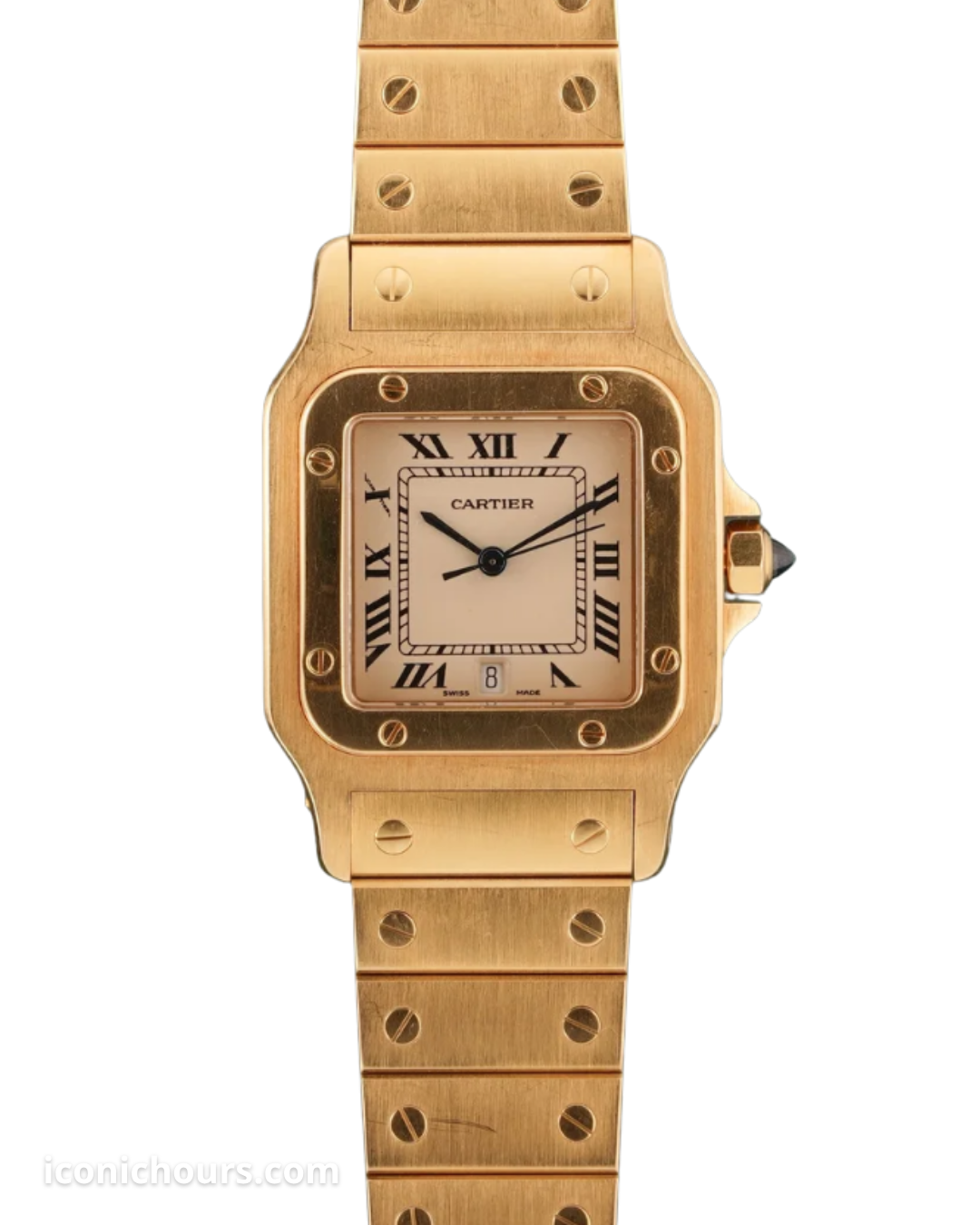
The Cartier Santos Galbée, ref. 887901: the solid 18-carat yellow gold square-cased dress sports watch with smooth bezel and integral gold bracelet, its design lineage running through the first men’s wristwatch Louis Cartier made for a Brazilian aviator in 1904, worn by Michael Douglas as Gordon Gekko in Oliver Stone’s Wall Street (1987), where the costume department’s decision to put a Santos rather than a Rolex on the corporate raider’s wrist communicates exactly the distinction between a man who has performed success and a man who has long since moved past performing it.
Oliver Stone’s Wall Street (1987) won Michael Douglas the Academy Award for Best Actor and entered the cultural vocabulary of late twentieth century capitalism with an efficiency that no number of subsequent analyses has fully accounted for. The film’s argument, that the 1980s financial market was governed by a philosophy of predation that the decade’s enthusiasm had normalised into something approaching virtue, was delivered through a character whose charisma made the argument seductive even as the film intended it as indictment. Gordon Gekko, the corporate raider whose “greed is good” speech at the Teldar Paper shareholder meeting has been quoted approvingly by real financial professionals for nearly four decades, is one of cinema’s most successful cases of a villain becoming an aspirational figure.
The watch on Gekko’s left wrist is the Cartier Santos Galbée ref. 887901 in solid 18-carat yellow gold, the all-gold version of the Santos family with its smooth bezel and curved case profile. The costume department’s choice has been analysed extensively. Wristcheck’s account is the most direct: in the scene where Gekko admonishes his apprentice in the back of a limousine with the line “if you’re not inside, you are outside,” a justification for illegal insider trading, he is wearing a gold Cartier Santos, “strategically picked out by the costume department as a decidedly ‘insider’ watch.” The watch is not incidental; it is part of the argument.
The Panthère on Bud Fox’s wrist, worn by Charlie Sheen, completes the costume design’s logic. Fox is Gekko’s apprentice who mimics his mentor’s tastes as he rises, choosing a Cartier like his idol but the Panthère rather than the Santos: the decorative piece rather than the watch with a history, the one that signals aspiration rather than arrival. The distinction the film draws between the two Cartiers is as precise as the distinction it draws between the two characters: the difference between wanting to be inside and already being there.
More on the film: imdb.com/title/tt0094291
1904: The Dinner at Maxim’s
The story that every Santos article begins with begins at Maxim’s, the Parisian restaurant on the Rue Royale that had been attracting the artistic and social elite of the Belle Époque since 1893. Alberto Santos-Dumont, the Brazilian-born aviator who had become the most famous man in Paris for his airship experiments over the city, was dining with his friend Louis Cartier when he raised a practical complaint: using a pocket watch while operating a flying machine required taking both hands from the controls, which in the early and largely improvisational days of powered aviation was not a theoretical inconvenience but a genuine operational hazard.
Louis Cartier’s solution was to miniaturise a pocket watch case into a form that could be strapped to the wrist. The resulting watch, presented to Santos-Dumont in 1904, was square rather than round, and featured a bezel held in place by visible screws, functional elements that the design incorporated without disguising. On November 12, 1906, Santos-Dumont flew 220 metres in 21.5 seconds in his 14-bis aircraft and was filmed doing so, wearing what is widely considered the first pilot’s wristwatch in history on his left wrist. The watch was not offered to the public until 1911, when Cartier began producing it commercially in platinum and yellow gold with movements supplied by Jaeger-LeCoultre.
Popularity for the Santos waned in the mid-twentieth century as round military watches dominated the aesthetic and the formal dress watch displaced the sport watch in precious metal. When Dominique Perrin was appointed Marketing Manager of Cartier in 1978, his mandate was to bring the brand to a wider audience, and his primary instrument was the Santos de Cartier, relaunched that year with a refined case, an integrated metal bracelet, and a commercial strategy that positioned it explicitly as the sport-luxury watch for the professional class that the decade was creating in unprecedented numbers. The Santos of 1978 was not a diving watch and not a racing chronograph; it was a watch that said its wearer was successful, educated, and cultivated without needing to make the declaration that a Rolex Day-Date requires.
The Galbée and the Smooth Bezel
Within the Santos family as it evolved through the late 1970s and 1980s, different references distinguished themselves by their case architecture. The Carrée, which takes its name from the French for square, features the most literal expression of the original Santos design: a squared case with a bevelled bezel held down by eight visible screws, the functional fasteners that Santos-Dumont’s original watch had established as part of the design vocabulary. The Galbée, whose name refers to its curved profile, offers a subtler variant: the same square case family with a smooth bezel that removes the visible screws, giving the watch a more refined and less overtly technical appearance.
The ref. 887901 is the Galbée in 18-carat yellow gold, a solid gold construction with the smooth bezel, the white dial carrying Roman numerals on a railway minute track, and blued steel sword hands whose contrast against the pale face is one of the most immediately recognisable Cartier dial signatures. The crown is set with a blue cabochon, the same decorative element that appeared on the original 1904 Santos and that runs through the entire Cartier fine watch range as a house identifier. The integral 18-carat yellow gold bracelet with its fold-over deployant clasp weighs the total assembly to approximately 115 grams, the weight of a watch that is also, in the most literal sense, a concentrated quantity of precious metal.
The case measures 29mm in diameter, 41mm lug-to-lug: a size that reads today as compact but that in the context of 1987, before the watch industry’s transition to larger case diameters in the 1990s and 2000s, sat squarely within the mainstream of men’s dress watch proportions. A 29mm gold case on an 18-carat gold bracelet, worn with French cuffs, suspenders, and slicked-back hair in the back of a Manhattan limousine, is a combination so precise in its period coherence that the costume department’s choices in Wall Street have been cited, studied, and imitated for nearly four decades.
The Costume Logic: Santos, Not Rolex
The decision not to put a Rolex on Gekko’s wrist is the most instructive element of the costume design. The Rolex Day-Date, the gold President on its fluted gold bracelet, was by 1987 so thoroughly identified with a certain category of American commercial success that wearing one was less a personal choice than a uniform: the watch that said you had arrived within the established order of things, that you had accumulated enough to afford the most recognisable gold watch in the world, and that you wanted this to be visible. The Day-Date is the watch of someone who has succeeded and wants everyone to know it.
The Santos Galbée says something different. It is French rather than Swiss, a jewellery house rather than a watchmaker, a watch whose design history runs through an aviator and a friendship rather than through chronometer certifications and professional endorsements. It is not the watch that announces itself to everyone; it is the watch that announces itself to people who know what to look for. The Deployant analysis of the film’s accessories is direct: “as the character of Gekko goes against the status quo, it seems befitting that it isn’t a Rolex on his wrist since he has a certain flair about him.”
For a character whose defining line is “if you’re not inside, you are outside,” the Santos is the watch of someone who is very much inside and whose choice of accessory is one of the signals by which other insiders recognise each other. The man who wears a Day-Date is performing success for a general audience. The man who wears a Santos Galbée Or Massif already knows he has succeeded and has moved on to the question of what he prefers. Gordon Gekko has moved on. The watch on his wrist knows it.
More on the Cartier Santos and its history: cartier.com/en-us/watches/collections/santos-de-cartier and on the watch’s film context: wristcheck.com/us/discover/culturecheck/cartier-santos:-the-ultimate-it-boy-watch
Technical note: Cartier Santos Galbée, ref. 887901. Solid 18-carat yellow gold case, smooth bezel, bracelet, and deployant clasp. Case 29mm diameter, 41mm lug-to-lug, approximately 29.5mm x 28mm. Curved Galbée profile. White dial with Roman numerals on railway minute track. Blued steel sword hands. Blue cabochon on winding crown. Date window at 6 o’clock. Sapphire crystal. Swiss quartz movement. Integral 18-carat yellow gold bracelet. Total weight with bracelet approximately 115 grams. Santos de Cartier line relaunched 1978 under Marketing Manager Dominique Perrin. The original Santos was created by Louis Cartier in 1904 for Brazilian aviator Alberto Santos-Dumont, first offered commercially in 1911 in platinum and yellow gold with Jaeger-LeCoultre movements; widely considered the first men’s wristwatch and first pilot’s wristwatch in history. The Galbée variant features a smooth bezel without visible screws, distinguishing it from the Carrée which retains the screwed bezel of the original design. Worn by Michael Douglas as Gordon Gekko in Wall Street (1987), directed by Oliver Stone. Bud Fox, played by Charlie Sheen, wears a gold Cartier Panthère, chosen by the costume department to distinguish the apprentice’s aspiration from the mentor’s established position.
Details
Brand:
Marketplace Price
€15 000
Movie Year:
1987
As seen on:
Movie/TV Series: