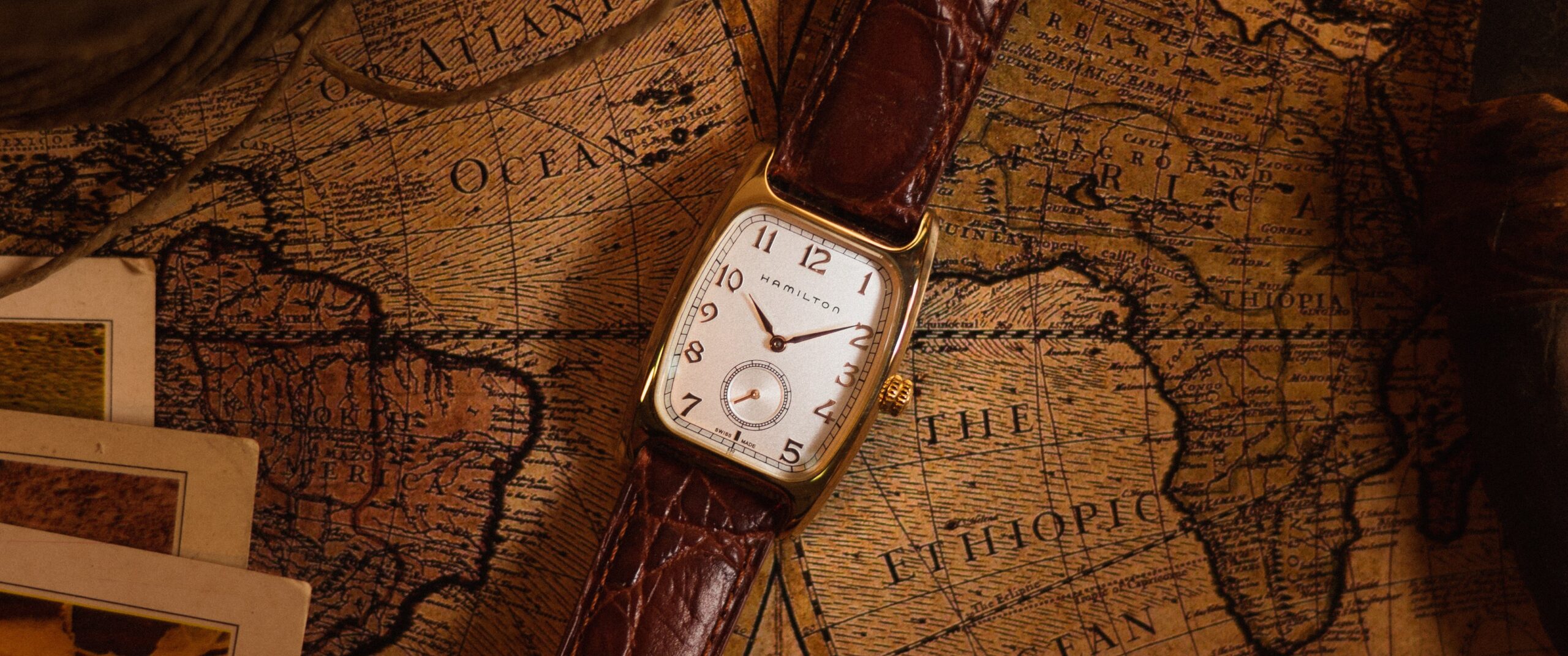

The Hamilton Frogman: a submersible tool watch born in the Bureau of Ships during World War II, worn by the Navy’s underwater demolition teams, and released to the civilian market and the silver screen simultaneously in 1951.
Lloyd Bacon’s The Frogmen (1951) is a film with a specific claim to documentary ambition. Made in full cooperation with the United States Navy and the Department of Defense, the production was built around authentic footage of the Navy’s Underwater Demolition Teams in action, intercut with dramatised scenes starring Richard Widmark as the newly appointed, initially distrusted Lt. Commander John Lawrence, and Dana Andrews as the chief petty officer who resents him. The film follows UDT-4, a unit whose real counterpart had seen combat at Okinawa, Saipan, Guam, and the Philippines, and its climax involves a night demolition mission against a Japanese submarine pen that recreates, with considerable fidelity, the kind of operation these teams actually conducted.
It was, as Wikipedia notes, the first major film about scuba diving. The aqualung had been developed by Jacques Cousteau and Émile Gagnan in 1943 and was still largely unfamiliar to civilian audiences in 1951; the film’s underwater sequences were a genuine novelty, and the Navy’s cooperation gave the production access to hardware and personnel that no independent production could have replicated. Among the hardware worn on the wrists of the UDT men on screen were Hamilton Frogman watches, chosen not by a prop master but because they were the actual watches that Hamilton had designed and manufactured for the Navy’s Bureau of Ships. There was no question of historical accuracy here. This was historical accuracy.
It was the second time a Hamilton had appeared in a major film, nineteen years after the Flintridge in Shanghai Express, and where that earlier appearance had been entirely unplanned, this one was the result of a direct and formal relationship between the brand and the American military.
More on the film: imdb.com/title/tt0043565 and en.wikipedia.org/wiki/The_Frogmen
From the Bureau of Ships to the Wrist: The Canteen Watch
The story of the Hamilton Frogman begins in 1943, with a brief from the Navy’s Bureau of Ships, known in military abbreviation as BuSHIPS. The UDTs needed a watch that could survive underwater. This was a problem for which the watch industry of the early 1940s had no established solution. The professional dive watch as a recognised category did not yet exist in any standardised form: the Rolex Submariner was still more than a decade away, and the only serious submersible watches in production were Panerai’s Radiomir instruments for the Italian Navy, which were neither available to American procurement nor widely known outside their immediate operational context.
Hamilton’s solution was characteristically pragmatic. The base was a military field watch, a category the brand understood thoroughly from two decades of military supply contracts, adapted for water resistance through a single decisive innovation: a canteen-style screw-down crown protector. This device, a small metal cap attached to the watch case by a short chain, screwed directly over an inner push-pull crown, creating a watertight seal at the watch’s most vulnerable point without requiring the thread engineering of a full screw-down crown. The watch was chrome-plated steel, dial marked “U.S.N. BU Ships,” with large Arabic numerals, substantial blued steel hands carrying luminous compound, and a construction designed for legibility and physical resilience rather than finish or elegance. It was, in the context of its purpose, exactly right.
The canteen crown protector is an extraordinary object when examined closely. It acknowledges, with complete honesty, the limits of 1940s watchmaking technology: rather than engineering a conventional crown to seal against water pressure, it surrounds the crown with a separate sealed enclosure. The result is a watch that looks, from the case profile, like something designed by an engineer who had never seen a conventional wristwatch, which in a sense is exactly what it was. Function had overridden every other consideration, and the function was absolute.
The Civilian Frogman: 1951
When Hamilton released the civilian Frogman in 1951, the watch carried the canteen-style crown mechanism forward from the military BuSHIPS reference into a production watch available for purchase. The DNA was preserved intact: large dial, high-legibility numerals, robust case construction, the distinctive locking crown. The simultaneous appearance in The Frogmen was both advertising and authentication, the brand demonstrating through the film’s Navy-approved imagery that this was not a dive watch styled to look military but a military watch that had been made available to the public. The distinction mattered in 1951 in a way it rarely matters now: the Korean War was being fought, Hamilton’s wartime record was recent and well-known, and the UDT teams whose equipment appeared on screen had genuine public admiration as practitioners of one of the most dangerous specialisations in military service.
The watch’s appearance in the film was not incidental decoration. It was the same relationship, and the same object, in a different context. What the production documented was the culture from which the civilian watch had been extracted.
What the Canteen Crown Meant for the Dive Watch
The Hamilton BuSHIPS and its civilian descendant occupy an unusual position in the genealogy of the dive watch. They are not the most technically sophisticated submersible timepieces of their era: Panerai’s early instruments had achieved greater water resistance through superior case engineering, and the Rolex Submariner, when it arrived in 1953, would define the category in ways that the Hamilton’s improvised crown solution could not match. But the BuSHIPS is an important object in that genealogy precisely because it represents the American military’s first systematic attempt to provide underwater operatives with purpose-built timing instruments, and because its distribution through Navy PX stores meant that it reached a broader audience than any European military watch of the period.
The men of the UDTs who brought their BuSHIPS watches home after their tours established a precedent: the submersible military watch as a practical and desirable civilian object, worn not for fashion but for the simple reason that it was what you trusted when your life depended on the equipment working. The Seiko 6105 would carry this logic forward for Vietnam-era servicemen twenty years later. The Hamilton BuSHIPS had established it first.
The Continuing Legacy
Hamilton revived the Frogman line in 2016 as the Khaki Navy Frogman, a modern dive watch in titanium at 46mm with 1,000 metres of water resistance, carrying forward the distinctive crown-protection mechanism as a design signature rather than a technical necessity. The canteen crown became, in the modern version, a telescoping enclosure or locking arm rather than a screw-on cap, but the visual and conceptual reference to the original was preserved deliberately. Hamilton has subsequently released 42mm and 41mm steel variants, broadening the line’s accessibility while maintaining the protective crown architecture that distinguishes it from every other dive watch on the market.
The Frogman remains the only major dive watch line whose direct lineage runs through a specific wartime military procurement, through an Oscar-nominated film made in cooperation with the Department of Defense, and through more than seven decades of continuous production. It is not the deepest diving watch Hamilton makes. It is the one with the most complete story, and the story begins in 1943, with a Bureau of Ships brief and a small metal cap on a chain.
More on Hamilton’s cinema and military history: hamiltonwatch.com/en-us/company/hamilton-watches-history and on the watch’s development: wornandwound.com/built-with-purpose-the-evolution-of-the-hamilton-khaki-navy-frogman
Technical note: Hamilton BuSHIPS “Canteen” Frogman, introduced 1943 for the US Navy Bureau of Ships. Chrome-plated steel case, circular profile, dial marked “U.S.N. BU Ships.” Distinctive canteen-style crown protector: a small metal cap attached to the case by a short chain, screwing over an inner push-pull crown for water resistance. Large Arabic numerals, blued steel hands with luminous compound, manually wound movement. Civilian Frogman released 1951, maintaining same canteen-crown architecture. Modern successor: Hamilton Khaki Navy Frogman Automatic (current production), available in 41mm steel (H-10 automatic movement, 80-hour power reserve, Nivachron balance spring, 300m water resistance) and 46mm variants. Unidirectional rotating bezel with raised numerals. Crown-protection device carried forward as design signature across all modern iterations.
Details
Brand:
Marketplace Price
€1 200
Movie Year:
1951
As seen on:
Movie/TV Series: