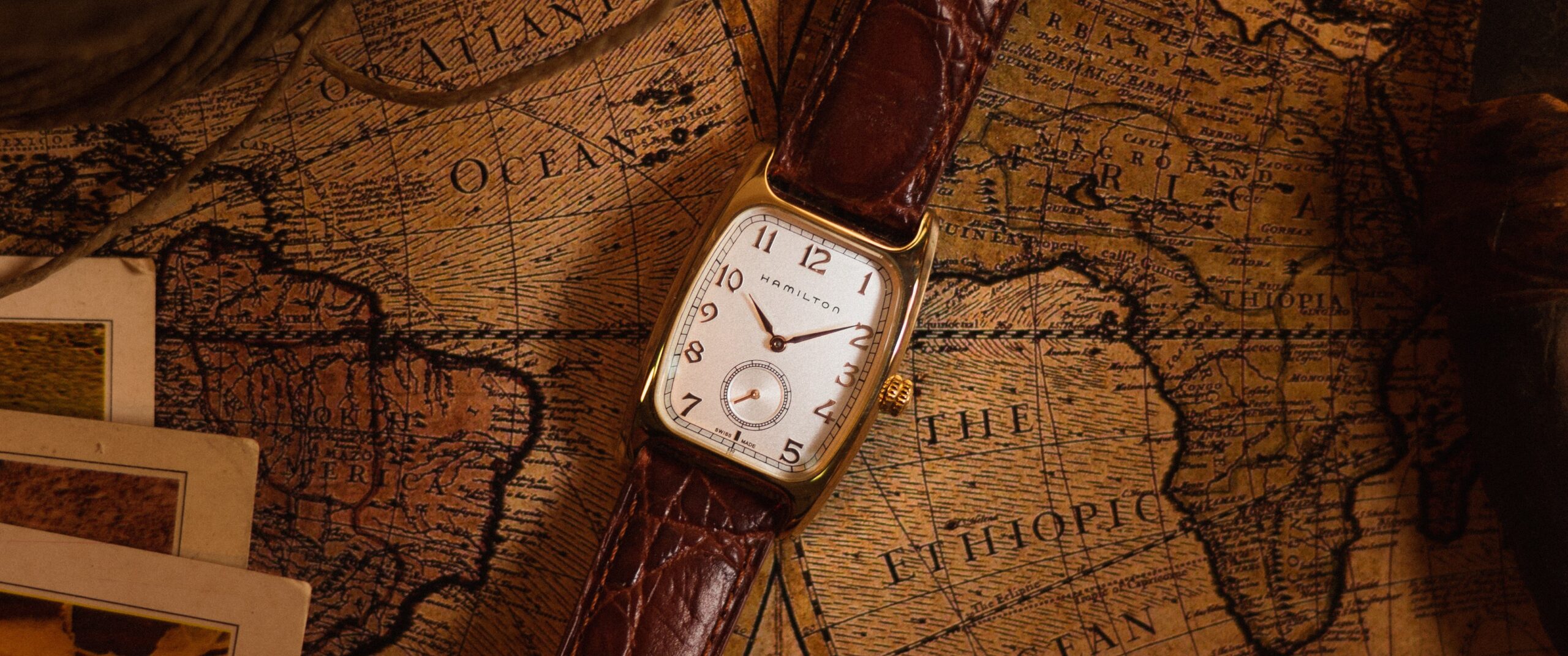

The Hamilton Flintridge: an Art Deco cover watch named after a California golf resort, worn by a British army officer on a train through a Chinese civil war, and the reason Hamilton has appeared in more than five hundred films.
Josef von Sternberg’s Shanghai Express (1932) is the fourth collaboration between the director and Marlene Dietrich, and for many the most perfect: forty minutes into the film, everything the two of them understood about desire, atmosphere, and the grammar of the close-up is concentrated into a single sequence on the outdoor deck of a train crossing China. British army officer Captain Harvey, played by Clive Brook, is approached by Shanghai Lily, the notorious woman he loved and lost five years earlier. She asks him the time. He raises his wrist, lifts the hinged cover of his watch, and the camera moves in. On the underside of the cover is a tiny photograph of a younger Lily. He has carried it, unspoken, all this time. The watch’s dial, beneath the photograph, bears the name HAMILTON in bold Art Deco lettering.
It is a scene of absolute economy. In the space of a lifted lid, the film tells you everything you need to know about five years of unarticulated feeling. And it is a Hamilton Flintridge that provides the mechanism for the revelation: a watch with a cover, the cover engraved or personalised on its interior face, the act of opening it transformed from a gesture of timekeeping into one of emotional disclosure. No other watch architecture could have produced the same moment. A conventional wristwatch has nothing to conceal, nothing to lift, no interior surface available for a hidden image. The Flintridge, with its hinged lid, creates a private space on the wrist. Von Sternberg understood exactly what that meant.
It was, according to Hamilton’s own records, the brand’s first appearance in a major film, and no records survive explaining how the watch came to be in the production. Sylvain Dolla, former president of Hamilton, has noted that the choice was almost certainly instinctive: Hamilton was the dominant American watch brand of the early 1930s, widely available, widely recognised, and the natural choice for a director who needed an object that would read as unambiguously American on an international audience’s wrist. In the years since, Hamilton has appeared in more than five hundred films. It all began with a hinge.
Hamilton: Lancaster, the Railroad, and the Watch of Accuracy
The Hamilton Watch Company was founded in 1892 in Lancaster, Pennsylvania, from the merger of two bankrupt watchmakers, the Keystone Standard Watch Company and the Aurora Watch Company of Illinois. The name was chosen in tribute to the city’s founders: Hamilton, named for the Scottish-born attorney Andrew Hamilton, who had purchased the original land grant, and whose son James had helped establish Lancaster as Pennsylvania’s capital. The company produced its first watch in 1893, the Broadway Limited, a railroad pocket watch that earned the designation still used in Hamilton’s marketing for the following decades: the Watch of Railroad Accuracy.
The precision required by the American railroad industry in the 1890s was a genuinely demanding brief. After a catastrophic collision in 1891 near Kipton, Ohio, caused in part by an engineer’s watch stopping and restarting eleven minutes slow, the railroad industry developed stringent accuracy standards that only a handful of manufacturers could meet. Hamilton was among them, and the railroad market provided both the technical discipline and the commercial foundation that allowed the company to become one of the most respected American watch manufacturers of the early twentieth century. By 1914, the American military had taken notice: Hamilton became an official supplier to the US Armed Forces, shifting its production toward wristwatches to meet the practical requirements of soldiers who could not check a pocket watch while in the field. The transition from pocket watch to wristwatch, which the Flintridge represents at its most design-conscious, was in part Hamilton’s story to tell.
The Flintridge: The Out-of-Doors Watch With a Cover
Hamilton employed a Director of Styling in the early 1930s whose role was dedicated specifically to developing new case forms and dials, an unusual and far-sighted appointment for an American manufacturer of the period. One of the first models to emerge from this creative brief was the Flintridge, a watch designed as what Hamilton’s own advertising of the era described as “the out-of-doors watch with a cover.” The name, like those of several Hamilton models of the period, was drawn from the American country club and golf resort world: Flintridge, a community in the San Gabriel Mountains of California, was home to a celebrated golf and polo club, and the Piping Rock and Meadowbrook models that appeared alongside the Flintridge in Shanghai Express were named for other prominent sporting venues of the same social milieu. The names spoke to an aspirational outdoor leisure culture, to the kind of person who played golf, travelled widely, and needed a watch that could survive both the fairway and the formal dinner.
The Flintridge case is rectangular, with softly curved sides, executed in gold or precious metal, and fitted with a hinged cover that closes flush with the case’s upper surface. The cover’s function was protective, shielding the dial and crystal from the dust, moisture, and impact of outdoor activity, and its interior surface, smooth and blank in the standard production version, invited personalisation: Hamilton actively promoted the option of engraving, enamelling, or fitting a miniature photograph to the cover’s inside face, a form of upselling that positioned the watch as both a luxury object and a sentimental one simultaneously.
The movement options were the 17-jewel calibre 987 or the premium 19-jewel calibre 979, manually wound. The case was produced in various gold alloys and was, at a retail price of between $125 and $150, a substantial purchase in the early years of the Great Depression, equivalent to a significant portion of a monthly professional salary. This was not a democratic object. It was a luxury watch for people who could still afford luxury in the worst economic decade of the twentieth century, which is precisely why Hamilton’s marketing leaned so heavily on aspiration, personalisation, and the association with outdoor sport and leisure.
The Cover, the Reverso, and the Problem They Both Solved
The Flintridge arrived in the same moment, and addressed the same problem, as a more celebrated watch from the other side of the Atlantic. Jaeger-LeCoultre had introduced the Reverso in 1931, a watch developed at the request of British officers playing polo in India, whose crystals were shattering under the impact of the ball. The Reverso’s solution was architectural: the case could be flipped on its axis, presenting the blank steel back to the world while the dial slid safely into its protective housing. Hamilton’s Flintridge addressed the same need through a different mechanism: a hinged cover that closed over the dial without requiring any case rotation, simpler to operate with one hand, and offering an interior surface immediately available for decorative use.
The proximity in time between the Reverso’s introduction and the Flintridge’s development was, as Revolution Watch has observed, one of those moments when two ideas converge independently on the same fundamental insight: that a wristwatch’s most vulnerable element, its crystal and dial, needed protection in an era when watches were worn during physical activity rather than only during formal occasions. Both brands were also quick to recognise the commercial potential of the interior cover surface as a personalisation opportunity, a detail that in Hamilton’s case produced one of cinema’s most quietly perfect emotional moments in a film shot less than a year after the Flintridge’s introduction.
The Flintridge’s production run was brief and surviving original examples are genuinely rare, with a distinctive tendency for the hinged lid to sustain damage over decades of opening and closing. When one appears in the secondary market in undamaged condition with an intact dial, it commands serious attention. Hamilton revived the model in a limited edition of 999 pieces in 2014, with a modern H-40 automatic movement beneath the cover and a Clous de Paris engraved lid, acknowledging both the original’s heritage and the impossibility of simply repeating it.
More on Hamilton’s cinema history: hamiltonwatch.com/en-us/at-the-heart-of-cinema and on the brand’s full history: teddybaldassarre.com/blogs/watches/hamilton-watch-history
Technical note: Hamilton Flintridge, introduced circa 1932. Rectangular case with softly curved sides, produced in 14-karat and 18-karat yellow and white gold. Hinged protective cover over dial and crystal, interior surface engraved, enamelled, or personalised with miniature photograph by customer option. Art Deco dial with Hamilton name in bold lettering, manually wound movement. Movement options: Hamilton calibre 987 (17 jewels) or premium calibre 979 (19 jewels). Retail price at introduction $125 to $150. A Hamilton Piping Rock, a companion model from the same era with applied Roman numeral markers, appeared alongside the Flintridge in the same film. Both models take their names from American country club and sporting venues of the period.
Details
Brand:
Marketplace Price
€6 000
Movie Year:
1932
As seen on:
Movie/TV Series: