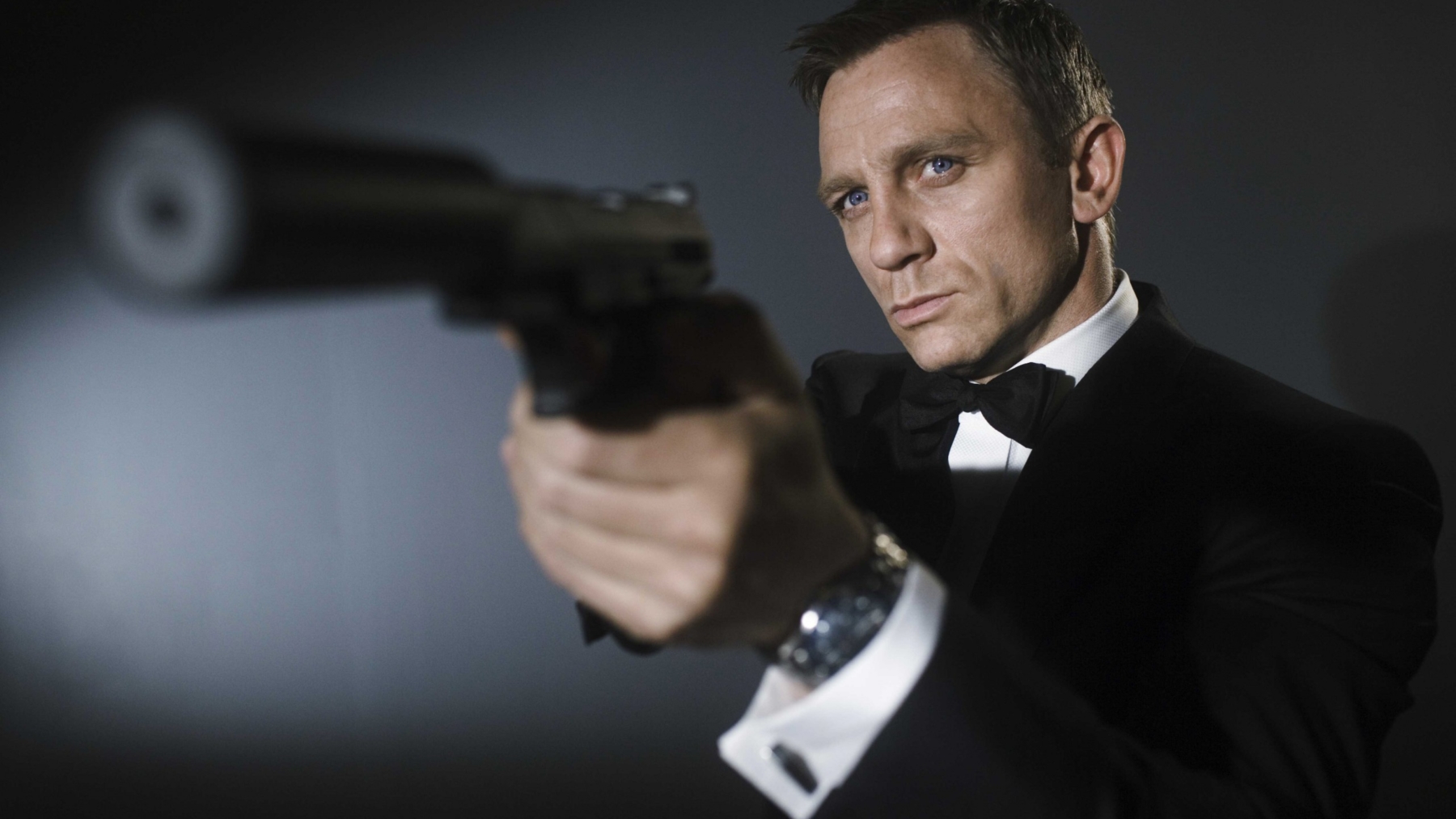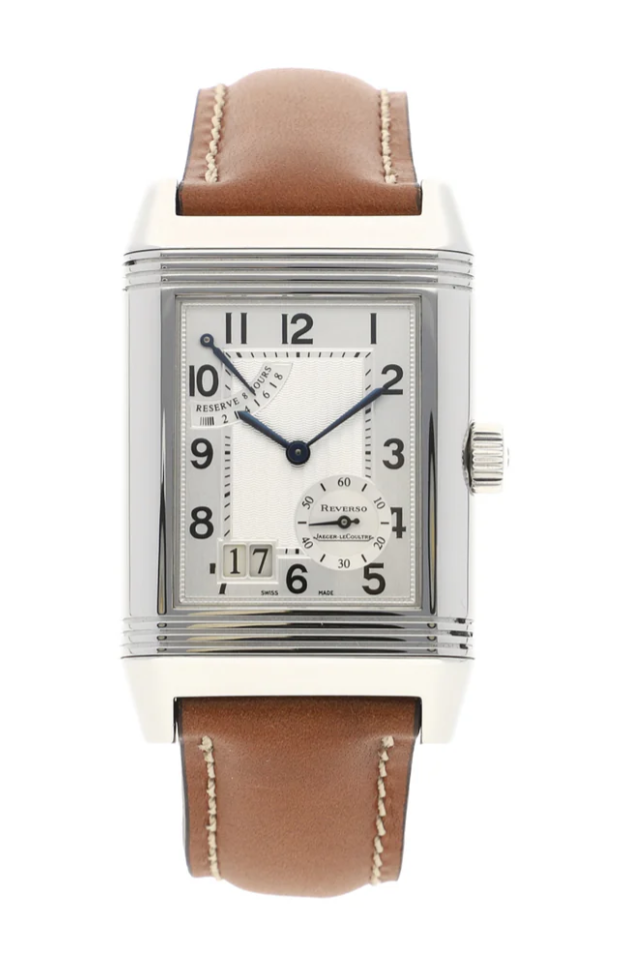
The Jaeger-LeCoultre Reverso Grande Date, ref. 240.8.15: the Art Deco rectangular watch born in 1931 from a challenge on a polo field in British India, now housing a double split-window date display and a transparent caseback, worn by Christian Bale as Bruce Wayne in Christopher Nolan’s The Dark Knight Rises (2012), where a watch designed to be flipped and hidden is placed on the wrist of a man whose entire life is built around flipping between identities
Christopher Nolan’s The Dark Knight Rises (2012) is the final chapter of the trilogy that began with Batman Begins in 2005 and reached its critical peak with The Dark Knight in 2008. It finds Bruce Wayne in physical and psychological decline, eight years removed from Batman’s last appearance in Gotham, living as a recluse in Wayne Manor while the city operates under the Dent Act. The arrival of Bane, a physically imposing mercenary played by Tom Hardy, forces Wayne back into the Batsuit for what the film presents as a final confrontation, the last act of a man who has spent two films learning that the cost of being Batman is incompatible with the cost of being human. The film stars Christian Bale, Michael Caine, Gary Oldman, Anne Hathaway, Marion Cotillard, Joseph Gordon-Levitt, and Morgan Freeman.
In all three films of the trilogy, the Jaeger-LeCoultre Reverso is on Bruce Wayne’s wrist. In Batman Begins (2005) and The Dark Knight (2008), Bale’s Wayne wears the Reverso Grande Taille. For The Dark Knight Rises, the reference changes to the Reverso Grande Date, ref. 240.8.15, which introduces a double split-window date display at the seven o’clock position and features a transparent caseback that reveals the movement rather than offering the original protective plain steel reverse. The transparent back is a significant detail in a watch whose entire design rationale is built on the ability to conceal: the movement that would normally be hidden is here made visible, as the man who would normally remain hidden is forced, over the course of the trilogy, back into public view.
To mark the film’s release, Jaeger-LeCoultre produced a ten-piece limited edition of the Grande Reverso Ultra Thin Tribute 1931, with the Batman logo engraved and lacquered on the caseback. This edition was never offered to the public; it was presented to Warner Bros. executives involved in the production.
More on Jaeger-LeCoultre: jaeger-lecoultre.com
The Polo Field and the Patent Office
In 1930, Swiss businessman César de Trey was travelling in India when British army officers, enthusiastic polo players, challenged him to create a watch capable of surviving the rigours of the game. The problem was specific and practical: polo involves riding at speed while swinging a mallet, and the watches of the era, with their glass dials facing outward, broke with regularity under the combination of impact and vibration. De Trey’s solution was elegant in the way that the best design solutions are, answering the problem exactly and generating a secondary function that would prove more enduring than the original purpose.
He brought the idea to his friend Jacques-David LeCoultre, who could provide the movements, and through connections with Jaeger SA, engaged the French industrial designer René-Alfred Chauvot to design the case and its swivelling mechanism. On March 4, 1931, Chauvot filed an application with the Paris patent office for “a watch capable of sliding in its support and being completely turned over.” In July, de Trey acquired the rights to the design; in November, he registered the name Reverso, from the Latin for “I turn.” De Trey and LeCoultre founded Spécialités Horlogères to commercialise the product, and the first Reverso watches were on sale within nine months of the original patent filing.
The initial case was composed of twenty-three parts. It was designed by casemaker Wenger into the streamlined rectangular form that has remained the Reverso’s visual signature for over ninety years. The Art Deco lines, the gadroons along the case sides, the trapezoidal proportions: all of these were established in 1931 and have not required significant revision since. What the original case provided, beyond protection from polo impacts, was something that Chauvot had not explicitly set out to design: a substantial blank metal surface on the reverse side that was ideal for engraving. From the watch’s earliest years, Reverso owners commissioned personalised casebacks, initialling them, commemorating occasions, decorating them with miniature enamel paintings. The watch designed to protect its dial had also accidentally created one of the most personalised objects in the history of portable luxury.
Production of the Reverso effectively ceased after the Second World War as round watches became fashionable and Art Deco fell from favour. The revival came gradually, and the watch was formally relaunched in the 1970s, reaching its current status as one of the Manufacture’s defining references through the 1980s and 1990s. The sixtieth anniversary in 1991 produced the Reverso Soixantième, the first Reverso to feature mechanical complications, and established the line as an active platform for technical development rather than a preserved historical reference.
The Grande Date and the Eight Days
The Reverso Grande Date ref. 240.8.15 that Wayne wears in The Dark Knight Rises is the full-size version of the Grande Date family, measuring 46.5mm in length by 30mm in width, 12mm thick. The case is stainless steel, polished and brushed. The dial carries the double split-window date display at seven o’clock: two apertures showing the date in large digits, a display format that requires a dedicated mechanism to advance both windows simultaneously. The caseback is sapphire crystal, transparent to reveal the movement, a departure from the original Reverso’s solid protective reverse and a detail that reads differently in the context of a watch designed to hide what is underneath.
The movement is manual wind with an eight-day power reserve, housed in a calibre that Jaeger-LeCoultre developed for the Grande Date family. An eight-day reserve in a rectangular case is a considerable technical achievement: the geometry that makes the Reverso case distinctive is also the geometry that makes fitting a substantial movement inside it demanding. The sword hands and applied indices maintain continuity with the broader Reverso design vocabulary, and the overall aesthetic sits at the boundary between the watch’s Art Deco origins and the more technically ambitious complications introduced into the line from the 1990s onward.
The Object That Mirrors the Character
The Reverso was chosen for Bruce Wayne because of its duality: a watch that has two sides and can be flipped to show either is the obvious choice for a man who maintains two identities. The polo field origin adds another layer; a watch designed for an aristocratic sport, worn by officers of the British Empire who needed to play hard without sacrificing their equipment, has the right social register for a billionaire who needs to function simultaneously as a public figure and a private operative.
Time and Tide Watches, in its analysis of the trilogy’s watch choices, notes that the Reverso is “famously a sports watch” despite reading as a dress watch to the untrained eye, precisely the kind of object that suits a character whose public self and private self are not merely different but structurally opposed. Hans Gruber, in Die Hard, wore a Cartier Tank: the purely decorative elegant man’s watch, with no sporting claim and no functional pretension. Bruce Wayne wears the Reverso Grande Date: a watch that looks like a dress watch, functions as a dress watch in public, and carries inside its case both the memory of physical sport and a mechanism capable of running for eight days unattended, long enough for a man who needs to disappear to disappear.
The transparent caseback of the ref. 240.8.15 complicates this reading slightly. In the earlier films, the solid reverse of the Grande Taille preserved the full original Reverso proposition: you see what I show you, and nothing more. The Grande Date reveals its movement to anyone who turns it over. By the third film, Wayne is no longer entirely in control of what is visible.
Technical note: Jaeger-LeCoultre Reverso Grande Date, ref. 240.8.15. Stainless steel rectangular case, 46.5mm x 30mm x 12mm. Double split-window date display at 7 o’clock. Transparent sapphire caseback revealing the movement. Manual-wind calibre, eight-day power reserve. Sword hands, applied indices. Worn by Christian Bale as Bruce Wayne in The Dark Knight Rises (2012), directed by Christopher Nolan. In Batman Begins (2005) and The Dark Knight (2008), Bale wears the Reverso Grande Taille. The Reverso was first introduced March 4, 1931, on a patent filed by designer René-Alfred Chauvot, acquired by businessman César de Trey in partnership with Jacques-David LeCoultre. The name derives from the Latin for “I turn.” To mark The Dark Knight Rises release, Jaeger-LeCoultre produced a ten-piece limited edition Grande Reverso Ultra Thin Tribute 1931 with Batman logo engraved on the caseback, presented to Warner Bros. executives and never offered for public sale.
Details
Brand:
Marketplace Price
€8 000
Movie Year:
2012
As seen on:
Movie/TV Series: