The Jaeger-LeCoultre Memovox E855: the world’s first automatic alarm wristwatch with calendar, worn by Robert De Niro as a New York mob boss hiding in plain sight in a French village — and using its alarm to time a scheme he cannot resist executing
Luc Besson’s The Family (2013), known in French as Malavita, is a black comedy built on a single irresistible premise: what happens when a New York Mafia family is relocated to a small town in Normandy under the FBI’s witness protection programme and cannot, despite every formal obligation and sincere intention, stop being who they are? Robert De Niro plays Giovanni Manzoni, now officially Fred Blake, a former crime boss whose testimony put his entire organisation away and who spends his days in a stone farmhouse outside Cholong-sur-Avres pretending to write his memoirs while periodically reverting to spectacular violence. Michelle Pfeiffer plays his wife. Tommy Lee Jones plays the long-suffering FBI handler. The family explodes into the village’s life with the inevitability of a controlled demolition.
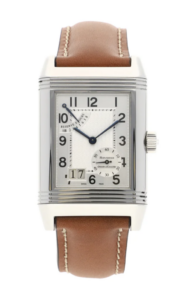
On De Niro‘s wrist, in the film’s margins rather than its foreground, is a Jaeger-LeCoultre Memovox E855. The watch appears in a specific functional role: the family uses it to time one of Giovanni’s schemes. That the instrument chosen for this purpose should be an alarm watch, a watch whose entire identity is built around the function of remembering to do something at a particular moment, is a piece of costume logic so precise it might be accidental.
Jaeger-LeCoultre: The Watchmaker’s Watchmaker
Jaeger-LeCoultre has carried the designation “watchmaker’s watchmaker” for long enough that it has become the brand’s informal identity, a recognition of the fact that for most of the twentieth century the manufacture in Le Sentier supplied movements and components to firms that sold watches under their own names, including Vacheron Constantin, Patek Philippe, and others, while also producing finished watches of exceptional quality under its own. The company was founded in 1833 by Antoine LeCoultre in the Vallée de Joux, the remote valley in the Swiss Jura that has been the cradle of complicated watchmaking since the seventeenth century. Antoine’s son Elie invented the micron measuring gauge in 1844, enabling precision tolerances that transformed the entire industry. The merger with the Parisian firm Edmond Jaeger, specialist in ultra-thin movements, took place in 1937 and produced the hyphenated name that has remained.
The company’s archive is among the most formidable in horology: the Reverso, introduced in 1931 to survive the polo field, is one of the most recognised watch designs of the century. The Duoplan of 1925 was among the first genuine complications in a wristwatch. The Gyromax balance, developed in 1951, became an industry standard. But the Memovox, introduced that same year, is the creation that most directly connects Jaeger-LeCoultre’s engineering ambition to the ordinary and intimate rhythms of a human life: the need to remember, and to be reminded.
The Memovox: Memory with a Voice
The name is a contraction of two Latin words, memor (remembering) and vox (voice), and the combination captures the complication’s function with unusual precision. A Memovox is a watch that speaks: at a preset time it rings, or vibrates against the wrist, or hammers against its own case back to generate a sound that reaches the wearer without requiring any external action. The first Memovox, introduced in 1951, was manually wound. The innovation that makes the E855 historically significant arrived in 1956, when Jaeger-LeCoultre introduced calibre K815, the world’s first automatic alarm wristwatch movement. For the first time, a wristwatch could wind itself and ring at a set time without requiring the owner to perform any intervention beyond setting the alarm hand the previous evening.
The E855 refined this achievement in 1959 by adding calendar. It was the first automatic alarm wristwatch with a date display, powered by calibre K825, an evolution of the K815 that incorporated a date mechanism while retaining the fundamental architecture of a bumper rotor automatic with two separate barrels, one for timekeeping and one for the alarm function, a design that ensures the alarm’s energy supply is never drawn from the main power reserve. The K825 comprises 241 individual components and was produced in a quantity of approximately 45,000 over its ten-year production run, a relatively modest number that contributes significantly to the E855’s present-day scarcity and desirability.
The E855: Two Crowns, One Disc, a Double Life
The most immediately distinctive feature of the Memovox E855 is its two crowns. The lower crown, at three or four o’clock depending on variant, winds and sets the time in the conventional manner. The upper crown sets the alarm hand, a separate display element that sits on the central alarm disc visible through the dial. Turning this crown rotates the disc until the alarm marker aligns with the desired hour, at which point the hammer, at the preset time, strikes a pin fixed to the case back. The case back itself functions as a resonance membrane, amplifying the sound through the watch’s own architecture rather than through any separate gong or bell. The result is a distinctly audible, distinctly physical alarm, one of those features of mechanical watchmaking that makes the object feel alive in a way that a digital alarm never manages.
The case is round and substantial, measuring 37mm to 38mm in diameter depending on production era, a dimension that was considered large for a dress watch of the early 1960s but that reads as appropriately sized by contemporary standards. The case was produced in stainless steel, gold-plated steel, 18-karat yellow gold, and 18-karat pink gold. The dial offered in the E855 came in a range of variants over the watch’s production life, from the austere silver examples with applied baton indices, to the striking black gilt variants, to the exotic lapis lazuli and tortoiseshell dials that now command the highest auction prices. A date window sits at three o’clock. The handset evolved across the production run from dauphine to bâton forms. Early examples bear applied Arabic numerals at twelve; later ones carry the applied JL monogram that became the standard identification mark.
The acrylic crystal is domed, a convex surface that gives the dial depth and catches light at angles that flat sapphire does not. On surviving examples in good condition, this crystal and the quality of the dial’s aging together create an object of very considerable visual warmth, the particular quality of mid-century Swiss craftsmanship at its best: formal enough for a suit, interesting enough to reward examination.
The Cinema Pedigree: McQueen, De Niro, and the Alarm in Crime Films
The Memovox has a specific and recurring relationship with crime cinema. Steve McQueen wore one in Norman Jewison’s The Thomas Crown Affair in 1968, on the wrist of a Boston financier who orchestrates a bank robbery for sport, and the association between the watch’s restrained elegance and the kind of criminality that wears good clothes established itself in that performance. De Niro’s use of the E855 in The Family, forty-five years later, extends the lineage. Giovanni Manzoni is a man of the old world, a man for whom quality objects are a natural assumption rather than an aspiration. The Memovox on his wrist in a Norman farmhouse is not a trophy or a statement; it is simply what such a man would own and use. That he uses it to time a scheme is entirely consistent with the watch’s nature: it exists to help you remember to do something at a particular moment. Giovanni has things he needs to do at particular moments. Old habits, after all, die hard.
The Memovox E855 was discontinued in the early 1970s as Jaeger-LeCoultre transitioned to newer alarm calibres, and surviving examples have entered the collector market with increasing enthusiasm over the past decade. The watch’s dual-crown silhouette, its historical claim as the first automatic alarm calendar wristwatch, its association with two of the defining American actors of crime cinema, and the inherent delight of its mechanical alarm function have made it one of the most sought-after Jaeger-LeCoultre references in the secondary market. JLC itself has acknowledged its significance, including restored E855 examples in its Collectibles programme, and the modern Memovox line continues to pay direct homage to the original’s design vocabulary. The voice of memory, as it turns out, carries across the decades without diminishing.
More on Jaeger-LeCoultre’s history: jaeger-lecoultre.com/us-en/universe/history and on the Memovox’s full lineage: en.wikipedia.org/wiki/Memovox
Technical note: Jaeger-LeCoultre Memovox, reference E855, introduced 1959. Round case in stainless steel (also produced in gold-plated, 14-karat and 18-karat gold), approximately 37 to 38mm diameter. Two crowns: lower for time setting and winding, upper for alarm setting via central rotating disc. Date window at 3 o’clock. Domed acrylic crystal. Calibre K825 automatic bumper-rotor movement, 241 components, 18,000 bph, separate barrels for timekeeping and alarm functions, alarm hammer strikes pin fixed to resonance case back. Available in silver, black, lapis lazuli, and other dial variants. Produced approximately 1959 to early 1970s, total K825 calibre production approximately 45,000 units. Lug width 18mm.
Details
Brand:
Marketplace Price
€3 000
Movie Year:
2013
As seen on:
Movie/TV Series: