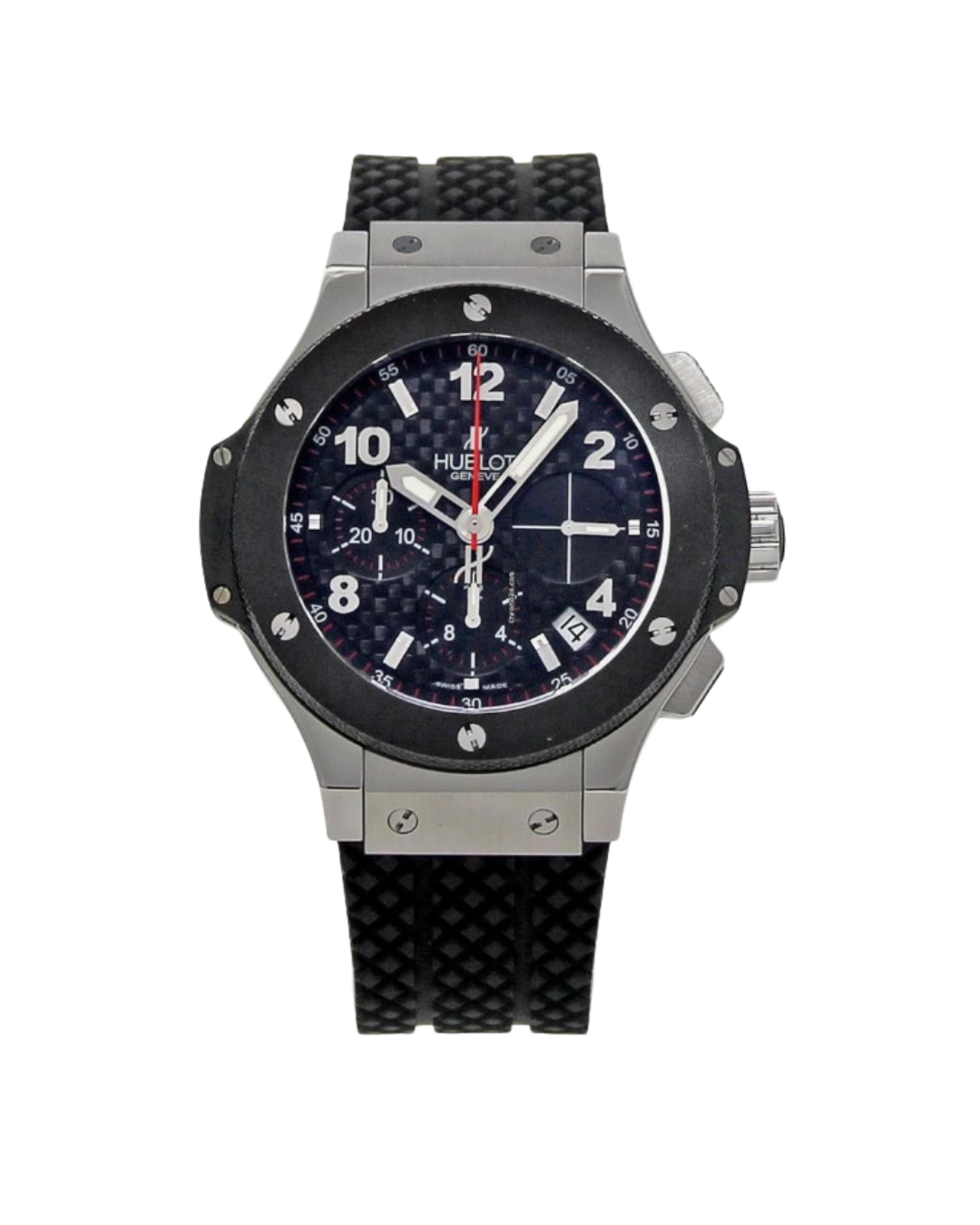
The Hublot Big Bang ref. 341.SB.131.RX: the steel and black ceramic chronograph from the watch that defined the Art of Fusion and won the 2005 Grand Prix de l’Horlogerie de Genève Design Prize in its first year of production, worn by Robert Downey Jr. as Tony Stark in Jon Favreau’s Iron Man (2008) during the film’s opening sequence, before Stark’s capture in Afghanistan ends his first-act existence and the suit begins
Iron Man (2008) opens with a signature that the film takes care to establish precisely: Tony Stark in a military convoy somewhere in Afghanistan, trading wisecracks with soldiers half his age, occupying the rear seat of a military vehicle with the comfort of a man who has never been anything but the most important person in any room he has entered. On his wrist, before the ambush, before the cave, before everything that follows, is a Hublot Big Bang.
The placement of the watch is deliberate in its timing. The Big Bang appears in the film’s opening sequence precisely because it is the watch of the pre-transformation Stark: a man who has built an empire on weapons, enjoys the proceeds, and has not yet been forced to reckon with what that means. The watch is large, bold, technically ambitious, expensive, and designed for maximum visual impact, which is an accurate description of Tony Stark before Afghanistan. It disappears from the film when Stark is captured, because the captors take everything, and when Stark returns to Malibu he is already, in some sense, a different person. The watches that follow, the Bvlgari Diagono Sport, the Diagono Retrograde Moonphase, belong to the character under construction; the Hublot belongs to the character that no longer quite exists.
aBlogtoWatch’s original 2008 analysis identified the watch as a Big Bang visible in the desert sequence, noting a blue-faced example with what appeared to be a tantalum bezel and gold case. Subsequent research by the RPF forum prop community confirmed the identification as Hublot beyond reasonable doubt through the visible H-shaped titanium screws around the bezel, one of the brand’s most immediately recognisable visual signatures. The ref. 341.SB.131.RX is the steel-and-ceramic configuration of the Big Bang family: stainless steel case, black ceramic bezel secured by six H-shaped titanium screws, black carbon-fibre-stamped dial, and black rubber strap.
The Watch: A Case Architecture in Six Screws
The Big Bang’s most immediately recognisable feature is not the case shape, the dial, or the rubber strap: it is the six H-shaped titanium screws that secure the ceramic bezel to the case. They are the visual signature that identifies a Big Bang at a distance on screen, and they are functional: the screws actually secure the bezel and are not purely decorative, which places them in the tradition of the integrated case construction that Hublot had established as a design language.
The 341.SB.131.RX is the 41mm variant of the Big Bang, a size introduced alongside the original 44mm case as a slightly more compact expression of the same design vocabulary. The case is satin-finished stainless steel with lateral inserts, the bezel fixed black ceramic, the dial stamped to replicate a carbon fibre texture with applied brushed-finish steel hour markers alternating between Arabic numerals and indices. Three chronograph subdials occupy the dial: running seconds at nine o’clock, thirty-minute counter at three, twelve-hour counter at six. The date appears between four and five o’clock. The crystal is scratch-resistant sapphire with anti-reflective treatment, and the caseback is sapphire exhibition, revealing the movement.
The movement is the Hublot calibre HUB4300 in earlier examples, subsequently updated to the HUB2894, both automatic chronograph calibres with a 42-hour power reserve. Water resistance is 100 metres. The black rubber strap is secured with a stainless steel deployant buckle. The overall construction combines four material families in a single object: steel, ceramic, rubber, and sapphire, which is precisely the Art of Fusion proposition that Hublot had built its identity around since 1980 and intensified with the Big Bang’s launch in 2005.
The Porthole and the Art of Fusion
Hublot was founded in 1980 by Carlo Crocco, an Italian entrepreneur from the family behind the Binda Group, which owns the Italian watch brand Breil. Crocco had left the family business in 1976, moved to Switzerland, and spent four years developing a concept for a watch that was unlike anything then in the luxury market: an 18-carat gold case paired with a natural rubber strap. The case shape was circular, inspired by a ship’s porthole, and the company took its name from the French word for porthole. The watches were presented at Baselworld 1980, to an industry that was largely baffled. Rubber was associated with inexpensive sports watches; gold was associated with traditional luxury; combining them was not a proposition that the established market was prepared to receive.
Crocco persisted. The brand grew slowly through the 1980s and 1990s, building a following among a particular clientele attracted to its Italian design sensibility and its material audacity. By the early 2000s, the brand was struggling commercially, and Crocco, increasingly committed to his Hand-In-Hand charitable foundation, sought a successor. In May 2004, Jean-Claude Biver, who had previously revived Blancpain from effective extinction and served as CEO of Omega within the Swatch Group, joined Hublot as CEO.
Biver recognised in Crocco’s original concept a proposition that the market was now, for the first time, ready to receive at volume. The Art of Fusion, the combination of unexpected materials as a design and manufacturing philosophy, became the brand’s explicit identity. The watch Biver chose to express this identity in full was the Big Bang, launched at Baselworld in 2005. The first Big Bang was a 44.5mm chronograph in stainless steel with Kevlar lateral inserts, ceramic bezel, woven carbon fibre dial, and natural rubber strap: the Art of Fusion made maximally visible. It won the Design Prize at the Grand Prix de l’Horlogerie de Genève that year, the Sports Watch Prize in Japan, and the Best Oversized Watch award in Bahrain. It became the watch that defined the oversized sport-luxury category for the second half of the decade.
LVMH acquired Hublot from Crocco and Biver in 2008, the same year Iron Man was released, adding the brand to a portfolio that already included TAG Heuer and Zenith.
The Watch Before the Arc Reactor
In the context of Tony Stark’s complete watch biography across the MCU, the Hublot Big Bang occupies a specific and non-recoverable position: it is the only watch associated with the version of Stark that the arc reactor ends. When the reactor is implanted in the cave to keep shrapnel from reaching his heart, Stark’s relationship to his own technology, to his company, and to his own life changes irrevocably. The watches that follow are selected for a character in the process of becoming something different. The Bvlgari pieces in the same film represent the transition; the Jaeger-LeCoultre AMVOX3 Tourbillon GMT of Iron Man 2 represents the arrival at a more considered self; the Urwerk UR-110RG of Spider-Man: Homecoming represents the fully formed version of Stark who has integrated his technological obsession with his personal identity.
The Big Bang belongs to none of that. It belongs to the fifteen minutes before the ambush, when Stark is telling soldiers about chauffeurs and enjoying being the most powerful person in the vehicle. It is the watch of the man who has not yet been broken, and its disappearance from the film at the moment of Stark’s capture is one of the more economical pieces of costume storytelling in the MCU’s first decade.
More on Hublot’s history: hublot.com and on the Big Bang’s origins: revolutionwatch.com/hublot-big-bang-two-decades
Technical note: Hublot Big Bang ref. 341.SB.131.RX. Satin-finished stainless steel case, 41mm diameter, 12mm thickness. Fixed black ceramic bezel secured by six H-shaped titanium screws. Black carbon-fibre-stamped dial with applied brushed stainless steel hour markers, alternating Arabic numerals and indices. Three chronograph subdials: running seconds at 9, 30-minute counter at 3, 12-hour counter at 6. Date between 4 and 5 o’clock. Calibre HUB4300/HUB2894 automatic, 42-hour power reserve. Sapphire exhibition caseback. Black rubber strap with stainless steel deployant buckle. Water resistance 100 metres. Hublot founded 1980 by Carlo Crocco in Nyon, Switzerland; Big Bang collection launched 2005 by CEO Jean-Claude Biver; won 2005 Grand Prix de l’Horlogerie de Genève Design Prize; LVMH acquisition 2008. Worn by Robert Downey Jr. as Tony Stark in Iron Man (2008), directed by Jon Favreau, in the opening Afghanistan sequence prior to Stark’s capture.
Details
Brand:
Marketplace Price
€7 000
Movie Year:
2008
As seen on:
Movie/TV Series: