
Released on October 14, 1994, and directed by Quentin Tarantino for Miramax Films, Pulp Fiction is an American crime anthology film starring John Travolta, Samuel L. Jackson, Uma Thurman, Harvey Keitel, Tim Roth, Amanda Plummer, Maria de Medeiros, Ving Rhames, Eric Stoltz, Rosanna Arquette, Christopher Walken, and Bruce Willis. The film weaves three interlocking stories set within the Los Angeles criminal underworld — a pair of philosophical hitmen running an errand for their employer, a boxer who has agreed to throw a fight and then doesn’t, and a restaurant hold-up couple navigating an unexpected complication — presented in a non-linear structure that scrambles chronology with a confidence bordering on provocation. Its premiere at the Cannes Film Festival in May 1994, where it won the Palme d’Or, announced the arrival of a filmmaker of genuinely disruptive ambition, and its theatrical release later that year generated a cultural detonation whose aftershocks are still measurable in contemporary cinema. Made for approximately eight million dollars, it grossed over two hundred million worldwide and was nominated for seven Academy Awards, winning one — Best Original Screenplay — a result widely regarded by critics as among the more egregious undersights in the award’s history. More consequentially, it rehabilitated John Travolta’s career from a position of near-total commercial irrelevance, restored independent film to the center of American cultural conversation, and established a mode of dialogue-driven, reference-saturated, genre-aware filmmaking that defined the aesthetic of American independent cinema for the decade that followed.
Behind the Scenes. Tarantino wrote the role of Vincent Vega with Michael Madsen in mind, but Madsen committed instead to Wyatt Earp, opening the part to Travolta at a moment when his asking price had fallen low enough to make casting him in an independent production financially viable. The casting proved transformative for both parties. Samuel L. Jackson’s Jules Winnfield was substantially expanded from the original draft after Jackson’s audition, during which he reportedly stopped mid-read to retrieve and consume a sandwich he had noticed in the production office, a display of inhabitation that convinced Tarantino immediately. The dance sequence between Travolta and Uma Thurman at Jack Rabbit Slim’s was choreographed around their actual limitations as dancers rather than in spite of them, a pragmatic decision that produced one of the most replicated scenes in 1990s cinema. The Gimp remains unidentified by the narrative and unexplained by Tarantino in any interview, a lacuna that has generated a volume of fan theorization disproportionate even by the standards of a film that invites obsessive close reading. The briefcase, its contents never revealed and its golden interior light sourced from a device never shown, is the most discussed MacGuffin in post-classical American cinema.
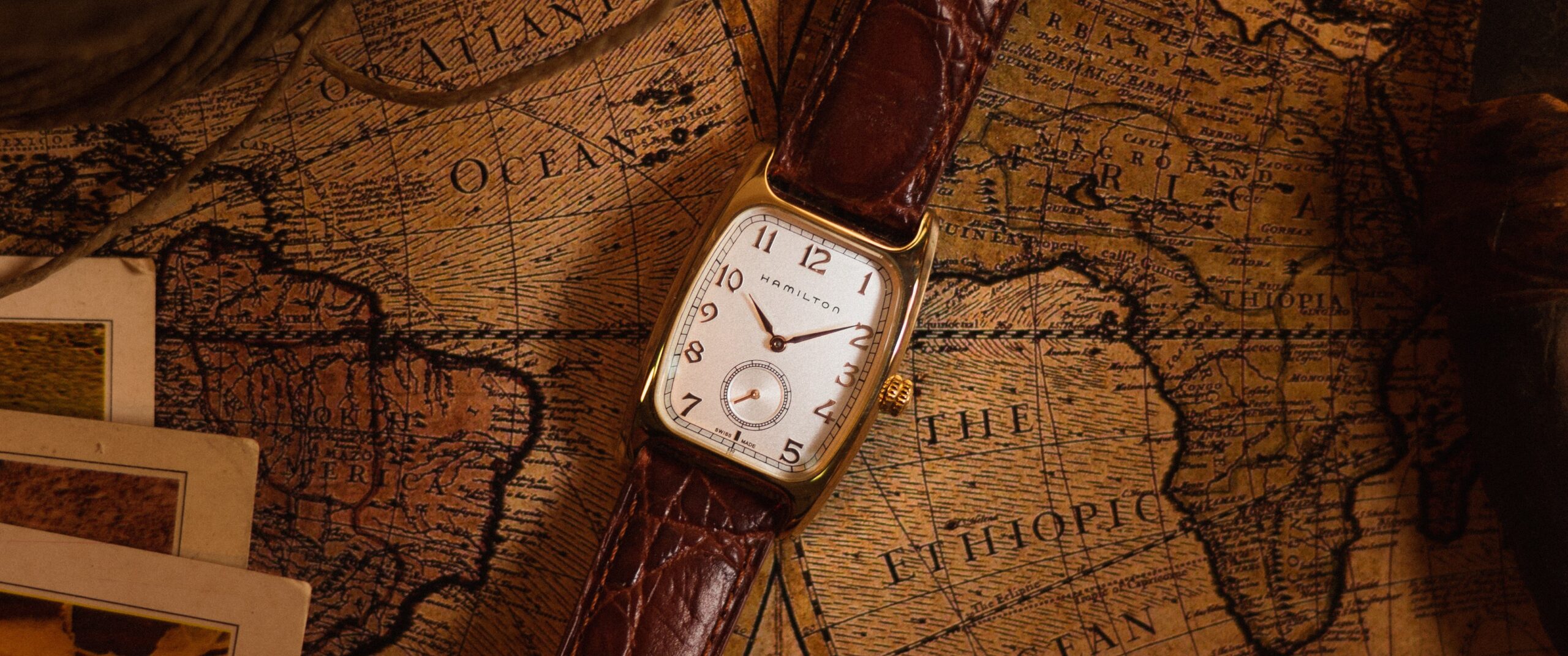
The Watch. The watch at the center of Pulp Fiction‘s most formally audacious sequence — the monologue delivered by Christopher Walken as Captain Koons to a young Butch Coolidge, tracing the provenance of a gold watch through successive generations of wartime captivity — is a Lancet trench watch, a piece whose design places it unmistakably in the First World War era from which the fictional object’s history is said to originate. Lancet was a trade name applied to a range of watches retailed through American jewelry and department store channels in the early-to-mid twentieth century, representing the broad category of affordable Swiss-movement pieces that supplied the mass market with reliable timekeeping under house brand labels rather than manufacturer names. The trench watch form factor — a small round case with wire lugs soldered onto a pocket watch conversion, or purpose-built with fixed wire lugs, fitted with a canvas or leather strap and often protected by a hinged or fixed metal grille over the crystal — emerged from the practical demands of infantry combat in the trenches of the Western Front, where a soldier needed to read the time without removing a pocket watch from his clothing and without the crystal of a wristwatch being shattered by the concussive debris of constant artillery. The specific Lancet on screen is a small-cased piece with a white enamel dial, Arabic numerals, and the skeletal wire-lug construction characteristic of the period, its age and fragility entirely legible on screen and entirely consistent with the object’s narrative biography as something carried through decades of captivity and passed between dying men. Tarantino’s use of the watch as a narrative device is one of the more elegant pieces of object-oriented screenwriting in American film: an item of negligible monetary value transformed by the specificity of its provenance into something of absolute personal consequence, its worth residing entirely in the chain of sacrifice and custody that constitutes its history rather than in any intrinsic quality of the object itself. The Walken monologue — written, by Tarantino’s account, as a deliberate exercise in the comedic deflation of sentimentality through the accumulation of anatomical specificity — depends entirely on the audience accepting the watch as a real artifact with real weight, and the casting of a period-correct trench watch rather than a generic prop contributes materially to that acceptance. Lancet pieces of this vintage are not rare in the absolute sense — the trade-name retailing model produced watches in large numbers — but examples retaining intact enamel dials, functional movements, and original wire lugs in unwelded condition represent a small fraction of surviving pieces, and the particular model’s appearance in one of the most quoted scenes in 1990s cinema has generated the predictable collector attention among those who track the intersection of screen history and vintage horology.
Details
Brand:
Marketplace Price
€600
Movie Year:
1994
As seen on:
Movie/TV Series: