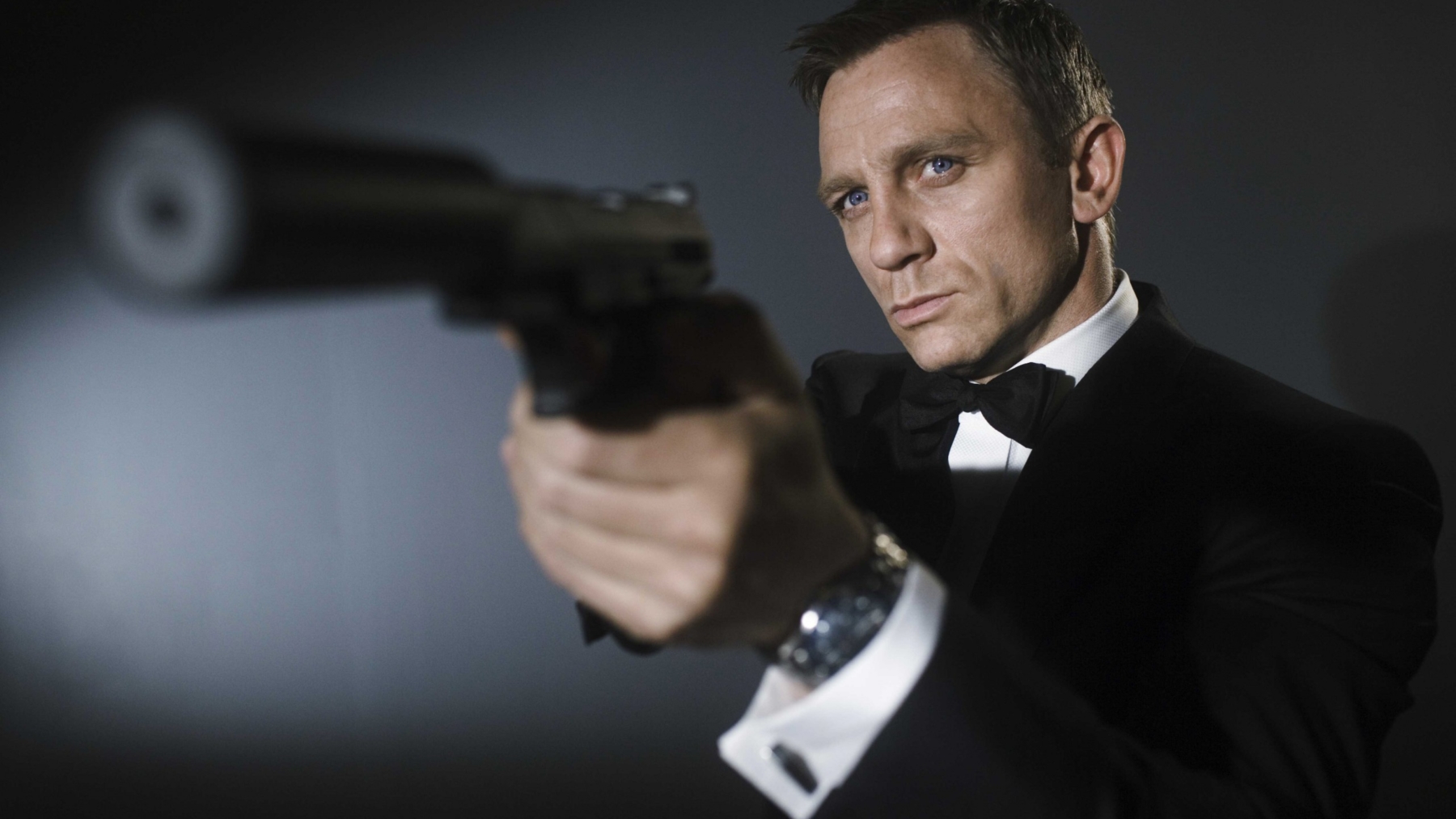

The Longines Evidenza Chronograph L2.656.4: an Art Deco tonneau case at a poker table in Montenegro, on the wrist of the most quietly menacing Bond villain of the modern era
Martin Campbell’s Casino Royale (2006) is a film organised around contrasts: Daniel Craig’s Bond is physical where previous Bonds were suave, direct where they were elliptical, and emotionally exposed where they were armoured. The poker game at the Casino Royale in Montenegro is the film’s centrepiece, a sequence of sustained tension in which everything hangs on the composition of the tableau: Bond on one side, Le Chiffre on the other, money and lives as the stakes. It is in chapter twenty of the film that the Longines Evidenza on Mads Mikkelsen‘s wrist becomes most clearly visible, a tonneau-shaped steel chronograph emerging from a suit jacket cuff as Le Chiffre counts his chips.
The choice of watch for Le Chiffre is, from the perspective of the film’s commercial architecture, quietly subversive. Omega has been Bond’s official watchmaker since 1995, and at the poker table most of the players wear Omega. That Bond’s primary antagonist wears a Longines is a decision that separates the two characters in horological terms as cleanly as the felt table separates them physically. Longines and Omega are both members of the Swatch Group, making the choice internally coherent from a sponsorship perspective while maintaining a visible distinction: Bond wears the aspirational brand; Le Chiffre wears the elegant but subordinate one. The villain is well-dressed, but not quite at Bond’s level. His watch, beautiful as it is, makes the same statement.
Longines: From a Long Meadow in the Jura to the World’s Oldest Active Trademark
The name Longines comes from a meadow. In 1867, Ernest Francillon, nephew of founder Auguste Agassiz, built the brand’s first integrated watch factory on a plot of land in Saint-Imier known locally as “Es Longines,” meaning long meadows. The name of the location became the name of the brand, and every watch that has left Saint-Imier since has carried it, alongside the winged hourglass that Longines registered as its trademark in 1889. That trademark is, according to the World Intellectual Property Organization, the oldest still in use in its original form of any watch brand on the planet, a record that tells you something about the company’s relationship with continuity.
Agassiz had established the original business in 1832 under the name Raiguel Jeune & Cie, initially operating on the établissage model in which components were made in watchmakers’ homes and assembled centrally. Francillon, an economist by training, transformed it into a true manufacture, a single factory where every stage of production occurred under one roof. This model, which Longines pioneered for Swiss watchmaking, allowed the quality consistency that the brand’s early competition chronographs required: by 1878 Longines had produced its first sports chronograph, calibre 20H, and by the 1880s it was the dominant timekeeper at horse racing events in the United States, its instruments trusted at tracks from New York to New Orleans.
The twentieth century added aviation to Longines’ credentials: the Lindbergh Hour Angle Watch of 1931, co-designed with transatlantic pilot Charles Lindbergh, remains one of the most technically significant pilot’s watches ever made. The quartz crisis of the 1970s nearly undid everything, as it nearly undid every Swiss manufacturer not called Swatch, and it was the merger that created the Swatch Group in 1983 that provided the institutional stability for Longines to continue. Within the group’s commercial hierarchy, Longines sits below Omega but above Tissot, positioned as the brand for buyers who want genuine Swiss watchmaking heritage at a price that does not require the mythology of a Submariner or a Seamaster to justify.
The Evidenza: Art Deco as Commercial Philosophy
The Evidenza collection is Longines’ most explicitly historical design statement, a line built directly on the vocabulary of 1920s and 1930s Art Deco watchmaking. The case is a tonneau, a barrel shape that was among the most fashionable forms in Swiss horology during the interwar period: its four sides curve gently inward and outward in a continuous organic geometry that sits against the wrist with the conformity of something designed specifically for that purpose. The word “evidenza” in Italian means evidence, or self-evidence, the quality of something that declares its own value without requiring argument. Longines chose it well.
The case of the L2.656.4 worn by Le Chiffre measures approximately 34mm in width and 40mm in length, dimensions that are compact by contemporary standards and entirely consistent with the historical references the collection draws on. The 1920s and 1930s produced dress watches that fit under a shirt cuff without announcing themselves, and the Evidenza follows that logic even in its chronograph form. The pushers are trapezoidal in section, matching the case’s tapered geometry, and the crown is flush with the case profile rather than protruding in the manner of a sports watch. The cumulative effect is a watch that reads, from across a poker table, as discreet, assured, and old money.
The Dial: Black, Arabic, and the Geometry of Legibility
The specific variant worn in Casino Royale, reference L2.656.4.53.6, carries a black dial with three black subdials and Arabic numerals, the combination that most closely references the instrument watches of the 1930s that the Evidenza draws its lineage from. The Arabic numerals are rendered in a distinctive font with slightly condensed proportions, a detail that contributes to the period atmosphere without tipping into pastiche. The three subdials handle the chronograph functions in the classic triple-register arrangement: hours, minutes, and running seconds distributed across the face in positions derived from pocket watch chronograph conventions.
The movement is quartz, calibre 541, an ETA-based module that Longines fitted to the Evidenza across its production run and that provides the accuracy and reliability the Swatch Group requires from its volume-production lines. This is not a confession of inadequacy but a statement of category: the Evidenza is a dress chronograph at a dress watch price, its value proposition built on case design, dial composition, and brand history rather than on movement architecture. The sapphire crystal sits flush with the bezel, protecting the dial without projecting beyond the case profile, and the steel bracelet on the Le Chiffre variant matches the polished case finish in a single-metal unity that reads as formal and complete.
The Swatch Group’s Sub-Table Game
The casting of the Longines Evidenza as the villain’s watch in a Bond film sponsored by Omega has an irony that the Swatch Group’s brand managers presumably appreciated. Le Chiffre is not a crude villain. He is a financier, a man of numbers and controlled affect, whose distinguishing physical characteristic in Ian Fleming’s novel and in Mikkelsen’s performance is a weeping eye and an absolute stillness under pressure. His watch matches him: it is not a tool watch, not a sports watch, not something chosen for adventure or action. It is a dress chronograph chosen for an interior, for a table, for a game where time matters but not in the manner it matters in the field.
The Longines Evidenza has appeared in Bond more than once. In Skyfall (2012) a Longines Evidenza appears on the wrist of a minor character in MI6, and a Longines Legend Diver is worn by the assassin Patrice. The brand’s recurrent presence in the franchise as the watch of supporting characters and antagonists, rather than of Bond himself, has created a quietly coherent secondary horological narrative within the series: the world that Bond operates against is elegantly furnished, but with different furniture.
Technical note: Longines Evidenza Chronograph, reference L2.656.4.53.6 as worn in Casino Royale (2006). Tonneau-shaped stainless steel case, approximately 34mm width, 40mm length, 12.5mm thickness. Black dial with three black chronograph subdials, Arabic numerals. Trapezoidal pushers. Date aperture at 6 o’clock. Quartz movement, Longines calibre 541 (ETA-based). Sapphire crystal. Stainless steel bracelet with double folding clasp. Water resistance 30 metres. Also available in multiple dial and strap configurations including silver dial with Roman numerals and brown leather strap variants across the L2.656.4 reference family.
Details
Brand:
Marketplace Price
€800
Movie Year:
2006
As seen on:
Movie/TV Series: