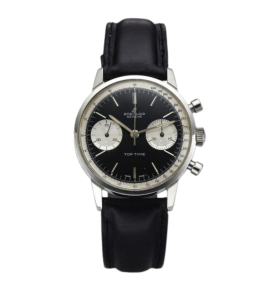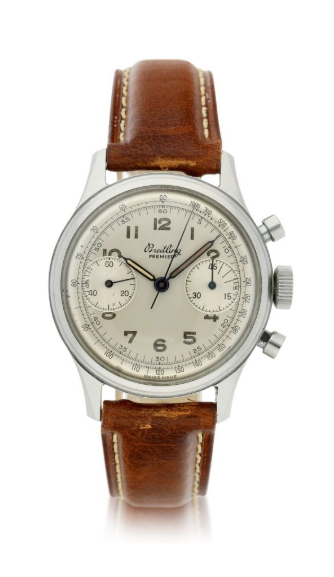
The Breitling Premier 790: the dress chronograph introduced by Breitling in 1943 and named after the French word for “first”, produced through the 1940s with Venus calibres and surviving in the collector market as a document of mid-century Swiss elegance, identified as the watch worn by Robert Downey Jr. as Lewis Strauss in Christopher Nolan’s Oppenheimer (2023), where it appears on a wrist seen almost entirely in black and white, a detail of character whose full legibility depends on knowing what to look for
The Structure of the Film and the Man Inside the Bracelet
Christopher Nolan’s Oppenheimer (2023) is built around a cinematographic distinction that carries its moral argument inside the photography itself. The sections of the film shot in colour represent the subjective perspective of J. Robert Oppenheimer, the theoretical physicist played by Cillian Murphy who led the Manhattan Project and, after the war, found himself the target of a security hearing orchestrated by people who feared what he represented. The sections shot in black and white represent the objective record, the formal proceedings, the Senate confirmation hearing of 1959 in which Lewis Strauss, played by Robert Downey Jr., seeks confirmation as Secretary of Commerce and finds, to his progressive dismay, that the case against Oppenheimer he had helped construct has returned to define him.
Lewis Strauss is the film’s antagonist, which is too simple a word for what Nolan and Downey construct. Strauss is a self-made man from Virginia who became a successful investment banker, was appointed to the United States Atomic Energy Commission, and developed a complex and corrosive relationship with Oppenheimer that moved from admiration through rivalry to something that the film presents as a kind of obsession disguised as principle. He is meticulous about his appearance, his reputation, and his standing. He wears a polished bracelet that matches a ring, details that Watch Clicker’s analysis of the film’s watches identified as the most visible horological elements on Strauss’s wrist, noting that the watch itself is mostly obscured across the film. The exact model, in Watch Clicker’s assessment, is not apparent to the audience, precisely because Nolan’s black and white photography reduces the information available in each frame.
The identification as a vintage Breitling Premier ref. 790 comes from close viewing and collector community research. It is consistent with the period, the character, and the film’s commitment to period accuracy. If you like these watches please take a look at this great book: Premier Story by Fred S. Mandelbaum available on watchprint.
The Nolan Commitment to Period Accuracy
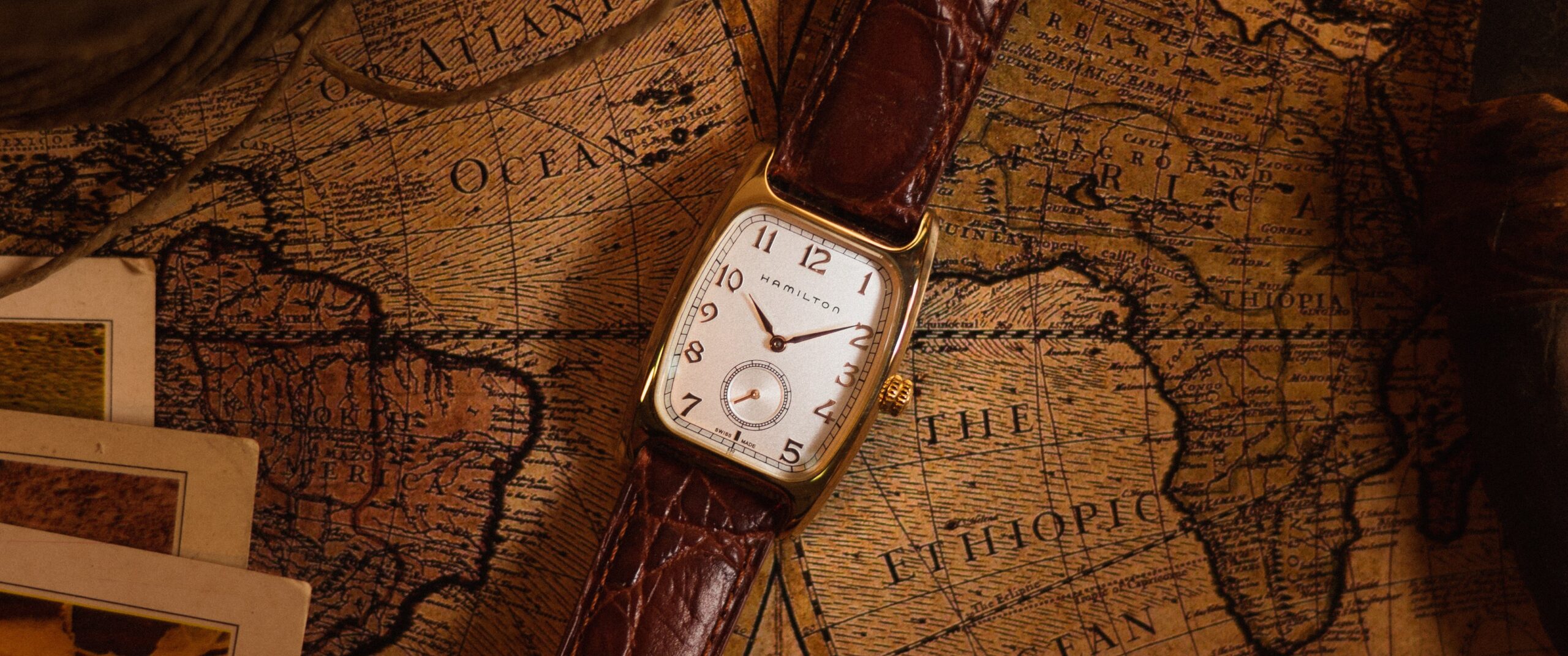
Nolan’s reputation for research and period accuracy is well documented, and Oppenheimer represents a sustained application of that reputation to a film covering roughly three decades of American history, from the early 1940s through the late 1950s. Hamilton was the film’s official watch partner, supplying vintage and period-correct Hamilton watches for the production through a collaboration with collectors and enthusiasts. The Hamilton page for the film cites Nolan’s attention to detail and his insistence that accessories match the period. The Calibrated Wrist noted that Nolan, unlike with Interstellar where a new watch was created for the film, wanted the aesthetics of Oppenheimer to be accurate to the 1940s and 1950s as possible.
Within this production context, a vintage Breitling Premier ref. 790 on Lewis Strauss’s wrist is precisely the kind of choice that costume designer Ellen Mirojnick, who researched the period exhaustively, would make. The ref. 790 was produced between approximately 1940 and the late 1940s, covering exactly the years in which Strauss was most active as a public figure in the film’s early timeline. It is a dress chronograph: elegant, with a bi-compax layout, blued steel hands, and a tachymeter scale on the periphery, housed in a modest 35mm stainless steel case that reads as the watch of a man who considers himself a gentleman of the mid-century American establishment. Strauss considers himself exactly that.
The Premier and the Brand That Invented the Chronograph
Breitling’s claim to have invented the modern chronograph is grounded in specific patent history. Léon Breitling founded the company in Saint-Imier, Switzerland, in 1884, producing pocket chronographs and stopwatches. His son Gaston Breitling moved the company to La Chaux-de-Fonds in 1892, and it was Gaston who filed a patent in 1915 for the first chronograph with an independent pushpiece for the start and stop function, a crown-operated pusher at 2 o’clock that separated the chronograph control from the time-setting crown for the first time. In 1923, Breitling filed another patent for a two-pusher chronograph with separate start and stop and reset functions, an architecture that underlies every column-wheel chronograph produced since. These two patents constitute Breitling’s foundation claim to chronograph history, and the brand has consistently built its identity around them.
Willy Breitling, Gaston’s son, who took over the company in 1932, introduced the Premier collection in 1943 as a deliberate departure from the aviation-focused chronographs that had defined the brand’s commercial identity. The Premier, whose name came directly from the French for “first”, was designed for elegant occasions rather than cockpits: a chronograph for the boardroom, the theatre, the diplomatic reception. Willy Breitling described it as “an unmistakable stamp of impeccable taste”, a phrase that Breitling continues to use in its current Premier marketing. The Premier was produced through the 1940s in various configurations, with the ref. 790 among the most documented, housing Venus calibres 150 and 175, both manually wound, 17 jewels, column wheel chronograph mechanisms built in Saint-Imier.
Breitling was acquired by Ernest Schneider in 1979, and the family sold the brand. It passed through several ownership structures before being acquired by CVC Capital Partners in 2017, under whose ownership the current CEO Georges Kern led the 2018 relaunch of the Premier collection, introducing the Premier B09 Chronograph 40 as the modern expression of the 1940s original. The B09 calibre, developed in-house at the Breitling manufacture, is manually wound, COSC-certified, runs at 28,800 vibrations per hour, delivers a 70-hour power reserve, and times to a quarter second with a 30-minute register. The 40mm case is available in stainless steel and 18-carat red gold, with dial options including a pistachio green that has become closely associated with the modern revival. The rectangular pushers, grooved case sides, bi-compax layout, and applied Arabic numerals are all direct references to the ref. 790 and its contemporaries.
A Watch in Black and White
The decision to place Strauss’s watch in the film’s black-and-white sections has a consequence that is partly practical and partly thematic. In black and white, the watch’s colour information disappears: what would in colour be a silver dial with blued hands becomes a grey surface with dark hands, legible in broad terms but stripped of the chromatic specificity that allows precise identification at a distance on screen. This is why Watch Clicker was honest about the identification difficulty and Spotern listed the watch as unresolved.
The thematic consequence is more interesting. Oppenheimer’s watches, the Hamilton pieces worn by Murphy, exist in the colour sections of the film, in the vivid subjective world of the man who saw the atomic age arrive and spent the rest of his life carrying it. Strauss’s watch exists in the objective record, in the formal proceedings where identities are constructed and destroyed through testimony rather than experience. The watch on his wrist belongs to the world of mid-century American institutional power, polished and meticulous, dressed for the occasion, visible as a category of object without quite being visible as a specific object. It is the watch of a man who wants to be seen as a certain kind of person, and it has been placed in the light that makes full identification difficult.
Whether this is a deliberate production decision or a consequence of the photography, it is the condition in which the Breitling Premier ref. 790 appears in one of the most closely watched films of 2023.
Technical note: Breitling Premier ref. 790, circa 1940 to late 1940s. Stainless steel case, 35mm diameter, 11.5 to 11.8mm thickness. Bi-compax chronograph layout: 45-minute register at 3 o’clock, running seconds at 9 o’clock. Tachymeter scale on dial periphery. Silver or two-tone dial. Blued steel syringe hands. Venus calibre 150 or 175, manually wound, 17 jewels, column wheel chronograph, Breitling signed. Lug width 18mm. Plexiglass crystal. Radium lume on hands and numerals. Case back stamped with reference number 790. Premier collection introduced 1943 by Willy Breitling as an elegant dress chronograph line. Breitling founded 1884 by Léon Breitling in Saint-Imier, Switzerland; 1915 patent for independent pushpiece chronograph; 1923 patent for two-pusher start/stop/reset chronograph. Modern reissue: Premier B09 Chronograph 40, introduced 2018. B09 calibre: Breitling manufacture, manually wound, COSC-certified, 28,800 vph, 70-hour power reserve, 28 jewels, quarter-second timing, 30-minute register. 40mm case, 13mm thickness, stainless steel or 18-carat red gold, sapphire exhibition caseback. Worn by Robert Downey Jr. as Lewis Strauss in Oppenheimer (2023), directed by Christopher Nolan. The watch appears in the film’s black-and-white sections, the objective cinematographic register assigned to Strauss’s perspective; the bracelet and matching ring are the most consistently visible accessories. Exact on-screen identification is limited by the film’s photography.
Details
Brand:
Marketplace Price
€3 500
Movie Year:
2023
As seen on:
Movie/TV Series: