“Technology gets better every day. That’s fine. But most of the time all you need is a stick of gum, a pocket knife and a smile.”
Released on November 21, 2001, and directed by Tony Scott for Universal Pictures, Spy Game is an American espionage thriller starring Robert Redford as Nathan Muir, a veteran CIA case officer spending his last day before retirement navigating the agency’s internal machinery in a covert attempt to save his former protege Tom Bishop, played by Brad Pitt, who has been arrested in China while attempting to smuggle a woman out of a military prison and is scheduled for execution within twenty-four hours. The film’s structure is one of sustained formal intelligence: the present-day drama of Muir’s interrogation by CIA executives who are simultaneously trying to assess Bishop’s operational history and build a case for abandoning him is intercut with a series of extended flashbacks moving from Vietnam to Berlin to Beirut, each revealing another layer of the relationship between the two men and of Muir’s willingness to use and discard the people around him in the service of objectives whose moral clarity diminishes as his career progresses. Scott’s direction is characteristically kinetic, the film’s rapid editing and restless camera work giving the CIA’s institutional spaces a claustrophobic urgency that complements the countdown structure of the main narrative. The film grossed over 143 million dollars worldwide and has grown in reputation since its release as one of the more intellectually serious entries in the post-Cold War espionage genre, its portrait of institutional cynicism and the corrosive effects of a career spent treating human beings as operational assets resonating with increasing force in the decade that followed.
Behind the Scenes
Spy Game reunited Redford with Brad Pitt, who had previously worked with him as director on A River Runs Through It in 1992, and the dynamic between the two actors, Redford’s weathered, sardonic authority against Pitt’s restless, idealistic energy, provides the film with its most reliable source of dramatic tension across the flashback structure. Tony Scott had previously worked with Pitt on Fight Club’s production company and brought to the film the visual style he had developed across a decade of large-scale action productions, here deployed in service of a narrative whose action sequences are considerably less central than the institutional drama of Muir’s one-man operation against his own agency. The screenplay, written by Michael Frost Beckner and David Arata, constructs its CIA as a bureaucracy so thoroughly instrumentalized that the decision to sacrifice Bishop is treated as a straightforward trade calculation rather than a moral one, a critique of institutional amorality that the film pursues with more consistency than the espionage genre typically allows. The Beirut sequences, depicting the 1985 Lebanese civil war with a location authenticity that gives the film some of its most visually charged passages, were praised by observers with professional intelligence backgrounds as among the more accurate depictions of field operations and tradecraft in mainstream American cinema. The film is dedicated to Elizabeth Jean Scott, Tony Scott’s mother, who died during post-production.
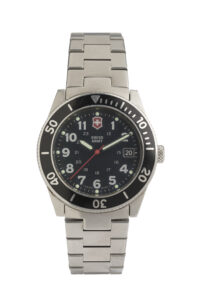
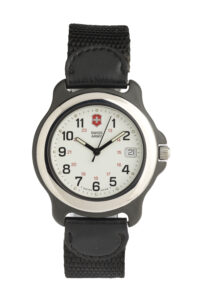
The Watch. The watch worn by Robert Redford as Nathan Muir throughout Spy Game is a Victorinox Swiss Army Officer’s 1884, a quartz analog piece in a 41mm stainless steel case with a white dial and stainless link bracelet, worn notably on Redford’s right wrist throughout the film rather than the conventional left, a detail consistent with Muir’s construction as a man of idiosyncratic personal habits and deliberate non-conformity. Victorinox is a name whose primary association in the popular imagination is with the Swiss Army knife rather than the wristwatch, a brand positioning that the company’s watch division has occupied since at least the early 1990s with a line of timepieces whose design vocabulary draws on the same values of functional reliability and unpretentious competence that define its cutlery. The Officer’s 1884 reference is a straightforward quartz instrument watch with a secondary 24-hour scale on the dial providing a second time zone reading, a practical feature for an operative whose career has required him to track time simultaneously across multiple continents. The choice of this particular watch for Muir is one of the most thematically precise in this volume: a man whose tradecraft philosophy is explicitly built around invisibility and anonymity, who teaches Bishop that the most dangerous thing an operative can do is attract attention through the wrong accessory or the wrong question, would no more wear a Rolex or a Patek Philippe than he would carry a briefcase with a monogram. The Victorinox communicates reliable competence without communicating wealth, status, or any aspiration beyond the accurate recording of time across the geographies that Muir’s career has required him to inhabit, and its presence on his wrist is, in the language of the film’s own tradecraft pedagogy, the correct choice by a gray man who has spent thirty years making correct choices about what not to reveal. The watch’s appearance in Spy Game has generated sustained attention within the community that tracks the intersection of intelligence tradecraft and material culture, the Watchesofespionage platform among others having identified the reference and noted the aptness of its selection, a recognition that extends beyond the screen-watch identification game into a genuine appreciation of the wardrobe intelligence that placed a Swiss Army watch rather than a Swiss luxury watch on the wrist of the film’s most accomplished operative.
Details
Brand:
Marketplace Price
€800
Movie Year:
2001
As seen on:
Movie/TV Series: