
“In future, Commander, let me suggest a perfectly adequate watchmaker just down the street.”
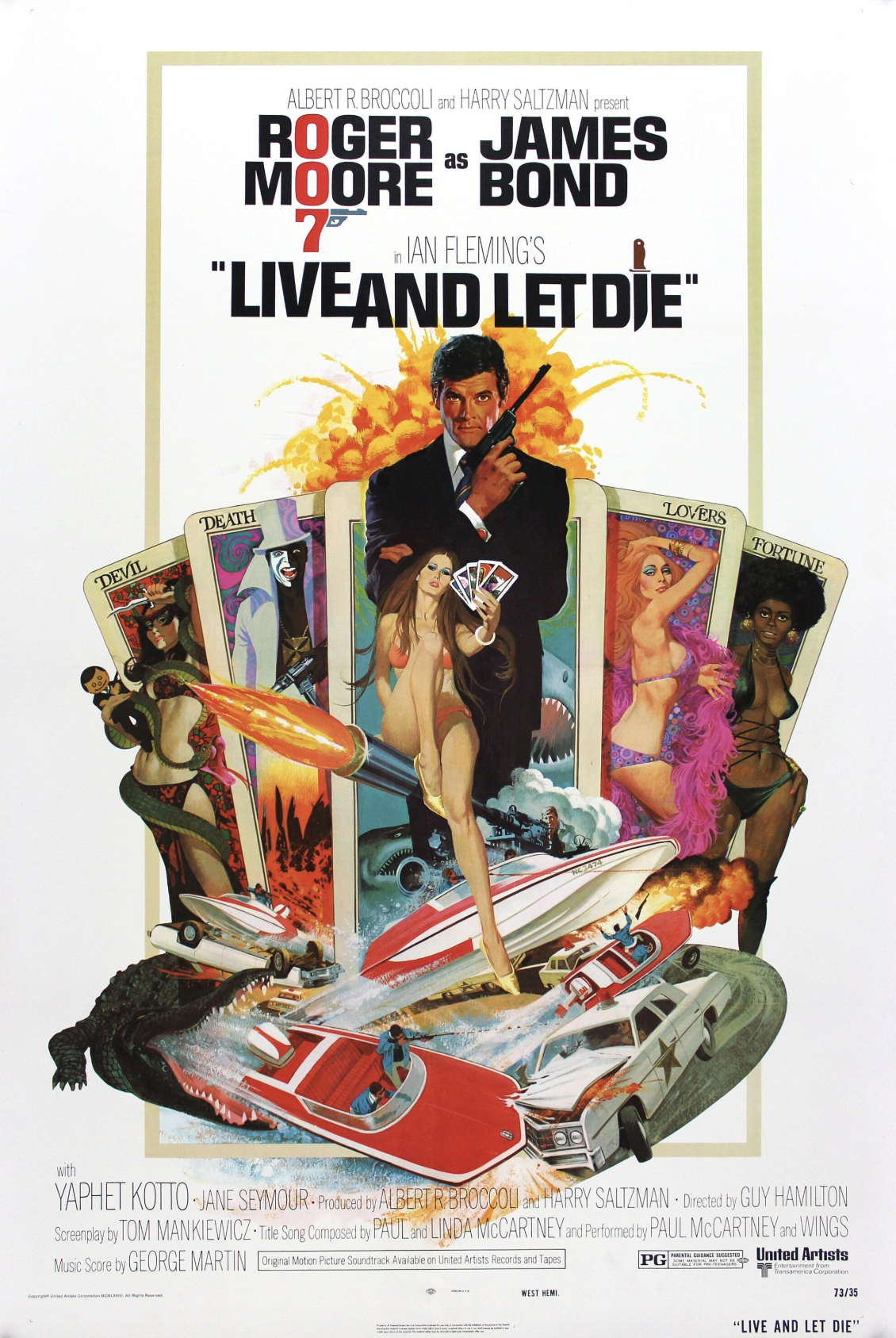
Released on June 27, 1973, and directed by Guy Hamilton for Eon Productions, Live and Let Die is the eighth entry in the official James Bond series and the first to star Roger Moore in the title role, marking one of the most consequential casting transitions in the franchise’s history. The film follows Bond’s investigation into the murders of three British agents, which leads him to Kananga, a Caribbean dictator who operates simultaneously as Mr. Big, a Harlem drug lord, and who is cultivating a vast heroin enterprise intended to flood the American market with free narcotics and destroy his competition. Yaphet Kotto‘s Kananga is among the more genuinely menacing villains of the Moore era, his double identity providing the film with a structural intelligence that its surface of voodoo iconography, Louisiana speedboat chases, and comedy sheriffs does not always suggest. The film’s visual grammar draws heavily on the Blaxploitation cinema that dominated American screens in the early 1970s, a cultural borrowing that the production team deployed with commercial calculation and that contemporary critics received with varying degrees of scepticism. The film grossed over 161 million dollars worldwide, confirming that the Bond franchise retained its commercial vitality after the troubled transition away from Sean Connery, and established Roger Moore’s lighter, more self-consciously ironic approach to the character as a viable alternative to the physical menace of his predecessor. The Paul McCartney and Wings title song became one of the most celebrated in the franchise’s history, its rock instrumentation marking a deliberate departure from the orchestral Bond theme tradition.
Behind the Scenes. Roger Moore’s first day on a Bond set required him to inherit a role that three actors before him had inhabited with varying success, and his decision to play Bond as a man who finds his own predicaments mildly entertaining rather than a creature of barely contained danger was both a conscious creative choice and a pragmatic acknowledgment of what he could and could not bring to the part. The film’s location work in New Orleans and Jamaica gave the production a visual texture of authentic American South and Caribbean that Hamilton’s direction exploited with considerable skill, and the speedboat chase through the Louisiana bayou, orchestrated by second unit director Lamar Boren, remains among the most kinetically accomplished action sequences of the Moore era. Jane Seymour as the psychic Solitaire, whose gift of foresight is contingent on her virginity, was the most discussed Bond woman of the film’s initial release, the character’s narrative function raising questions that the film declines to examine with much seriousness. Clifton James as Sheriff J.W. Pepper was received by contemporary audiences as broadly comic relief and by subsequent critical assessments as a rather more troubling deployment of Southern white authority as buffoonery, his return in the following film suggesting that the production was less conscious of the ambiguity than it might have been.
The Watch. The watch that appears on Roger Moore‘s wrist in certain scenes of Live and Let Die is a Tissot PR-516 Visodate Automatic in its MK1 configuration, and its presence in the film constitutes one of the most remarkable stories of horological invisibility in the history of screen watches. The film is officially associated with two other watches of considerably greater celebrity: the Hamilton Pulsar P2 LED digital watch with which Moore opens the film and whose magnetic functions are demonstrated to M in the briefing scene, and the Rolex Submariner 5513 with its gadget-enhanced rotating bezel that Q subsequently provides as Bond’s operational equipment. For decades, virtually every analysis of the film’s watches began and ended with these two pieces, and the Tissot’s presence went entirely unremarked in the mainstream Bond literature despite being visible in the Bleeker Flying School airport scene and throughout the film’s celebrated speedboat chase sequence, as well as in a substantial body of behind-the-scenes photography from the production. The identification of the Tissot was accomplished by dedicated researchers who had studied the behind-the-scenes material with sufficient attention to notice that Moore was wearing neither the Pulsar nor the Rolex in certain contexts, and who then cross-referenced the visible case architecture and dial configuration with surviving production examples to establish the reference. The PR-516 Visodate Automatic is a Swiss piece introduced in Tissot’s catalog in the late 1960s and produced in multiple configurations including date, day-date, alarm, and chronograph variants across a 36mm stainless steel case with what collectors describe as holey lugs, a bakelite rotating bezel with tritium numerals, and an acrylic crystal. The specific example on Moore’s wrist presents the configuration that has since been named by the collector community the “Roger Moore” variant: a blue-green mirror dial with tritium markers, a matching handset, and a distinctive orange seconds hand whose chromatic eccentricity makes the watch immediately recognizable once one knows what to look for. The movement inside is Tissot’s calibre 786-2 automatic, a reliable Swiss movement of no particular complication, housed in a case fitted to a three-link pseudo-Oyster bracelet that gives the watch an overall silhouette of informal elegance. How the Tissot came to appear on Bond’s wrist remains genuinely unresolved: the most widely credited theory holds that it was Moore’s personal watch, worn during the production and simply not replaced with the official prop watch during certain scenes, a hypothesis supported by the frequency of the Tissot’s appearance in behind-the-scenes photography and by Moore’s documented habit of wearing it well beyond the production period. An alternative theory suggests that the Rolex prop watch was not yet ready when certain scenes were filmed, and the Tissot served as a practical substitute. Tissot themselves have acknowledged the connection, releasing a modern reinterpretation, the PR516 Powermatic 80, in 2024, with a dial configuration designed to evoke the original Roger Moore variant. For collectors, the authentic PR-516 in the blue-green dial configuration has appreciated considerably since its screen identification became widely known, the combination of genuine Swiss automatic quality, a design of considerable period charm, and a Bond provenance that is simultaneously authentic and entirely accidental making it one of the more singular entries in the Bond watch canon.
Details
Brand:
Marketplace Price
€400
Movie Year:
1973
As seen on:
Movie/TV Series: