The Timex Triathlon: the thirty-five-dollar sport watch that Timex took to Hawaii in 1984, sold all fifteen hundred examples before the event ended, and which Tom Selleck wore as an architect turned reluctant father in the highest-grossing American film of 1987.
Leonard Nimoy’s Three Men and a Baby (1987) was the box office phenomenon of its year, a comedy in which three Manhattan bachelors, an architect named Peter Mitchell (Tom Selleck), a cartoonist named Michael Kellam (Steve Guttenberg), and an actor named Jack Holden (Ted Danson), find an infant on their doorstep and discover that no professional achievement, no social confidence, and no quantity of bachelor lifestyle adequately prepares a person for the practical reality of caring for someone who cannot yet communicate anything except distress. The film was adapted from the French original Trois hommes et un couffin (1985) and domesticated it with a drug-smuggling subplot that nobody asked for and three leads with sufficiently easy chemistry to make the comedy work regardless.
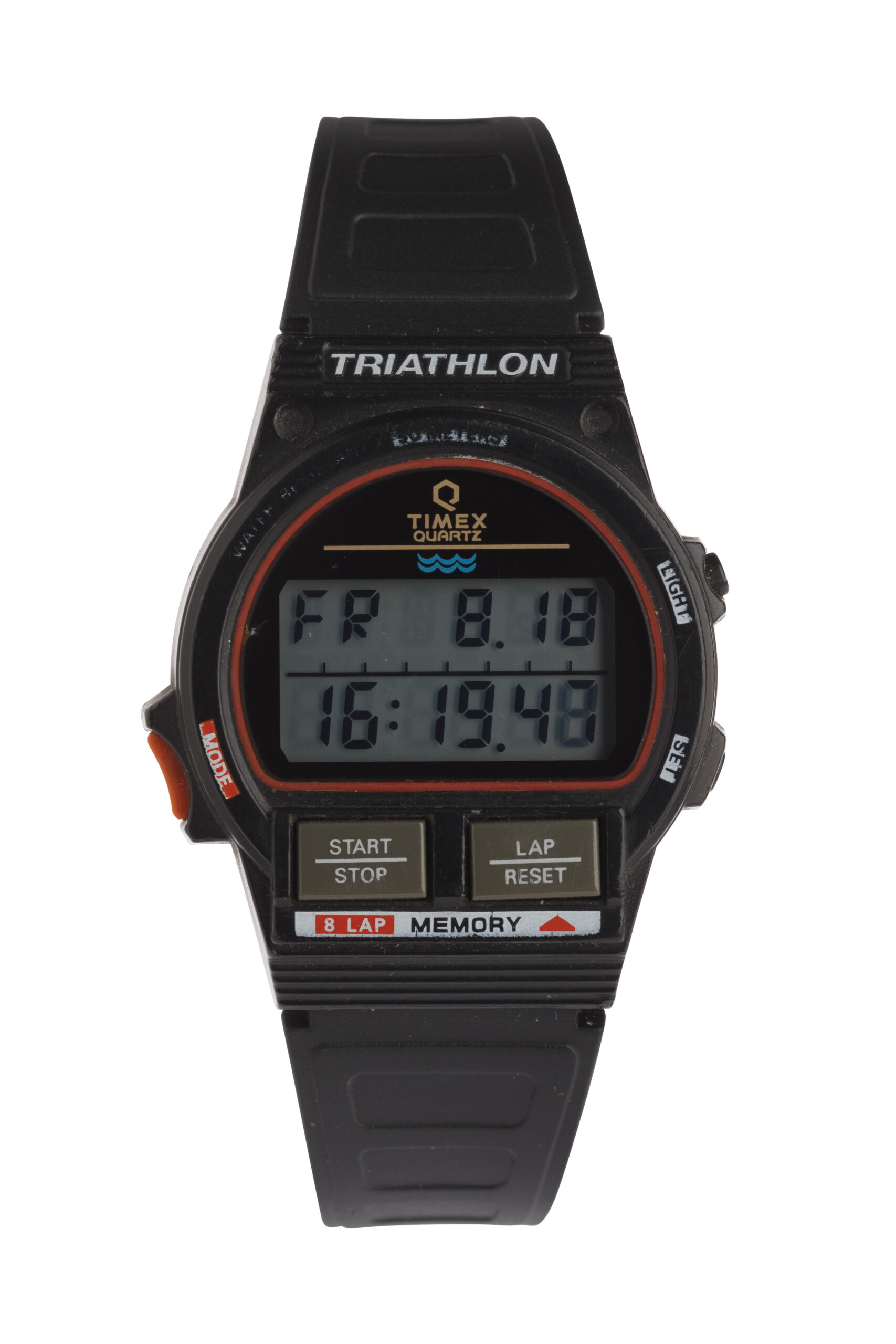
Selleck’s character Peter is an architect, which places him in the category of the 1987 film’s aspirational male: successful, creative, physically capable, fundamentally decent, and demonstrably unequipped for the infant now occupying his immaculate New York loft. The watch on his wrist throughout the film is a Timex Triathlon, a sport digital watch introduced in 1984, priced at $34.95 and designed for the specific demands of endurance athletes competing across three disciplines without stopping to change equipment. Selleck also wore a two-tone Rolex in some scenes and promotional materials, consistent with the architect character’s resources, but the Watchonista’s survey of Selleck’s screen watches confirms the Triathlon as Peter Mitchell’s main on-wrist presence. The combination is its own character note: a man who can afford a Rolex but reaches for a sport watch because he is, fundamentally, a person who does things rather than a person who performs doing things.
Timex, the Triathlon, and the Problem of Survival
The Timex company had been building a reputation for affordable, durable watches since the mid-twentieth century on the back of a sustained advertising campaign that demonstrated their watches withstanding punishment that would destroy most domestic objects. A watch taped to a baseball bat and subjected to batting practice. A watch run through a washing machine. A watch dropped from a building. The tagline was “It takes a licking and keeps on ticking,” and it ran through the 1950s, 1960s, and 1970s as one of American television advertising’s most durable propositions. Timex was not making luxury watches. Timex was making the watch that would still be functioning when the luxury watch had to go in for service.
By the early 1980s, Timex needed to compete with the Japanese digital watch manufacturers who had democratised precision timekeeping in a way that the American and Swiss industries had not anticipated. Casio, in particular, had demonstrated with the F-100 and its successors that a resin-cased digital watch could be made for a price that forced every other watch manufacturer in the world to reconsider their product positioning. Timex’s response was not to compete directly on digital specifications but to find a niche where durability and functionality converged on a specific community of users who needed exactly what Timex could provide.
That community was endurance athletes.
The Hawaii Connection: 1,500 Watches and a Marketing Idea
In 1984, Mario Sabatini, Timex’s product manager for digital watches, took fifteen hundred examples of the newly developed Timex Triathlon to the Ironman Triathlon in Hawaii. The watch had been developed in consultation with world-class runners including Alberto Salazar and Mary Decker Slaney, with input from writers at Runner’s World, and it was designed around the specific functional requirements of triathlon competition: timing three disciplines in sequence, tracking laps, setting alarms for pacing, and surviving the transition between swimming, cycling, and running without complaint.
Sabatini priced the watches at $34.95. All fifteen hundred sold before the event ended. This was, in the compressed logic of sports marketing, all the confirmation Timex needed. The watch had been designed for endurance athletes and endurance athletes wanted it. The company launched a twenty-million-dollar television advertising campaign using the Torture Test format that had worked for decades, demonstrating the Triathlon’s 50-metre water resistance, its shock resistance, and its capacity to continue functioning after treatment that would render a more prestigious watch inoperable.
In 1986, Timex acquired the rights to the Ironman name from the race organisers, and the Triathlon was rebranded and developed into the Timex Ironman Triathlon, with water resistance upgraded to 100 metres, an updated black, orange, and grey colour scheme designed by John T. Houlihan, a former General Motors automotive designer, and the ribbed strap adorned with the Ironman name and three stylised M logos. The pewter-grey case colour of the original was achieved using DuPont automotive paint, inspired by a car parked outside Timex’s office in Cupertino. The Ironman sold more than 400,000 units in its first year and became the best-selling watch in the United States within twelve months of its 1986 release.
When Tom Selleck wore the Triathlon in Three Men and a Baby in 1987, the Ironman had already been in production for a year and the Triathlon it descended from was already the established watch of American endurance sport. The choice of the Triathlon rather than the Ironman for the film is a small continuity of the production timeline: the film was shot in 1986, when the Ironman was new and the Triathlon remained in circulation, and the costume department reached for the watch that was already established as the sport digital of the era.
The Watch as Character Detail
Peter Mitchell the architect is a man who lives physically. His apartment is a loft, spacious and artfully designed, and his daily reality before Mary’s arrival involves sporting activities, social confidence, and the kind of effortless physical competence that Selleck projects without effort. The Timex Triathlon is consistent with this character in a way that a calculator watch would not be and a Rolex Submariner would overcomplicate. It says that its wearer runs, swims, cycles, keeps track of elapsed time in the way that athletes keep track of elapsed time, and does not think of a watch as a status signal. It is the watch of a man who is genuinely active rather than aspirationally so, and it sits on Selleck’s wrist with the matter-of-fact comfort of an object worn because it is useful.
The irony of its appearance in Three Men and a Baby is that the Triathlon’s design philosophy, timing three continuous disciplines without stopping, is precisely not applicable to the situation the film puts its characters in. Parenthood is not triathlon. There are no laps, no transitions, no defined endpoints. The watch that was designed for structured endurance has been placed on the wrist of a man learning, badly and then progressively less badly, to endure the completely unstructured. It keeps ticking regardless.
Clinton, Criticism, and the Watch That Refused to Be Ashamed
The Timex Ironman’s cultural trajectory after its 1986 introduction tracks a specific argument about what kind of person wears what kind of watch. Bill Clinton wore early Ironman models through his time as Governor of Arkansas and in the first years of his presidency, appearing in inaugural photographs with a blue and black Ironman on his wrist and wearing it to his inaugural ball in January 1993. The Washington Post’s Gene Weingarten described it as “a plastic digital watch, thick as a brick, and handsome as a hernia.” Omega ran advertising in 1992 suggesting that Clinton should upgrade. Clinton stopped wearing his Ironman publicly in 1994.
The cultural conversation this provoked, which was whether the leader of the free world should wear a plastic digital sport watch or something more consistent with the dignity of the office, is the same conversation that the Triathlon on Tom Selleck’s wrist in 1987 implicitly addresses. Selleck’s character is a successful architect in a Manhattan loft. He could wear almost anything. He wears a Timex Triathlon. The film does not comment on this. It does not need to. The watch is there, on the wrist of an aspirational 1987 male character, and it looks entirely right.
More on the Timex Triathlon and Ironman history: en.wikipedia.org/wiki/Timex_Ironman and on Selleck’s watch history: watchonista.com/articles/history/unlikely-watch-collector-tom-selleck
Technical note: Timex Triathlon, introduced 1984. Resin case and strap. Quartz digital movement. Functions: time, stopwatch/chronograph with lap memory, countdown timer, alarm, hourly time signal. Water resistance 50 metres. Retail price at introduction $34.95. Designed by John T. Houlihan in collaboration with input from endurance athletes and Runner’s World magazine. Introduced at the 1984 Ironman Triathlon in Kona, Hawaii, where all 1,500 initial examples sold. Preceded the Timex Ironman Triathlon, introduced 1986, which upgraded water resistance to 100 metres, added a black, orange, and grey colour scheme, and carried the licensed Ironman name. Both the Triathlon and the Ironman remained in simultaneous production until 1991. Worn by Tom Selleck as Peter Mitchell in Three Men and a Baby (1987), directed by Leonard Nimoy.
Details
Brand:
Marketplace Price
€250
Movie Year:
1987
As seen on:
Movie/TV Series: