Directed by Martin Brest and produced by Don Simpson and Jerry Bruckheimer for Paramount Pictures, Beverly Hills Cop follows Axel Foley, a fast-talking, street-smart Detroit detective who travels to Beverly Hills — entirely without authorization — to investigate the murder of his best friend, only to find himself entangled in a drug and art smuggling conspiracy run by the charming and ruthless Victor Maitland. Released on December 5, 1984, it became the highest-grossing film of the year in North America, earning over $230 million domestically on a budget of approximately $14 million, and launched one of the most successful action-comedy franchises in Hollywood history. It was nominated for an Academy Award for Best Original Screenplay.
Behind the Scenes. The role of Axel Foley was originally written as a serious, straight-action part intended for Sylvester Stallone. Stallone departed the project roughly two weeks before filming was scheduled to begin and repurposed several of his own script ideas into what became Cobra. In the subsequent scramble, producers turned to Eddie Murphy — who was at the time riding the momentum of 48 Hrs. and Trading Places — and the entire tone of the production shifted almost overnight from hard-boiled thriller to action-comedy. Among the actors previously considered for the role were Al Pacino, James Caan, Mickey Rourke, and Harrison Ford, the last of whom turned it down. Murphy improvised a substantial portion of his dialogue throughout the production, and literally hundreds of takes were abandoned because cast members, crew, and on one occasion the director himself, could not stop laughing. Judge Reinhold, in the scene where Murphy delivers an extended monologue about “super cops,” is visibly struggling to maintain his composure: he is simultaneously pinching his own thigh beneath the frame to keep from breaking. The iconic Mumford High School sweatshirt Murphy wears throughout the film was a tribute by producer Jerry Bruckheimer to his own alma mater, Samuel C. Mumford High School in northwest Detroit; within weeks of the film’s release, the school was flooded with orders for the shirt from around the world. The famous Axel F theme was composed by Harold Faltermeyer on a synthesizer in roughly twenty minutes. He did not expect it to become one of the most recognizable pieces of music in cinema history. Glenn Frey of The Eagles contributed the opening theme The Heat Is On, which he initially declined to write before being played an early cut of the film and changing his mind on the spot.
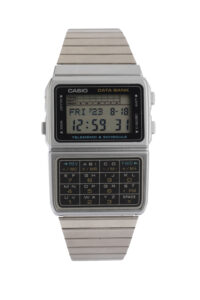
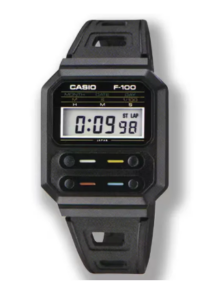
The Watch. The Casio AQ-30W worn by Eddie Murphy as Axel Foley is one of the most perfectly cast watches in cinema history — not for its prestige, but for its complete lack of it. The AQ-30W is an ana-digi quartz watch launched by Casio in 1983, powered by module 305, featuring a round resin case with a black dial divided between a traditional two-hand analogue display in the upper portion and a curved LCD strip at the bottom showing digital time, date, alarm, and stopwatch functions. It retailed for $34.95 — roughly the price of a tank of gasoline in 1984 — and was water-resistant to 50 metres. The watch was sold exclusively in the American market under the designation AQ-30W, while a virtually identical variant labelled AQ-30Q circulated in other regions. It is the quintessential Casio of its era: functional, inexpensive, unpretentious, and quietly ahead of its time in combining analogue legibility with digital versatility in a single slim package. On Axel Foley’s wrist it reads as an extension of the character’s entire philosophy — a man from Detroit who solves problems with his brain rather than his budget, and who has absolutely no interest in impressing anyone with what he wears. The watch has no brand cachet, no heritage story, no celebrity endorsement — and that is precisely why it is right. On the secondary market, surviving examples in good condition are now listed specifically as the Axel Foley watch, with sellers routinely invoking the Beverly Hills Cop connection to justify prices several times what the watch originally cost new.