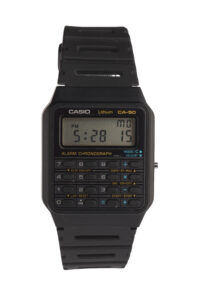
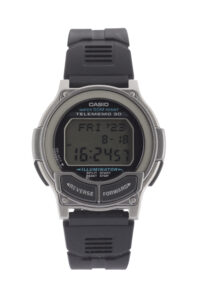
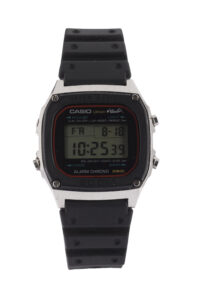
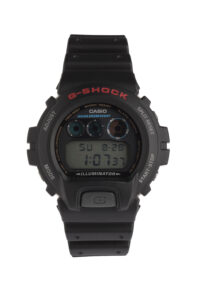
The Casio DBC-610 Databank: the watch that distilled an entire era of technological optimism into a membrane keyboard small enough to fit a wrist, worn by a character who is himself a distillation of human experience into something not quite human
WandaVision, the 1980s, and the Perfect Prop
Matt Shakman’s WandaVision (2021) is, among many other things, an act of extraordinarily precise costume design. The Disney+ series follows Wanda Maximoff (Elizabeth Olsen) and Vision (Paul Bettany) as they live out an existence shaped by the conventions of American sitcoms, decade by decade, each episode advancing the stylistic clock and demanding that every prop, garment, and set detail be credibly anchored to its era. When the series reaches the 1980s in its fifth episode, “On a Very Special Episode…”, the showrunners drew primarily from Family Ties, Growing Pains, and Full House for their visual vocabulary, and the costume department placed a Casio DBC-610 Databank on Vision’s wrist.
The choice is, in its quiet way, flawless. Vision is an android, a being composed entirely of information and the capacity to process it, wearing a watch whose entire identity is built around the storage and retrieval of data. The DBC-610 is a pocket organiser, a calculator, a phonebook, and a clock, all compressed into a 33mm case with a membrane keyboard so small it is almost a joke. On a human wrist it reads as aspirational nerdery. On Vision’s, it reads as something close to self-portraiture: a machine wearing a miniature machine, both of them performing a version of humanity for the benefit of the people around them.
Casio and the Databank Line: A Pocket Computer for the Wrist
Casio introduced the Databank line in the early 1980s as part of a broader ambition to make the wristwatch do things that no wristwatch had previously been asked to do. The company had already established itself as a pioneer of the calculator watch with the earlier Casiotron and Casio calculator models of the 1970s, but the Databank series represented a specific and more ambitious proposition: a personal organiser, genuinely useful, genuinely miniaturised, genuinely wearable.
The DBC-610 arrived in 1985, powered by Casio module 676, and it was the first model in the line to feature the distinctive membrane keyboard that became the visual signature of the entire Databank family. The keyboard sits below the LCD display in a flat, flush arrangement, its tiny keys labelled with letters and numbers that serve double duty for both the calculator and the alphanumeric data entry functions. The case is chrome-plated over resin, approximately 33mm wide, slim, and in the stainless steel bracelet version, the DBC-610, dressed appropriately for an office environment without being conspicuous. A gold-plated variant, the DBC-610G, was available for those whose work required a more elevated presentation.
The functions stored inside that modest shell were genuinely extraordinary for their moment. Up to 50 Telememo records, each carrying nine characters of text and twelve digits of telephone number. A full appointment calendar with 50 entries, each holding 12 characters of description plus date and time. An eight-digit calculator with memory functions. Dual time zones. An alarm. A countdown timer. World time. Password protection for the phonebook, with the stored data erased on failed entry, a feature that sounds like something Q Branch might have specified. In 1985, before smartphones, before personal digital assistants, before any device smaller than a briefcase could store and retrieve this kind of information, the DBC-610 was genuinely transformative. The mid-1990s represented the commercial peak of the Databank concept, when the watches had come down in price and improved in capability but mobile phones capable of storing contacts were not yet ubiquitous. The DBC-610 sat at the beginning of that arc, when the technology was still new enough to seem remarkable.
The Keyboard and the Display: Organised Density
The design of the DBC-610 is a study in the aesthetics of function under severe spatial constraint. The LCD display occupies the upper portion of the face, a three-line layout in which the top line shows appointment flags for the current and coming week alongside symbols for the alarm and hourly chime status. The middle and lower lines handle the primary display of time, date, and mode information. Below the display, the membrane keyboard is arranged in a grid of small rectangular keys, each bearing multiple character assignments accessed through repeated pressing, in the manner of early mobile phone text entry. The keys are essentially impossible to operate with anything other than a fingernail or a stylus, which gives the DBC-610 a quality that is simultaneously impressive and comic: a device of genuine sophistication that demands a very particular kind of patience to use.
The stainless steel bracelet of the DBC-610 is integrated into the case design in a way that gives the whole assembly a visual coherence that the resin-strap DBC-61 sibling lacks. The brushed finish of the bracelet links and the chrome-plated case produce a uniform, understated metallic surface that reads, from any distance, as simply a watch. Only close examination reveals the keyboard and the full density of what is happening below the display.
The 1980s and the Technology of Optimism
The Casio DBC-610 belongs to a very specific cultural moment: the mid-1980s conviction that computing technology, shrinking in cost and size with each passing year, was going to solve problems of organisation and memory that had previously required paper, secretaries, or simply better recall. The Databank watches were consumer objects built from this conviction. They were not marketed at engineers or professionals in the modern sense; they were marketed at anyone who had telephone numbers to remember and appointments to keep, which is to say at everyone. That they also happened to be calculators was, by 1985, almost incidental, so established had Casio’s identity as a calculator watchmaker become.
WandaVision‘s 1980s episode understands this moment with the precision of genuine research. The Casio DBC-610 on Vision’s wrist is not simply a period-correct prop; it is a prop that carries a specific cultural charge, the charge of that decade’s particular relationship with information technology, its optimism about what small machines could do, its delight in the miniaturisation of capability. Vision, a being composed of information processing, wearing the era’s most information-dense civilian wristwatch, is one of those quiet costume decisions that rewards attention without demanding it.
A Modern Object, a Vintage Feeling
The DBC-610 remained in production in updated form for decades, the DBC-611 serving as its direct successor with a simplified keyboard and reduced functionality but essentially the same visual identity. Casio still sells Databank models. The original DBC-610 in good condition, with its membrane keyboard intact and its LCD segments fully legible, is increasingly sought by collectors interested in the history of personal computing as much as in horology proper. It is an object that sits on the boundary between watch and device, belonging fully to neither category, which is precisely what made it remarkable in 1985 and what makes it resonant now.
On Vision’s wrist, that boundary-crossing quality becomes thematic. He is an object that sits on the boundary between machine and person, belonging fully to neither. The watch and the character are, in their quiet way, the same kind of thing.
Technical note: Casio DBC-610 Data Bank Calculator, introduced 1985, module 676. Chrome-plated resin case with stainless steel bracelet, approximately 33mm width, approximately 10mm thickness. Three-line LCD display. Membrane alphanumeric keyboard. Functions: time and date with 12/24-hour option, Telememo phonebook with 50 entries (9 characters text, 12-digit number, password-protected), appointment calendar with 50 entries (12 characters, date and time), eight-digit calculator with memory, dual time zones, world time, countdown timer, alarm, hourly chime, LED backlight. Also available in black resin as DBC-61 and gold-plated as DBC-610G.
Details
Brand:
Marketplace Price
€250
Movie Year:
2021
As seen on:
Movie/TV Series: