The Casio CA-50: the eight-digit calculator worn on a resin strap, a watch that cost about thirty dollars in 1985, appeared on the most recognisable film poster of its decade, and made every teenager who saw it want one before the end credits had finished rolling.
Robert Zemeckis’s Back to the Future opened on July 3, 1985, and became the highest-grossing film of the year in the United States. It tells the story of Marty McFly, a seventeen-year-old from Hill Valley, California, who is accidentally sent back to 1955 in a time machine built from a DeLorean by his friend and mentor Dr. Emmett Brown, and who must then engineer his own parents’ first meeting, ensure his own eventual birth, and find a way to return to 1985 before it is too late. The film is a comedy, a science fiction adventure, a period piece, and a meditation on causality and personal history compressed into one hundred and sixteen minutes, and it is nearly perfect at all of it.
Marty McFly wears a Casio CA-50 calculator watch throughout the film. It is visible on the film’s poster, where Marty stands against the DeLorean and checks the time, his wrist raised, the watch unmistakable in close-up: a rectangular black resin case, a full numerical keypad on the face, and the LCD display showing the time. By the time the film had been in cinemas for a month, the CA-50 had become the most desirable watch in the world for a specific demographic, which was every male between the ages of ten and twenty-five who had seen the film and wanted, in the way that audience members want things they see on screens, to be as cool as Marty McFly.
More on the film: imdb.com/title/tt0088763 and on the trilogy’s watch inventory: en.wikipedia.org/wiki/Casio_CA-53W
What the Watch Was and What It Could Do
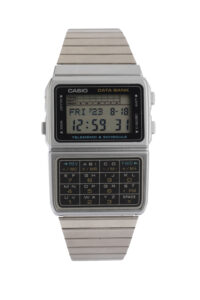
The Casio CA-50 was introduced in approximately 1984 and runs the module 437, a calibre shared with the original CA-53, the CA-55, and the CA-56. It is a resin-cased rectangular watch with a full sixteen-button numerical keypad integrated into the face of the watch, an LCD display at the top of the dial, and side buttons for mode switching and function access. The eight-digit calculator function performs the four basic arithmetic operations: addition, subtraction, multiplication, and division. Beyond the calculator, the module supports timekeeping in 12 and 24-hour format, a chronograph, an alarm, and hourly time signals.
The case and strap are both resin, giving the watch a uniform matte black appearance in its most common configuration, the one worn by Marty McFly. A gold-tone version also existed in production. The watch is light, unobtrusive, and inexpensive, retailing in the mid-1980s for approximately thirty dollars, which placed it within reach of the teenage market at which both the film and the watch were independently aimed.
The CA-50’s primary vulnerability, as generations of collectors have discovered, is the keypad itself. The rubber compound used for the buttons in early 1980s Casio calculator watches is prone to degradation over time, softening into a material collectors have described with uniform distaste. Intact, fully functional CA-50 examples with uncorrupted keypads have become genuinely rare, which is why surviving examples in good condition command prices on the secondary market that would have astonished anyone who paid thirty dollars for the watch new in 1985.
The Calculator Watch and the Problem It Solved
To understand why Marty McFly wore a calculator watch rather than any other kind of watch, it is necessary to understand what a calculator watch was for in 1985. Calculators had been portable since the early 1970s, but they remained separate objects that had to be carried separately from a watch. The integration of a calculator into a wristwatch, first achieved by Pulsar in 1975 at a price of approximately four thousand dollars, placed computational capability on the wrist of anyone who could afford it. By 1980, when Casio introduced the C-80, its first calculator watch, Japanese manufacturing efficiency had reduced that price by two orders of magnitude. By 1984, when the CA-50 was introduced, a fully functional calculator watch cost less than a cinema ticket for a family of four.
The social meaning of the calculator watch in the mid-1980s was specific and charged. It signalled a particular kind of person: someone who valued technology, who was comfortable with numbers, who would rather have a piece of useful hardware on their wrist than a decorative object. In the cultural geography of 1985, this was simultaneously the identifier of the nerd and the aspiration of the forward-thinking teenager. Marty McFly is neither nerd nor nerd-aspirant: he is a guitarist, a skateboarder, a kid who wants to be cool rather than clever. But he carries a calculator on his wrist because in 1985 the calculator watch had crossed the line from specialist tool to mainstream accessory, and because Robert Zemeckis and his costume department understood that the CA-50 read on screen as contemporary, as belonging to the present moment of the film’s setting, without any of the explanatory weight that a more obscure or expensive watch would have required.
The Trilogy’s Continuity and the CA-53W
Back to the Future is the film in which Marty wears the CA-50. The second and third films in the trilogy, Back to the Future Part II (1989) and Back to the Future Part III (1990), show Marty wearing a CA-53W, a model introduced in 1984 and distinguished from the CA-50 primarily by a refinement of the case shape and module layout. Both watches share the module 437, and to any viewer not paying close attention to collector-level detail, the two are indistinguishable. The substitution is the kind of production decision made when the original prop watch is no longer available, or when a production team acquires a replacement that is close but not identical, or when continuity across productions separated by several years is managed by the costume department’s best reasonable approximation.
The distinction matters to collectors and to the fraction of the audience who care about such things, and to the film’s internal logic it matters not at all. What matters is that Marty McFly wears a Casio calculator watch throughout the trilogy, and that the trilogy’s association with that watch has never faded.
The Watch That Never Went Out of Production
The CA-53W, the direct successor to the CA-50 and Marty’s watch in Parts II and III, has been in continuous production since 1984, making it one of the longest-running production watches in the history of the medium. It is sold new today for approximately fifteen dollars, unchanged in any material respect from the version worn on screen in 1985. The Museum of Modern Art in New York has stocked it in its design shop. In October 2025, to mark the fortieth anniversary of the first film, Casio released a limited edition CA-500WEBF-1A, a chrome-plated version with DeLorean-inspired case finish, time circuit-themed display, and a flux capacitor engraved on the case back, sold at approximately a hundred euros and packaged in a VHS cassette-inspired box. It sold out at casio.com within minutes.
The CA-50 that started the whole connection is now a collector’s item. Original examples with intact keypads sell for several hundred dollars. The CA-53W that replaced it in Parts II and III costs fifteen dollars new. Both watches run the same module. The distance between those two price points is the entire distance between what a watch is and what a watch means.
More on the CA-50 and its collector context: digital-watch.com and on the 2025 anniversary edition: casio.com/intl/watches/casio/product.CA-500WEBF-1A
Technical note: Casio CA-50, introduced approximately 1984, Japanese manufacture. Resin case (rectangular), resin strap. Module 437 (shared with CA-53, CA-55, CA-56). LCD display. Eight-digit calculator function: addition, subtraction, multiplication, division. Additional functions: timekeeping in 12 and 24-hour format, chronograph, programmable alarm, hourly time signal. No backlight. Available in black resin and gold-tone variants; black resin is the version worn in Back to the Future. Primary collector vulnerability: rubber keypad degradation over time. Film appearance: Back to the Future (1985), worn by Michael J. Fox as Marty McFly; visible on the film’s theatrical release poster. Succeeded in the trilogy by the CA-53W in Back to the Future Part II (1989) and Back to the Future Part III (1990), the latter sharing module 437 and remaining in continuous production as of 2025.
Details
Brand:
Marketplace Price
€200
Movie Year:
1985
As seen on:
Movie/TV Series: