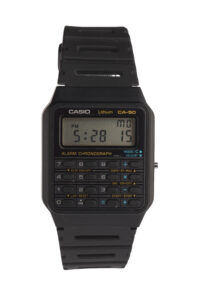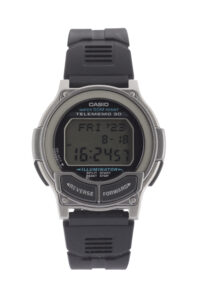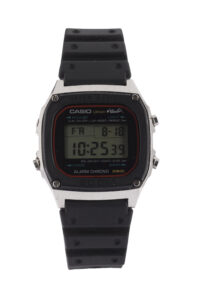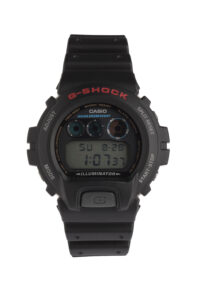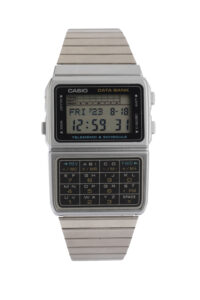


The Casio F-100: the first resin-cased watch ever produced, a thirty-nine-dollar Japanese digital instrument from 1977, and the raw material from which the prop department of Alien assembled the most iconic science fiction wristwatch of its decade, doubling two of them on a single strap with an orange backing plate to create something that looked like nothing available on any market in 1979.
Ridley Scott’s Alien (1979) is a film about the failure of institutional protection, about the indifference of corporate interest to human life, and about the survival instinct of a single woman against an organism designed by evolution, or by something beyond evolution, to be unkillable. It is also, in the specific visual language of its production design, a film about what the future looks like when it has been worn in, when it has accumulated the grime and fatigue and improvised repair of actual use. The Nostromo is not a sleek spacecraft. It is a working vessel, industrial and unglamorous, and the objects the crew carry reflect this: functional, affordable, real.
Ellen Ripley, played by Sigourney Weaver in her breakthrough role, wears a watch throughout the film that could not have been purchased in any shop for more than forty dollars. So does Arthur Dallas, the ship’s captain. So do the other crew members of the Nostromo. On each wrist, the prop department placed a creation of their own: two Casio F-100 watches linked face-to-face, head-to-tail, on a single strap, with an orange or red-tinted flexible backing plate holding them in alignment. The result looked like nothing Casio had ever sold and nothing any other watch manufacturer had produced: a wide, flat, black double-faced instrument that reads on screen as plausibly advanced technology from a century and a half hence, something a commercial deep-space crew member might be issued along with their flight suit and their personal emergency locator.
In the Alien franchise’s expanded canon, the 2014 video game Alien: Isolation retroactively designated this prop the Samani E-125, giving it a brand name, a model number, and a place in the fictional universe’s product catalogue. In the reality of Shepperton Studios in 1978 and 1979, it was two Casio F-100s and a piece of orange plastic.
The F-100: Casio’s First Plastic Watch
The Casio F-100 was introduced in 1977 at a retail price of $39.95 and carries module 52, a calibre shared with its steel-cased sibling the 52QS-14. It is significant in Casio’s history for a reason that has nothing to do with cinema and everything to do with materials science: it is the first watch Casio ever produced with a case made entirely of resin, including the case back, although the interior is steel-coated. Before the F-100, every Casio watch was housed in metal. After the F-100, plastic became the dominant material for affordable digital watches worldwide.
Casio’s own official history describes the F-100 as a watch that “popularized resin cases at a time when metal was the norm” and identifies it explicitly as “a springboard to the design and construction of future Casio timepieces, including the G-SHOCK, whose lightweight, shock-resistant construction was made possible by resin.” The G-Shock arrived in 1983, six years after the F-100, and the line from the F-100’s resin case experiment to the G-Shock’s shock-absorbing outer shell is not metaphorical: one was the material proof of concept for the other. Without the F-100, Kikuo Ibe’s engineer team would not have had the manufacturing infrastructure and material knowledge to pursue the Triple Ten concept, and the G-Shock, which Casio describes as the watch that survived being used as an ice hockey puck in a North American television advertisement, might not exist in the form it does.
The Design: Four Buttons on the Face
The F-100’s most immediately distinctive visual element is the placement of its four function buttons. On virtually every other watch, including later Casio models, the buttons that control modes and functions are positioned on the side of the case, where they can be pressed without obscuring the dial. On the F-100, all four buttons are placed directly on the face of the watch, below the LCD display, in a row, each identified by a different colour rather than a text label. The colours correspond to the watch’s four functions: the coloured buttons controlled, from left to right, setting, the backlight, the calendar display, and the 1/100-second chronograph.
The front-button layout makes the F-100 look, from even a slight distance, like a small control panel or instrument module rather than a wristwatch. This quality is precisely what attracted the prop department of Alien to it. A watch that already looked like science fiction equipment required minimal modification to read as the genuine article. The four coloured buttons have the visual grammar of a device designed to be operated in conditions requiring clear differentiation between functions, without text labels that could be misread in poor light or under stress. In 1977, this was simply a cost-reducing simplification of the labelling problem. On screen in 1979, it became exactly the right aesthetic vocabulary for a commercial deep-space vessel’s standard-issue crew watch.
The 1/100-second chronograph was itself technically notable in 1977. Most mechanical chronographs of the period measured to 1/20 of a second. Some of Casio’s earlier electronic models offered only full-second timing. The module 52’s ability to record elapsed time to one hundredth of a second was, at the price of forty dollars, genuinely unprecedented, and it was advertised prominently in contemporary promotional materials.
Two Watches, One Strap, One Prop
The prop department’s modification of the F-100 for Alien is a piece of film craft that deserves specific attention. The instruction, implicit or explicit, was to make the crew’s watches look futuristic: not alien, not incomprehensible, but sufficiently advanced to suggest a century and a half of technological development while remaining legible as wristwatches. The solution was lateral: take two F-100s, place them face-to-face in opposite orientations so that the double row of coloured buttons forms a central band on the combined object, add an orange or red flexible backing plate to give the assembly a unified form, attach the original resin strap at either end, and put the result on Sigourney Weaver’s wrist.
The combined prop is approximately twice the width of a single F-100, which gives it a presence on the wrist that a single watch would not have. The double row of colour-coded buttons, now reading as a more complex control interface than four simple function switches, suggests a device with multiple simultaneous readouts or modes. The orange backing plate adds a colour accent that reads against the black resin as a deliberate design choice rather than an accidental combination. The prop department did not know that they were creating something that collectors and cosplayers and film historians would study in detail for more than forty years. They were solving a production problem on a limited budget, quickly, with materials available to them in 1978.
The F-100 was discontinued in 1979, the same year Alien was released. Casio’s product planning had no way to anticipate the film’s cultural impact, and the watch was already being phased out as the newer generation of Casio models arrived. The discontinuation turned what had been an affordable mass-market watch into a collector’s item, and original examples in good condition have commanded prices far in excess of that original $39.95 for decades.
The Reissue and What It Confirms
In 2021, Casio released the A100 series as a modern reissue of the F-100, acknowledging the original’s cultural significance directly. The A100 replicates the F-100’s defining visual grammar, including the front-facing button layout and the coloured mode indicators, while upgrading the case material to chrome-plated resin with a metallic appearance, the crystal to acrylic, and the strap options to include stainless steel link bracelets. It retails at approximately fifty-five to seventy-five dollars, maintaining the F-100’s tradition of affordability, and it comes in silver, gunmetal, and gold-tone variants. None of them replicates the all-black positive display of Ripley’s prop exactly, which means that anyone who wants to recreate the Nostromo crew watch still needs to do their own modification.
The reissue is the confirmation of an argument the F-100 has been making implicitly since 1979: that a watch can be historically important for reasons that have nothing to do with its price, its movement, or its materials, and everything to do with the moment in which it appears, the hands that modify it, and the wrist on which it is placed.
More on the F-100’s history and the A100 reissue: silodrome.com/casio-vintage-a100-watch-ripley-watch-alien and on the watch in the franchise’s expanded canon: avp.fandom.com/wiki/Samani_E-125
Technical note: Casio F-100, introduced 1977, discontinued 1979. Resin case and strap (first resin-cased watch in Casio’s production history; steel-coated interior). Module 52 quartz movement. Four colour-coded function buttons on watch face (not on case sides): setting, backlight, calendar display, 1/100-second chronograph with lap function. LCD display. Original retail price $39.95. Film prop configuration: two F-100 units placed face-to-face in opposite orientations on a single resin strap, joined by an orange/red flexible backing plate, creating a double-width wrist instrument. Worn by Sigourney Weaver as Ellen Ripley and Tom Skerritt as Arthur Dallas in Alien (1979). In-universe designation: Samani E-125, as retroactively named in the 2014 video game Alien: Isolation. Modern reissue: Casio A100 series, introduced 2021.
Details
Brand:
Marketplace Price
€600
Movie Year:
1979
As seen on:
Movie/TV Series: