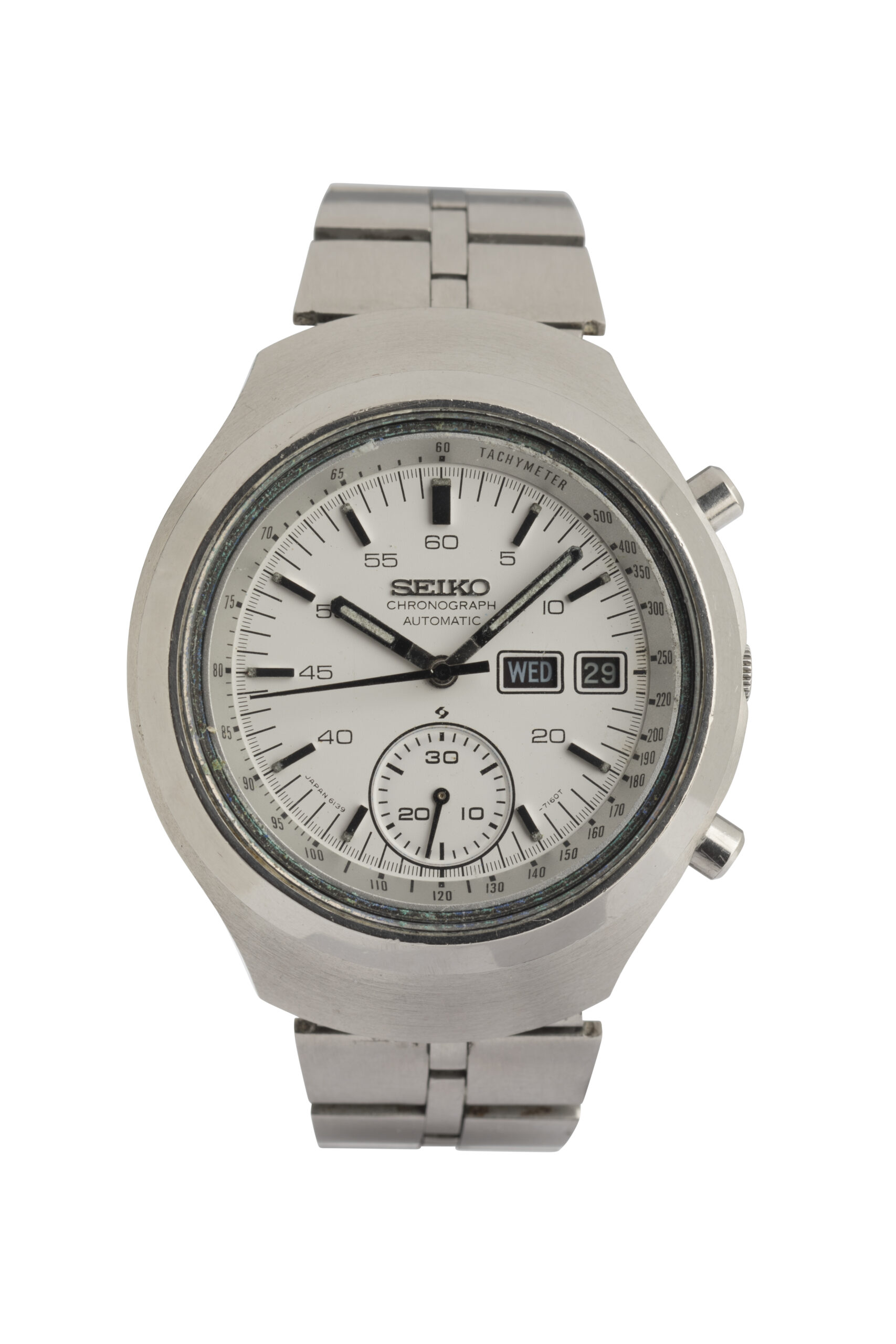
The Seiko 6139-7100 “Helmet”: the Japanese automatic chronograph with a helmet-shaped case and white dial, descendant of the world’s first automatic chronograph, worn by Al Pacino as Formula One racing driver Bobby Deerfield in Sydney Pollack’s eponymous film (1977), in a product placement operation that Seiko built on the precedent of Paul Newman with the Rolex Daytona in Winning and Steve McQueen with the Heuer Monaco in Le Mans
Sydney Pollack’s Bobby Deerfield (1977) is a film that its historical moment did not fully appreciate. Based on Erich Maria Remarque’s novel Der Himmel kennt keine Günstlinge, published in 1961 and known in English as Heaven Has No Favorites, it follows Bobby Deerfield, an accomplished American driver competing on the European Formula One circuit, who witnesses the death of a teammate and the serious injury of a rival in a racing accident. Visiting the survivor in hospital leads him to Lillian Morelli, an eccentric and impulsive Swiss woman racing against time with a terminal illness. He is accustomed to winning and to control; she is the precise opposite. Pacino, embodying the character’s cold calculation with the same physical discipline he brought to Michael Corleone and Serpico, was nominated for a Golden Globe as Best Actor in a Drama Motion Picture.
On Bobby Deerfield’s wrist throughout the film is the Seiko 6139-7100 with white dial. The choice was not accidental. Seiko was one of the film’s corporate sponsors, and according to the collector community’s established oral history, the Japanese company put its catalogue at Pacino’s disposal and allowed him to choose freely, the same strategy that Paul Newman had applied almost inadvertently with the Rolex Daytona in Winning (1969) and that Heuer had pursued deliberately with Steve McQueen in Le Mans (1971). Seiko’s ambition was evident: a Formula One driver on the big screen, an automatic chronograph on the wrist, an actor at the peak of his career. The narrative context was right. The historical moment, as collectors note, was perhaps already a year or two past the prime of the racing movie as a major theatrical genre.
More on the film: imdb.com/title/tt0075774
The Helmet and the White Dial
The 6139-7100 belongs to the “Helmet” variant family of the calibre 6139, named for the shape of the case which evokes the profile of a motorcycle or aviator’s helmet seen from the front: a shape that does not fit comfortably into conventional watch design categories, and which collectors find characterising of the period precisely because of that. The case is stainless steel, approximately 41mm by 49mm lug-to-lug, with a recessed crown set into the side of the case and short lugs. The white dial with an internal tachymeter ring, black hands for hours, minutes, and chronograph, and the day-date aperture at three o’clock: a combination of clear legibility and sporting vocabulary that the 1970s design idiom could render with a formal confidence that reads today as a period marker.
The white dial version is considered the rarest variant within the 6139-7100 family. The Watch Site forum documents an approximate ratio of one white-dial example to every seven or eight black-dial examples on the collector market. Philippine-market examples with white dials have acquired a reputation for being redials over time, and the caution exercised by experienced buyers is proportional to the rarity of the original.
The Calibre 6139 and the Race of 1969
Understanding what Pacino wears requires going back eight years before the film: to 1969, the year in which three competitors raced for the title of the world’s first automatic chronograph, and in which Seiko won that race without almost anyone noticing.
In January 1969, Zenith announced the completion of its El Primero prototype and presented it as the first automatic chronograph. On March 3 of the same year, the Chronomatic group, a consortium formed by Heuer, Breitling, Hamilton-Buren, and Dubois-Dépraz, presented its Calibre 11 at a high-profile event in Geneva and New York. Steve McQueen would wear a Monaco on his wrist in Le Mans two years later, and that race would be discussed for decades. Meanwhile, in Japan, Seiko had completed the design of calibre 6139 in September 1968, begun mass production in October, and put the first examples of the 6139-6000 on sale in the domestic market on May 21, 1969: before the Monaco reached shops, before the El Primero was commercially available.
The calibre 6139 is the world’s first integrated automatic chronograph with a vertical clutch. Not a module stacked on top of an existing automatic movement, as the Calibre 11 was, but a movement conceived from the ground up as a chronograph, with a column wheel, vertical clutch, and automatic winding. The same architecture that Rolex would adopt twenty years later for the calibre 4130 of the Daytona. Seiko did not make much noise about this achievement in 1969, because it had other things to attend to: on December 25 of that year it presented the Astron, the world’s first quartz watch, and that was what would change the world. The priority of the automatic chronograph remained in the shadows for decades.
The calibre 6139 is an automatic movement with 17 jewels oscillating at 21,600 vibrations per hour, with a single-register 30-minute subdial at six o’clock, the magic lever system for winding, and a day-date complication at three. The same calibre carried Colonel William Pogue aboard Skylab in November 1973: he had bought his 6139-6005 for seventy-one dollars at a kiosk on the air base, it was not an official NASA-approved instrument, but he kept it on his left wrist for the entire duration of his stay on the space station.
Seiko, Hollywood, and the Racing Hero Strategy
The logic of Seiko’s product placement in Bobby Deerfield belongs to an established tradition of the preceding decade. Paul Newman had brought the Rolex Daytona to public attention in Winning (1969) without it being a planned marketing decision by Rolex; the story of the “Paul Newman” Daytona is notoriously that of a watch that becomes legend almost incidentally. The Heuer Monaco in Le Mans (1971) was by contrast a deliberate choice by Heuer, through an arrangement with racing patron Jo Siffert, which led to McQueen wearing the square-cased chronograph in front of the cameras.
Seiko in Bobby Deerfield pursued a variant of that strategy with a different instrument: an actor who was in 1977 among the most respected of his generation, a film set in the world of European motorsport, and the freedom of choice offered to the lead. The result was a watch that never became legend with the same force as Newman’s Daytona or McQueen’s Monaco, for reasons that collectors attribute in part to the historical moment and in part to the nature of the film itself. Bobby Deerfield was not a commercial success, and the romantic narrative at its center left less room than Le Mans for the overlap between the character’s identity and that of the watch. But the 6139-7100 remains documented, identifiable, and in the collector market carries the film’s name as part of its standard denomination.
More on the 6139 and its history: chrono24.com/magazine/the-legend-of-the-seiko-6139 and on the priority of the automatic chronograph: plus9time.com/blog/2019/3/14/50th-anniversary-first-auto-chronograph
Technical note: Seiko 6139-7100, “Helmet” variant with white dial. Stainless steel case, approximately 41mm x 49mm lug-to-lug, recessed crown. White dial with internal tachymeter ring, sword hands with chronograph hand, day-date aperture at 3 o’clock. Calibre 6139B, automatic bidirectional winding, 17 jewels, magic lever system, vertical clutch, column wheel, single-register chronograph 30 minutes at 6 o’clock, 21,600 vph. The calibre 6139 is the world’s first integrated automatic chronograph, commercially available in Japan from May 21, 1969. The 6139 family was produced from 1969 to 1978. The white-dial variant is considerably rarer than the black-dial version. Worn by Al Pacino as Bobby Deerfield in Bobby Deerfield (1977), directed by Sydney Pollack, based on the novel Der Himmel kennt keine Günstlinge by Erich Maria Remarque (1961). Seiko was a corporate sponsor of the film.
Details
Brand:
Marketplace Price
€800
Movie Year:
1977
As seen on:
Movie/TV Series: