
Released on June 6, 1983, and directed by John Glen for Eon Productions, Octopussy is the thirteenth entry in the official James Bond series and the sixth to star Roger Moore in the title role, making it the film in which Moore’s tenure as the character reached its greatest numerical extension and in which the question of the actor’s age relative to the role’s physical demands became most visibly pressing. The film arrived in a year of unusual franchise significance: it opened in direct competition with Never Say Never Again, the unofficial Bond production starring Sean Connery in an unauthorized remake of Thunderball that represented the most direct commercial challenge the Eon series had faced since its inception, and the box office contest between the two films — which Eon’s production won comfortably, grossing over 187 million dollars worldwide against its competitor’s 160 million — was read within the industry as a definitive confirmation of the official franchise’s institutional durability over the residual appeal of its original star. The plot deploys a Fabergé egg as its initiating MacGuffin, tracing a conspiracy involving a exiled Afghan prince, a Soviet general pursuing unauthorized nuclear brinksmanship in Western Europe, and the titular Octopussy — a jewel smuggler and circus proprietor played by Maud Adams, returning to the franchise after a previous appearance as Andrea Anders in The Man with the Golden Gun — whose organization Bond infiltrates and whose allegiance he eventually redirects against the film’s primary villain. Glen’s direction maintains the kinetic efficiency that had distinguished For Your Eyes Only while accommodating a tonal register of considerably broader comedy, including a jungle chase sequence involving a tiger, a chase through an Indian market conducted on the outside of a tuk-tuk, and a climactic sequence in which Bond defuses a nuclear device while dressed as a circus clown — a moment that has attracted more retrospective critical attention than almost any other in the Moore era as an illustration of the franchise’s increasing difficulty in locating a coherent register.
Behind the Scenes. Roger Moore was fifty-five years old during the filming of Octopussy, a fact that the production was acutely conscious of and that manifested in casting and scripting decisions designed to manage the visual evidence of the age differential between the actor and his co-stars. Maud Adams, at thirty-eight the oldest principal Bond woman of the Moore era, was selected in part because her maturity provided a more plausible romantic counterpart than the younger actresses who had populated the preceding films, though the differential remained considerable. The Indian location work, shot primarily in Udaipur at the Lake Palace Hotel and surrounding locations, gave the film a visual richness and exoticism that Glen’s second unit exploited with considerable skill, and the palace sequences represent some of the most atmospherically successful location photography in the Moore era. Louis Jourdan’s Kamal Khan, the primary villain, was received as one of the more convincingly menacing antagonists of Moore’s run — a cultivated, cold-blooded operator whose elegance provided a genuine counterpoint to Bond’s rather than a comic-book approximation of evil. The pre-title sequence, depicting Bond in a Central American country destroying a military installation before escaping in a miniature Acrostar jet concealed in a horse trailer, is among the most purely enjoyable of the Moore era’s cold opens, its combination of practical stunt work and light comic timing exemplifying the franchise at its most professionally self-aware.
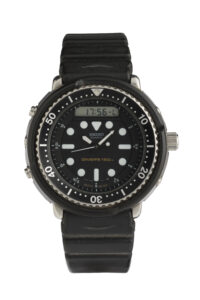
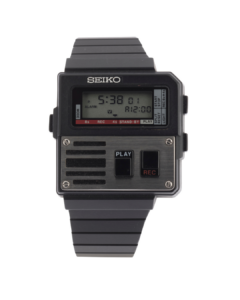
The Watch. The watch worn by Roger Moore as James Bond in Octopussy is a Seiko reference G757-5020, a sophisticated analog-digital sports watch from the Japanese manufacturer’s upper-tier production of the early 1980s that represents the final appearance of Seiko on Bond’s wrist before the franchise’s transition to the Lassale sub-brand in the same film’s later sequences and, more consequentially, its eventual permanent realignment with Omega from GoldenEye onward. The G757-5020 is a piece of considerable technical ambition for its moment: housed in a angular, multi-faceted stainless steel case of the kind that Japanese manufacturers were producing with particular confidence in the early 1980s, it combines an analog time display with a digital module offering chronograph, alarm, and countdown timer functions, the two display systems integrated into a single dial architecture with a visual complexity that reads as purposeful rather than cluttered. The case’s profile — deeply sculpted flanks, pronounced crown guards, and a broad bezel carrying tachymeter markings — gives the reference an aggressive physical presence on the wrist that the film’s gadget deployment exploits with characteristic Bond ingenuity: the G757-5020 is equipped in the film’s fiction with a television receiver capable of displaying images transmitted from a miniature camera, the watch’s analog and digital display architecture providing a visual plausibility for the gadget application that a simpler piece could not have sustained. The placement of a functioning television receiver in a wristwatch was, in 1983, sufficiently close to the frontier of consumer electronics possibility to register with audiences as ambitious extrapolation rather than pure fantasy — Seiko had been pushing the boundaries of watch-integrated technology throughout the late 1970s and early 1980s with its computer peripheral watch program, and the G757-5020’s gadget role in Octopussy was entirely consistent with the brand’s public identity as a manufacturer for whom the watch as technological platform rather than merely timekeeping instrument was a genuine commercial ambition. The reference marks, in retrospect, the end of an era in the Bond-Seiko relationship: the association that had begun with the 7549 in The Spy Who Loved Me and continued through Moonraker, For Your Eyes Only, and into Octopussy represented a decade of Japanese watchmaking at the center of the world’s most visible watch placement, a positioning whose cultural consequences for Seiko’s international brand recognition were substantial and whose conclusion — when Omega assumed the franchise relationship twelve years later — left the Seiko Bond pieces as historical artifacts of a specific and unrepeatable moment in both franchises’ histories. Among collectors, the G757-5020 benefits from a confluence of desirability factors that its original retail positioning as a mass-market sports watch did not anticipate: the Bond association, the genuine technical interest of its analog-digital architecture, and the broader rehabilitation of early 1980s Japanese sports watch design within the vintage collecting community have combined to make well-preserved examples with intact bezels, functioning digital modules, and original bracelets considerably more difficult to locate and considerably more expensive to acquire than the watch’s production volume would suggest.
Details
Brand:
Marketplace Price
€800
Movie Year:
1983
As seen on:
Movie/TV Series: