
The Seiko M354 Memory-Bank Calendar: a Japanese LCD watch at the epicentre of the quartz revolution, and the device that Roger Moore used to blow up a space launch platform
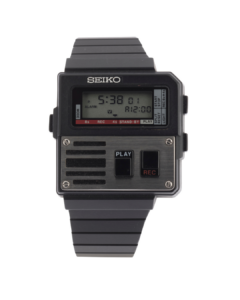
In Lewis Gilbert’s Moonraker (1979), James Bond is sent to investigate a hijacked space shuttle and ends up confronting a billionaire eugenicist orbiting Earth with a hand-picked master race. It is the most extravagant, gravity-defying entry in the Roger Moore era, and the watch is equal to the moment. The Seiko M354-5019 Memory-Bank Calendar sits on Moore’s wrist throughout the film and earns its keep in the sequence on the Moonraker launch platform, where Bond, captured alongside CIA agent Holly Goodhead, opens the case back to reveal a concealed explosive. He detonates it, escapes, and saves the world. The watch gets a close-up that the film’s cinematographer clearly enjoyed: LCD display frozen at 10:08:20 on Wednesday 2 December, the exact time and date printed in the Seiko M354 user manual — a detail that speaks to how precisely the prop department staged its moment.
The M354 is not the only Seiko Bond wears in the film. Seiko was a formal partner of the Moonraker production, its logo visible on a Rio de Janeiro roadside billboard, and promotional campaigns ran featuring Roger Moore himself. It was a commercial arrangement that reflected something real: in 1979, Seiko was not a concession to popular taste but a statement about where watchmaking was going.
Roger Moore’s Seikos: A Partnership Born of the Quartz Revolution
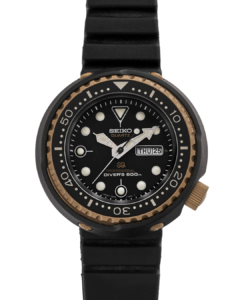
When Roger Moore took over the role of Bond in Live and Let Die (1973), the watch world was in upheaval. Japanese quartz movements — accurate, inexpensive, and requiring no winding — were dismantling the economic foundations of Swiss mechanical horology in what the industry called, with understandable dread, the quartz crisis. Moore’s Bond registered this shift with unusual fidelity. After opening Live and Let Die with a Hamilton Pulsar LED on his wrist, the most futuristic object then available to a consumer, he pivoted to Seiko from The Spy Who Loved Me (1977) onward and stayed there for the remainder of his eight-film tenure, wearing a different Seiko model in every subsequent outing: the 0674 LC in The Spy Who Loved Me, the M354 in Moonraker, the Golden Tuna diver and the H357 Duo Display in For Your Eyes Only, the television-screen-equipped TV Watch in Octopussy, and three separate Seikos in A View to a Kill.
The partnership was explicit and commercially significant. Bond had spent fifteen years as Rolex’s most visible ambassador, Connery’s Submariner inseparable from the character’s identity. Moore’s pivot to Seiko was a cultural declaration: the future of timekeeping was Japanese, it was electronic, and it was something that Q Branch’s imaginary gadget department could plausibly modify into a weapon. This was not incidental. The Roger Moore era is the period in which Bond’s watch first became an active instrument — something that did things rather than merely measuring time. The Seiko partnership made that possible because the watches themselves were already doing things that mechanical watches could not.
The M354: Memory Bank at the Dawn of Digital
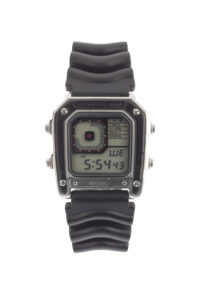
The M354-5019 was introduced in 1978, at the height of consumer appetite for LCD digital watches, and it represented a specific tier of Seiko’s ambitions for the category. Its name was not marketing language: the Memory-Bank Calendar function was a genuine technological achievement for a wristwatch of the era. The watch could store telephone numbers and calendar data, recallable via a miniaturised digital interface — a proposition that in 1978 occupied the border between watch and computer. The case is steel, square-cornered and compact, its face dominated by an LCD display that presents time, date, and stored data in the segmented numerals that defined the visual language of the era. Seiko offered the M354 in silver-tone and gold-tone variants; the Bond film uses the silver version.
What makes the M354 interesting beyond its Bond association is what it represents in Seiko’s own history. By the late 1970s, Seiko had been at the forefront of the quartz revolution for a decade: the company had introduced the first quartz wristwatch commercially available, the Seiko Astron, on Christmas Day 1969, and had subsequently driven LCD technology forward by abandoning the energy-hungry Dynamic Scattering Mode displays in favour of the more efficient Field Effect Mode, producing watches that were both accurate and practical for daily wear. The M354 sits at the mid-point of this trajectory — no longer a novelty, not yet the mass-market commodity that quartz would become in the 1980s, but a genuinely sophisticated object at a genuinely accessible price. Q Branch, in the film’s logic, merely adds the explosive.
The Gadget as Character
The M354’s role in Moonraker is worth examining on its own terms, because it illuminates something about how the Roger Moore films used technology. Connery’s Bond trusted his instincts and his training; his watch told the time. Moore’s Bond operated in a world where the equipment was as important as the man, where Q’s laboratory was as much a source of narrative excitement as any villain’s lair, and where a wristwatch that stored telephone numbers could, with minor modification, destroy a launch platform. The M354 is the right watch for that Bond: precise, modern, carrying more information than it appears to, and capable, when necessary, of doing something unexpected.
The close-up of that frozen LCD display — 10:08:20, Wednesday 2 December, identical to the manual — is one of cinema’s minor horological jokes: a prop that is simultaneously a real object and an advertisement, a gadget that in its screen life demonstrates capabilities its manufacturer could only hint at in print. The watch works, even when it isn’t working.
For collectors today, the M354-5019 in the silver-tone version and good working condition is genuinely rare. The LCD technology that made it cutting-edge also makes it vulnerable to age: displays fail, seals degrade, batteries leak. An example with a functioning screen and intact bracelet is worth seeking out — not only for the Bond association but as a physical record of the precise moment when Japanese precision engineering convinced the world that the future of the wristwatch was electric.
Technical note: Seiko M354-5019 Memory-Bank Calendar, reference SFX003 — Steel case, square profile, approximately 34mm; LCD digital display showing hours, minutes, seconds, date, day and stored memory data; Memory-Bank function for telephone numbers and calendar entries; quartz movement; mineral crystal; stainless steel bracelet (note: the film prop uses a non-standard two-part bracelet differing from the retail deployment-clasp version). Available in silver-tone (M354-5019, as worn in Moonraker) and gold-tone variants. Introduced 1978.
Details
Brand:
Marketplace Price
€500
Movie Year:
1979
As seen on:
Movie/TV Series: