
Released on June 8, 1984, and directed by Ivan Reitman for Columbia Pictures, Ghostbusters is an American supernatural comedy film starring Bill Murray, Dan Aykroyd, Sigourney Weaver, Harold Ramis, and Ernie Hudson. Written by Aykroyd and Ramis, the film follows three disgraced parapsychology professors — Peter Venkman, Egon Spengler, and Ray Stantz — who establish a ghost-catching business in New York City, are joined by a fourth operative, Winston Zeddemore, and find themselves confronting a Sumerian demigod of destruction whose manifestation in the physical world threatens the city with apocalyptic consequence. The film’s achievement is one of sustained tonal precision: it operates simultaneously as a special effects spectacle, a workplace comedy, a New York location film, and a genuinely unsettling horror construction — the library ghost, the hotel corridor sequence, and the final Zuul possession are shot and cut with a craft that would be unremarkable in a straight horror film but are remarkable in a comedy — without any of these registers disrupting the others. It was the highest-grossing film of 1984 in the United States, earning over 295 million dollars domestically against a production budget of approximately 30 million, and its cultural penetration was immediate and total: the logo, the theme song, the Ecto-1, the proton pack, and the Slimer became embedded in popular culture with a speed and completeness that only a small number of films in any decade achieve. The franchise it generated — a sequel in 1989, an animated television series, a reboot in 2016, and a legacy continuation in 2021 — has sustained the original film’s cultural presence across four decades without diminishing the particular quality of the 1984 original, which retains a freshness and specificity that its successors have variously honored and failed to replicate.
Behind the Scenes. The film’s genesis lay in Dan Aykroyd’s longstanding personal interest in parapsychology — his family had a documented history of involvement in spiritualist research — and an original screenplay concept of considerably larger and more expensive ambition that Ramis substantially restructured into a producible form, relocating the action from a future universe of multiple dimensions to contemporary New York and reducing the scope of the ghost-catching operation from an interplanetary enterprise to a small business. Bill Murray’s casting as Venkman was not inevitable: John Belushi had been Aykroyd’s original conception of the character, and his death in 1982 required a reconfiguration of the project’s central dynamic. Murray’s improvisational authority over his own dialogue was extensive enough that significant portions of Venkman’s dialogue in the finished film depart substantially from the written screenplay, and the character’s particular quality of detached, ironic engagement with events of increasing supernatural implausibility is as much Murray’s invention as Aykroyd and Ramis’s. Harold Ramis’s Egon Spengler, constructed around a performance of deadpan technical absorption, became one of the most beloved comic supporting characters in American film of the decade, and Ramis’s death in 2014 lent the legacy sequel Ghostbusters: Afterlife an emotional dimension that its filmmakers — including Ramis’s son-in-law Jason Reitman — handled with a sincerity that the film’s reception confirmed had genuine popular resonance. The practical effects work, supervised by Richard Edlund, represented a significant technical achievement in the pre-digital era, and the proton pack designs, realized as functional-looking practical props of considerable physical weight that the cast wore throughout filming, contributed materially to the grounded credibility of the film’s central conceit.
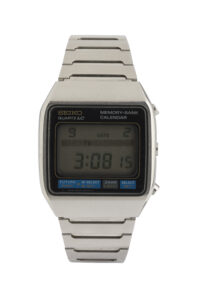
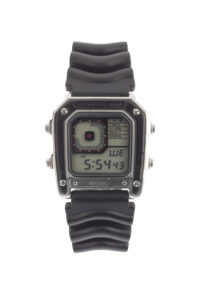
The Watch. The watch worn by Bill Murray as Dr. Peter Venkman throughout Ghostbusters is a Seiko M516, a LCD digital watch from the Japanese manufacturer’s early 1980s upper-tier digital production that represents Seiko at its most ambitious and peculiar in the consumer electronics space. The M516 belongs to Seiko’s computer peripheral watch program of the early 1980s — a remarkable and now largely forgotten chapter in the history of wearable technology in which Seiko produced a series of watches capable of receiving and displaying data transmitted from a compatible home computer, in this case the Seiko UC-2000 wrist terminal system. The M516 is the data storage and display module of this system: a rectangular LCD watch of conventional wristwatch dimensions that can receive alphanumeric data downloaded from a computer via a dedicated docking cradle and store it for subsequent retrieval on the wrist, functioning as a proto-smartwatch of genuine conceptual ambition at a moment when the personal computer itself was barely a decade old as a consumer product. The case is a slim, angular rectangular construction in brushed stainless steel, the LCD display presenting time, date, and stored data across a dot-matrix screen of modest but functional resolution, the overall aesthetic occupying the intersection of professional instrument and science fiction prop that characterized the most forward-looking Japanese consumer electronics design of the early 1980s. Its appearance on Venkman’s wrist is, like the Baylor on Peppard and the Lancet in Pulp Fiction, apparently unsponsored — a wardrobe choice whose logic is entirely consistent with the character’s construction as a scientist of genuine technical curiosity operating at the boundary between established academia and entrepreneurial improvisation. The M516’s data capabilities would have been understood by a small but technologically literate fraction of the 1984 audience, most viewers registering it simply as an unusually purposeful digital watch of the kind that a parapsychologist running a small business in contemporary New York might plausibly own. Its identification as the specific Seiko computer watch reference was accomplished, as with many screen watch discoveries, by dedicated researchers cross-referencing frame captures with surviving product documentation and collector examples, and the watch has since acquired a collector following that draws on three distinct communities — vintage Seiko enthusiasts, early wearable technology historians, and screen-used prop researchers — whose overlapping interest has driven prices for functional examples, particularly those retaining their original docking cradle and data transfer cable, to levels that would have astonished anyone who encountered one new in a Japanese electronics retailer in 1982.
Details
Brand:
Marketplace Price
€1 800
Movie Year:
1984
As seen on:
Movie/TV Series: