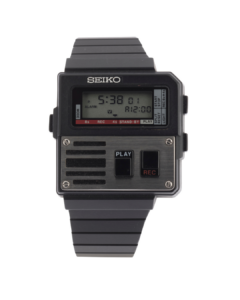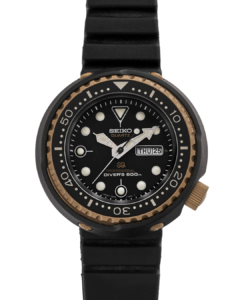

The Seiko H558-5000 “Arnie”: the world’s first ana-digi dive chronograph, a watch that climbed Everest and visited both Poles, and the timepiece that Arnold Schwarzenegger wore through the jungle of the most relentless action film of 1987.
John McTiernan’s Predator (1987) is built on a single escalating premise: a team of elite special forces operatives deployed to a Central American jungle to extract hostages, who discover they are themselves being hunted by something they cannot explain or outgun. At the centre of it is Major Alan “Dutch” Schaefer, played by Arnold Schwarzenegger at the apex of his physical and commercial power, and on Dutch’s wrist, visible in several scenes against the backdrop of mud, canopy, and thermal imaging, is a Seiko H558-5000. It is not a subtle watch. On most wrists it is a substantial object. On Schwarzenegger’s, it reads as proportionate, which tells you something about both the man and the watch.
Predator was not the first film in which the H558 appeared. Schwarzenegger had worn it in Commando (1985) and Raw Deal (1986), and would wear it again in The Running Man (1987) and Twins (1988). The consistency suggests personal preference rather than prop department allocation. Schwarzenegger was, and remains, a serious watch collector, and the H558 appears to have been a genuine favourite rather than a costume decision imposed from outside. The watch earned its nickname, “the Arnie,” not through any single iconic scene but through sheer accumulation across five films over three years, during which Schwarzenegger was the biggest box-office draw on the planet.
The H558: Firsts, Records, and the Tuna Family
The Seiko H558-5000 was introduced in 1982 and discontinued around 1990, an eight-year production run that was, by any standard, historically productive. At its launch it claimed a specific and verifiable distinction: it was the world’s first hybrid dive watch with an analogue-digital display incorporating both a chronograph and an alarm. The ana-digi format, combining traditional swept hands on a conventional dial with a digital LCD readout, was not unique to Seiko in 1982, but no one else had put it inside a rated dive case with this level of complication. The H558 is a genuine technical first in the history of wristwatches.
The watch belongs to Seiko’s Tuna family, the line of dive watches that the Japanese manufacturer had been developing since the 1970s and that took their nickname from the distinctive shape of the monocoque case shroud. Where the original Tuna was a pure professional diver in the tool-watch tradition, the H558 applied the same basic architecture to a more complex brief: a watch that could function as a dive instrument and as an everyday multi-function timepiece, managing time zones, alarms, and elapsed time with equal competence. The case measures 45mm in diameter, sits approximately 11.3mm off the wrist, and is constructed from stainless steel encased in a protective plastic shroud that absorbs shock and impact. Water resistance is rated to 150 metres. The unidirectional ratcheting bezel and screw-down crown complete the dive credentials.
Seiko’s engineers tested the H558 across a temperature range from -40°C to +60°C, and the watch subsequently proved its credentials in the field: examples accompanied expeditions to Mount Everest and to both the North and South Poles. In Japan the retail price was 45,000 yen, making it a serious investment in 1982, positioned at the upper end of what a working professional might spend on a wristwatch.
The Dial: Two Technologies, One Face
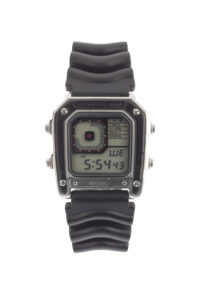
The H558 dial is an exercise in organised density. The analogue section occupies the upper portion, with broad sword-style minute and hour hands and a seconds hand on a conventional chapter ring. Below this sits the LCD display, presenting digital time, date, and function data in the segmented numerals of the era. The relationship between the two display modes is entirely practical: the analogue hands give an immediate time reading at a glance, while the digital section handles the chronograph, alarm, calendar, and GMT functions that would be illegible on a traditional dial. The two technologies are not competing but complementing, each doing what it does best.
The JDM version, reference H558-5000, carries the inscription “Water 150M Resist” on the dial. The export variant reads “Diver’s 150M” and exists in both yellow and, more rarely, orange-red text, the latter being the version most closely associated with the film prop. The Hardlex mineral crystal sits flush with the dial plane, protected by the case shroud on three sides, giving the watch a bunker-like visual solidity that is, on a Dutch-in-the-jungle wrist, almost comically appropriate.
The Quartz Movement: H558 Caliber
The movement inside the H558 is the Seiko caliber H558, a quartz module purpose-built for the watch’s multi-function requirements. It manages three time zones simultaneously, drives the chronograph to standard precision, triggers the alarm, and maintains the perpetual calendar, all from a single button-cell battery. Regulation is straightforward; setting is achieved through a combination of crown positions and pushers. The movement was designed for robustness rather than for horological display and does not offer the transparency of the Valjoux 72 or the mechanical romance of a column wheel, but it does what it was designed to do with exceptional reliability, which is why examples purchased new in 1986 are still running today with nothing more than a battery change.
Roger Moore Wore One Too
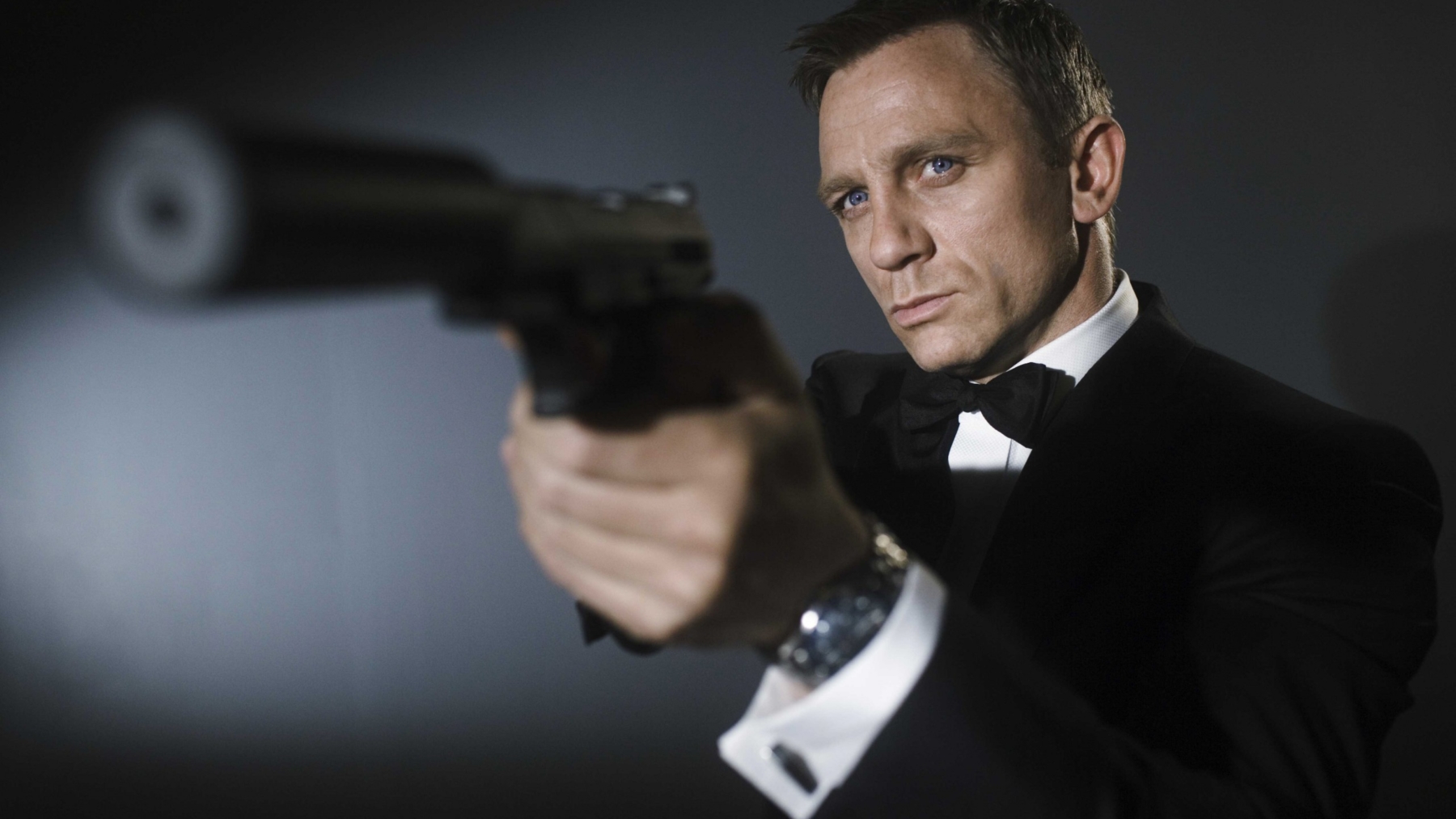
The H558 has a Bond connection that is often overlooked in the shadow of the Schwarzenegger association. Roger Moore wore the H558-5000 in A View to a Kill (1985), during the Eiffel Tower chase sequence, making it the only watch to have appeared on both the wrist of James Bond and the wrist of Arnold Schwarzenegger within the same calendar year. The overlap is a small historical footnote but a satisfying one: two of the era’s defining action archetypes, one ironic and tailored, the other massive and direct, unified by a Japanese quartz ana-digi diver from Suwa.
The Nickname and the Legacy
The name “Arnie” attached itself to the H558 through the specific mechanism of cultural saturation. In 1985, 1986, and 1987, Schwarzenegger released four major films in rapid succession, each one enormous at the box office, each one featuring the same watch on the same wrist doing the same implausible things. Fans noticed, collectors took note, and the nickname fixed itself permanently to the reference number. When Seiko discontinued the H558 in 1990, the watch passed immediately into collector mythology.
In 2019, Seiko revived the design under its Prospex line as the SNJ025 Solar, a solar-powered recreation with a 200-metre rating and a fully automatic calendar accurate to 2100, carrying the Arnie name as an explicit acknowledgment of the original’s cultural position. The reissue is a capable modern watch. The original, in good working condition with intact shroud and legible LCD segments, is something else: a physical object from the moment when Japanese precision and Hollywood excess found each other in the jungle, and the resulting combination turned out to be exactly right.
Technical note: Seiko H558-5000 “Arnie”, introduced 1982, discontinued circa 1990. Stainless steel case with protective plastic shroud, 45mm diameter, 46.5mm lug to lug, 11.3mm thickness. Analogue-digital display with swept hands and LCD readout. Seiko caliber H558 quartz movement. Functions: hours, minutes, seconds (analogue), digital time, GMT second time zone, third time zone, chronograph, alarm, calendar. Unidirectional ratcheting bezel. Screw-down crown. Hardlex crystal. Water resistance 150 metres. Rubber strap, reference GL831. JDM variant (H558-5000) reads “Water 150M Resist”, export variant (H558-5009) reads “Diver’s 150M”. Reissued 2019 as Seiko Prospex SNJ025 Solar.
Details
Brand:
Marketplace Price
€800
Movie Year:
1987
As seen on:
Movie/TV Series: