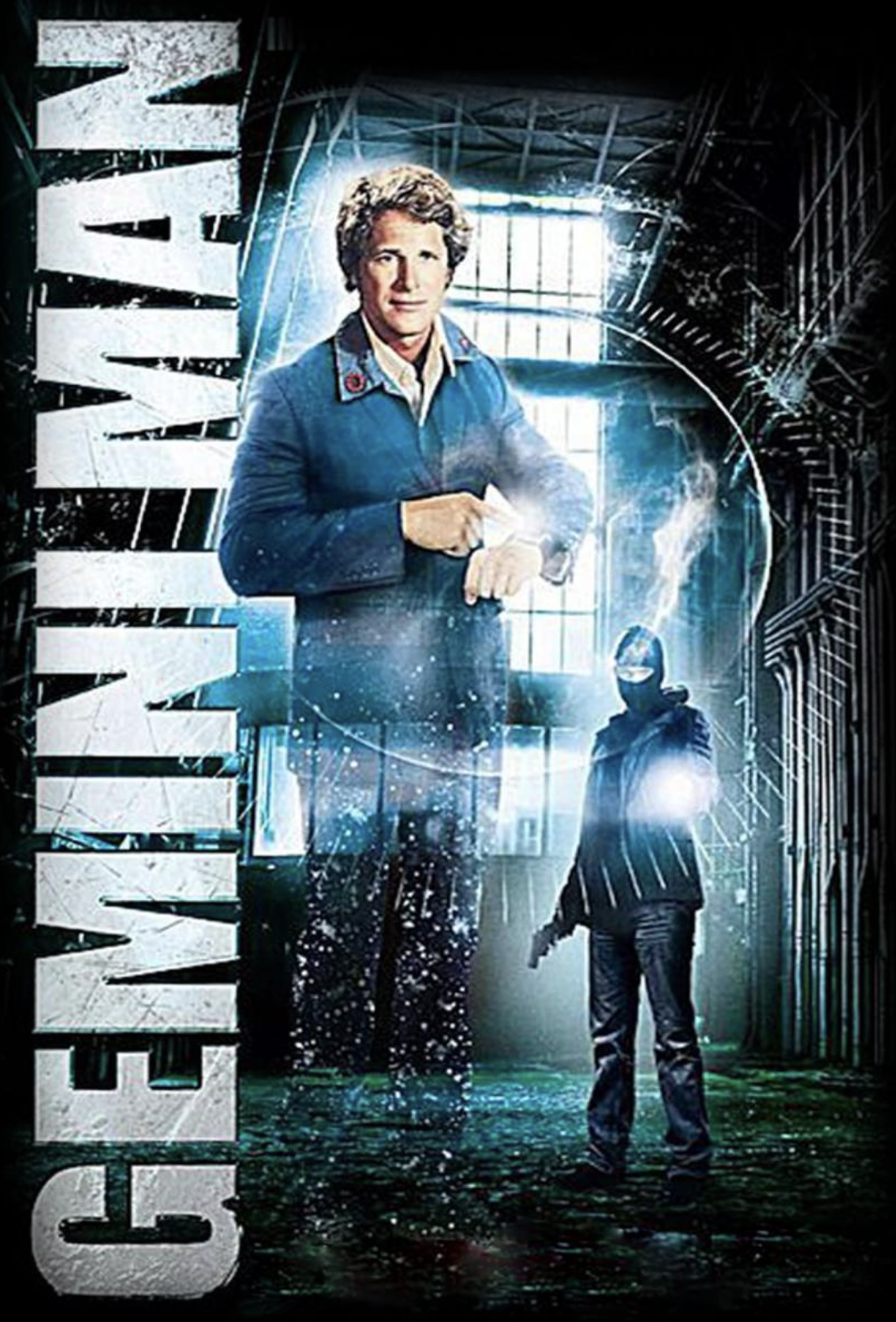
Gemini Man is an American action science fiction series that aired on NBC in 1976, produced by Harve Bennett and Steven Bochco for Universal City Studios. The pilot episode, broadcast on May 10, 1976 under the title Code Name: Minus One, was followed by a regular series that began on September 23 of the same year. The show starred Ben Murphy as Sam Casey, a laid-back, denim-wearing government operative employed by Intersect, a fictional high-tech intelligence organization, who is exposed to radiation during an underwater salvage mission to recover a fallen Soviet spy satellite and rendered permanently invisible as a consequence. Scientist Dr. Abby Lawrence, played by Katherine Crawford, devises a solution in the form of a specially modified digital wristwatch designated a DNA stabilizer, which when worn with its three gold contacts against the skin maintains Casey’s cellular structure and returns him to visibility. By pressing the watch’s stem, Casey can voluntarily revert to invisibility for field operations, but with a critical constraint: more than fifteen minutes of continuous invisibility per day will cause his cellular structure to disintegrate permanently, and the watch’s display provides the only means of monitoring the elapsed time. The series was conceived as a second attempt to adapt H.G. Wells’ The Invisible Man for American network television following the previous season’s The Invisible Man starring David McCallum, with the specific innovation of substituting the prosthetic makeup effects of the earlier production with less expensive optical invisibility techniques and centering the entire dramatic mechanism on the wristwatch device. The show was cancelled after five episodes due to low ratings and high production costs, though all eleven produced episodes eventually aired in Britain, where the series performed considerably better and generated a tie-in annual and record album. In the United States, two episodes were later repackaged into a theatrical compilation film released to drive-in cinemas as Riding With Death in 1976, giving the series a peculiar afterlife in the exploitation cinema circuit that its network television origins had not anticipated.
Behind the Scenes. The production inherited both the production infrastructure and the network timeslot of its predecessor The Invisible Man, and the speed of its development from concept to broadcast reflects the urgency with which Universal and NBC needed to fill the schedule vacancy created by the earlier show’s cancellation. Harve Bennett, who would later go on to produce the Star Trek film series beginning with The Wrath of Khan in 1982, brought to the project a competent professionalism that the material required but that the ratings did not reward, the series finding itself in direct competition with The Waltons on CBS and Welcome Back Kotter on ABC in its Thursday night slot, a scheduling context that left it with minimal room to build an audience. Ben Murphy, cast for physical presence and an ease on screen that read as appropriate for a character whose central attribute was the ability to disappear, was received by contemporary critics as a competent but unremarkable leading man, the consensus being that his natural affability did not generate sufficient dramatic tension for a series whose premise demanded it. Katherine Crawford’s Abby Lawrence, functioning as both the scientific intelligence behind the DNA stabilizer and the operational monitor of Casey’s invisibility duration, provided the show with its most consistently grounded performance and with the practical logic of the watch’s narrative function, her monitoring of the display device giving the audience a legible countdown mechanism around which the series’ action sequences were organized. The decision to locate the show’s central dramatic constraint in a physical object worn on the wrist was, in retrospect, one of the more formally inventive choices in the science fiction television of its era, even if the series surrounding it did not consistently rise to the narrative possibilities the device created.
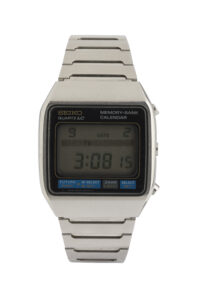
The Watch. The watch worn by Ben Murphy as Sam Casey throughout Gemini Man is a Seiko 0634, specifically a reference from the 0634 caliber family that Seiko had introduced in 1975 as the world’s first digital quartz watch with an integrated chronograph function, a claim of genuine horological significance that the series’ use of the piece as its central narrative device places in an unusually consequential dramatic context. The 0634 caliber was engineered at Suwa Seikosha and represented a milestone in Seiko’s aggressive push into digital watchmaking during the mid-1970s: a self-contained LCD module capable of displaying hours, minutes, and date alongside a chronograph function recording to one-tenth of a second with start, stop, and lap capabilities, housed within a rectilinear stainless steel case of angular, purposeful design that reflects the aesthetic vocabulary of the earliest generation of digital consumer watches before the category had developed its own settled visual conventions. The case variants produced under the 0634 caliber designation include the 5000 of 1975, the 5001 of 1976, and the 5009 and 5019 references, all sharing the same essential movement with minor module revisions designated 0634A and 0634B, and varying in bracelet specification and minor case finishing details. The watch’s presence in Gemini Man is without parallel in the history of screen horology for the specificity and centrality of its narrative role: where virtually every other watch documented in this volume is an accessory worn by a character, the Seiko 0634 in Gemini Man is the show’s premise, its dramatic engine, and its most consequential prop simultaneously. The DNA stabilizer fiction constructed around it exploits precisely the watch’s most visible real-world features: the LCD display, which in the show’s narrative reads out Casey’s remaining invisibility time rather than the hour and minute, and the crown or stem, which in the show’s logic toggles between visible and invisible states rather than setting the time, a fictional elaboration of the object’s genuine physical controls so precisely calibrated to its actual architecture that the watch functions as the DNA stabilizer with complete visual plausibility. That a Japanese digital watch retailing in American department stores at a price accessible to the general consumer should become the load-bearing narrative device of a network science fiction series in 1976 is, in retrospect, an index of the degree to which Seiko’s digital watch program had penetrated American popular culture with sufficient depth and speed to make the 0634 immediately recognizable as a credible instrument of advanced technology, its novelty as a consumer object translating directly into plausibility as a piece of fictional science. The series’ cancellation ensured that the 0634’s screen profile remained confined to a small and largely forgotten chapter of 1970s American television, and the watch’s subsequent collector history has been shaped more by its status as Seiko’s first digital chronograph than by its television association, though the Gemini Man connection has been noted with increasing interest as the vintage Seiko digital community has grown and the series has accumulated a cult following among enthusiasts of the period’s science fiction television.
Details
Brand:
Marketplace Price
€400
Movie Year:
1976
As seen on:
Movie/TV Series: