

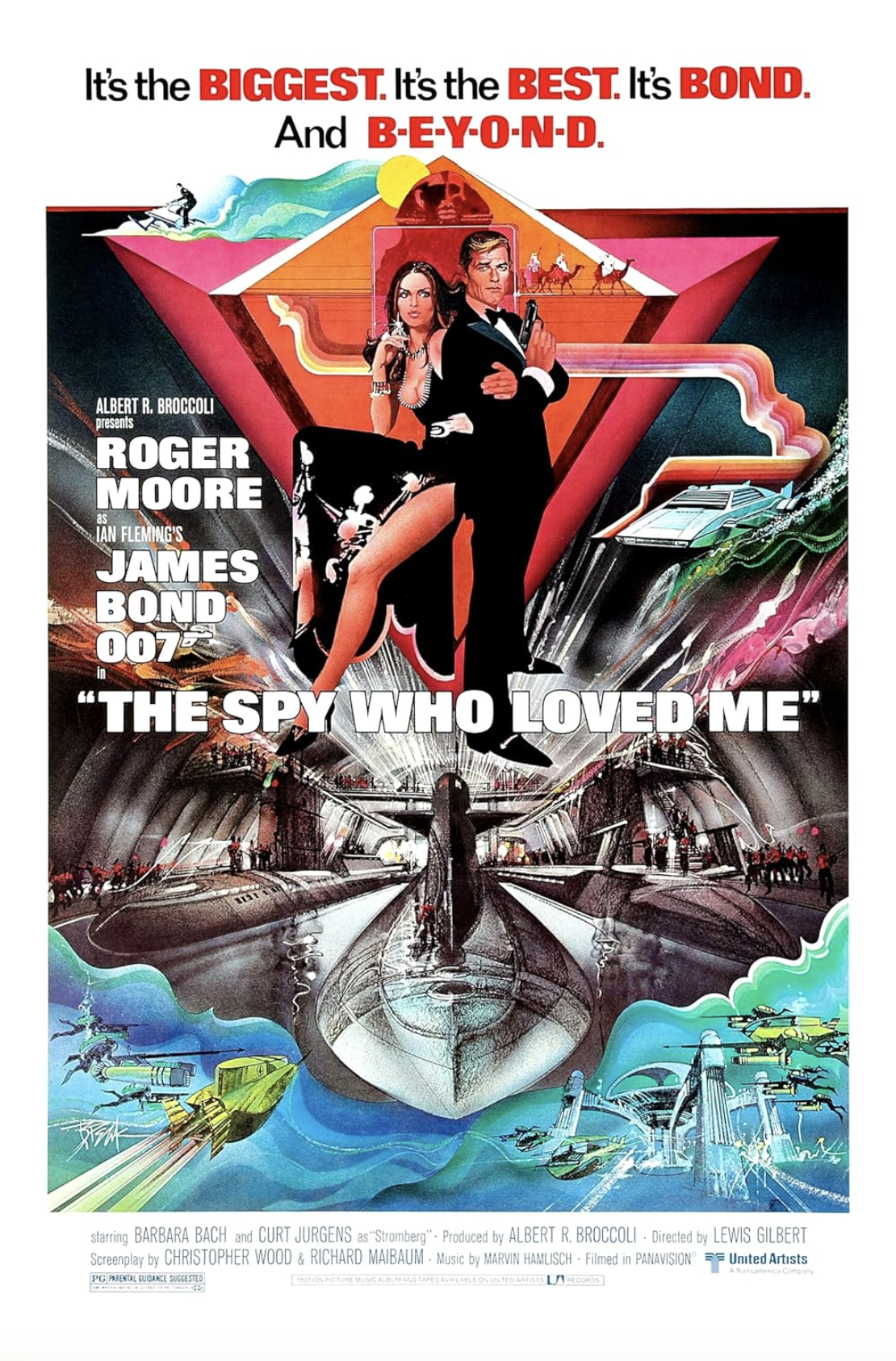
Released on July 7, 1977, and directed by Lewis Gilbert for Eon Productions, The Spy Who Loved Me is the tenth entry in the official James Bond series and the third to star Roger Moore in the title role. It arrived at a moment of genuine uncertainty about the franchise’s continued viability: the preceding film, The Man with the Golden Gun, had performed disappointingly at the box office and received a critical reception that raised serious questions about the direction in which the series was moving, and the production of its successor was complicated by a prolonged legal dispute with Kevin McClory over the rights to the Blofeld character and the Spectre organization, which forced the screenwriters to construct the film’s villain and plot from entirely fresh material. The result, against considerable odds, was the most accomplished and commercially successful Bond film of the Moore era and one of the strongest in the entire series: a confident, visually expansive thriller built around the submarine-swallowing supertanker Liparus, the steel-toothed assassin Jaws played by Richard Kiel, and Barbara Bach’s Major Anya Amasova, a Soviet intelligence officer whose professional competence and personal motivation provide the film with a dramatic counterweight to Bond that the series had rarely managed with such consistency. The film grossed over 185 million dollars worldwide against a production budget of approximately 14 million and is widely credited with rescuing the franchise from the commercial and creative difficulties of the mid-1970s, establishing a template of large-scale spectacle and confident tonal balance that the immediately following films would attempt to sustain with varying success. The Ken Adam production design, particularly the interior of the Liparus tanker constructed on the largest purpose-built film stage in the world at Pinewood Studios, remains among the most audacious set construction achievements in the history of the action genre.
Behind the Scenes. The film was the first in the series not to draw on any Fleming novel beyond the title and a handful of character names, the literary rights to the original story having been retained by Fleming’s estate under terms that prevented their use in the Eon productions. The screenplay, credited to Christopher Wood and Richard Maibaum, constructed its narrative from whole cloth, a creative freedom that paradoxically produced one of the more coherent and purposeful plots in the franchise’s history. Curt Jurgens as Karl Stromberg, the film’s primary villain, was received as a convincing if conventionally conceived antagonist, but it is Richard Kiel’s Jaws who lodged most permanently in the popular imagination, his physical scale, his steel teeth, and his apparent indestructibility generating a character response so positive that the producers brought him back in the following film, Moonraker, in a role that leaned further into the character’s comic dimensions. Barbara Bach’s Anya Amasova was conceived as a Bond woman of genuine professional standing whose personal vendetta against Bond, whose actions had caused the death of her lover, creates a narrative tension that the film sustains with more consistency than might have been expected. The underwater sequences, filming of which required the construction of a purpose-built tank at Nassau in the Bahamas, were supervised by underwater photography director Lamar Boren and represent some of the most accomplished practical underwater cinematography of the decade. The Carly Simon title song Nobody Does It Better, composed by Marvin Hamlisch, became the most commercially successful Bond theme in the history of the franchise to that point, reaching the top five in both the American and British charts.
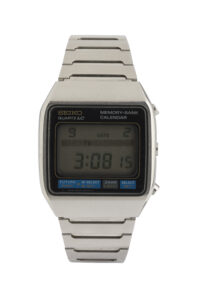
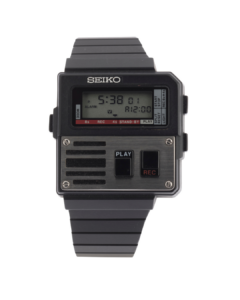
The Watch. The watch worn by Roger Moore as James Bond throughout The Spy Who Loved Me is the Seiko reference 0674-5009, designated by Seiko as model DK001 and marketed under the Quartz LC designation, a piece whose significance in the history of both the Bond franchise and the consumer electronics industry exceeds considerably what its modest physical presence on screen might suggest. The 0674-5009 is an LCD digital watch of the type that was transforming the watch industry during the mid-1970s, its liquid crystal display technology representing a generational advance over the LED displays of the preceding years in terms of battery consumption, the LCD drawing a fraction of the current required by the light-emitting diode displays of watches like the Hamilton Pulsar that Bond had worn in Live and Let Die four years earlier. The display presents time as a sequence of segmented numerical digits of the kind that defined the visual language of digital timekeeping throughout the decade, the “field-effect modulation” liquid crystal technology offering legibility in ambient light conditions that the LED displays could not match without active illumination. The case is a slim, rectilinear stainless steel construction of restrained proportions, the bracelet integrated into the overall design in the manner typical of early LCD watch architecture, the overall aesthetic projecting the technological confidence of a manufacturer that understood it was at the frontier of a new kind of timekeeping and wanted the object on the wrist to communicate that understanding without ostentation. The film’s deployment of the 0674-5009 is the most narratively inventive of the Seiko Bond appearances: the watch functions as a covert communications device, receiving and printing a message from M on a DYMO-style embossed tape that emerges from between the case and the first bracelet link, the printed text reading “007 TO REPORT HQ. IMMEDIATE M” in the film’s most celebrated gadget sequence involving the watch. This ticker-tape messaging function was the fictional elaboration of genuine LCD technology at a moment when the concept of receiving written communications on a wrist-worn device was sufficiently novel to register with audiences as credible near-future extrapolation rather than fantasy, and the scene’s premise anticipates by two decades the kind of wrist-based communication that would eventually become commonplace in the smartwatch era. The Bond-Seiko association formally initiated with this film was acknowledged in the closing credits, where Seiko Watches appears among the production’s credited partners, the arrangement representing one of the earlier and more commercially transparent watch placement deals in the franchise’s history, a relationship that Cubby Broccoli himself singled out for specific mention in his autobiography, describing the watch as “a wristwatch that printed tape messages from M” in a passage that confirms the producer’s own recognition of the gadget’s effectiveness as a piece of narrative engineering. Among collectors of Bond watches and vintage Seiko digital pieces, the 0674-5009 occupies a foundational position as the watch that inaugurated the Roger Moore-era Seiko association, the specific model DK001 variant being definitively authenticated by documentation provided by Seiko UK, and well-preserved examples commanding secondary market prices that reflect both the watch’s historical importance within the franchise and the relative difficulty of finding pieces in working condition whose LCD displays have not succumbed to the segment degradation that afflicts early liquid crystal technology after decades of use.
Details
Brand:
Marketplace Price
€800
Movie Year:
1977
As seen on:
Movie/TV Series: