“Wow, what a view!” – May Day, “To a kill!” – Max Zorin
Released on May 22, 1985, and directed by John Glen for Eon Productions, A View to a Kill is the fourteenth entry in the official James Bond series and the seventh and final film to star Roger Moore in the title role, Moore being fifty-seven years old at the time of filming, a fact that the production was acutely conscious of and that subsequent critical assessments have not been shy about noting. The film follows Bond’s investigation of Max Zorin, a microchip magnate and former KGB asset played by Christopher Walken with a quality of cheerful, unpredictable menace that constitutes the film’s most compelling performance, whose plan to destroy Silicon Valley by triggering a catastrophic earthquake would grant him a monopoly over the global microchip market. Zorin’s associate May Day, played by Grace Jones in a performance of extraordinary physical authority and studied amorality, provides the film with its most visually striking presence and with a Bond woman of genuinely unusual construction whose eventual alliance with Bond against Zorin gives the film’s climax a dramatic logic that its action sequences sustain only partially. The film performed respectably at the box office, grossing over 152 million dollars worldwide, but its reception among critics and within the Bond community has settled into a consensus that places it among the weaker entries of the Moore era, the combination of an aging lead, an uneven tone, and action sequences of variable conviction having accumulated into a film that feels more like the conclusion of an era than a confident statement within one. The Duran Duran title song was the last Bond theme to reach number one on the UK charts for three decades.
Behind the Scenes. The production was filmed across locations in France, Iceland, and San Francisco, the latter providing the film’s climactic sequences aboard a dirigible above the Golden Gate Bridge with a visual grandeur that the preceding action had not consistently sustained. Tanya Roberts as geologist Stacey Sutton was received by contemporary critics as one of the less convincing Bond women of the era, her character’s professional credentials and her screen chemistry with Moore generating a scepticism that reviews of the period expressed with varying degrees of politeness. Patrick Macnee, cast as Bond’s ally Sir Godfrey Tibbett, brought to the film a quality of easy, self-aware English charm that his long association with The Avengers had honed to considerable refinement, and his scenes with Moore constitute some of the film’s most relaxed and pleasurable passages. The pre-title sequence, set on a Soviet Arctic location where Bond recovers a microchip from the body of agent 003 before escaping a pursuit across the ice in a sequence that includes a snowboard improvised from a piece of wreckage, established the film’s ambition to deliver spectacle that its subsequent San Francisco sequences only intermittently matched. The film marked the end of a decade-long relationship between the franchise and Seiko, whose watches had appeared on Bond’s wrist across five consecutive films beginning with The Spy Who Loved Me in 1977, a partnership concluded in the closing credits of A View to a Kill with the final appearance of the “Seiko Time (UK) Ltd” partner credit that had accompanied the Moore era’s Japanese watch association throughout.
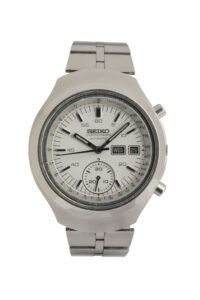
The Watch. The watch worn by Roger Moore as James Bond in A View to a Kill is a Seiko reference 7A28-7020, a quartz chronograph whose significance in the history of watchmaking extends well beyond its screen association and whose presence in the film represents the Bond-Seiko partnership at its most technically distinguished. The caliber 7A28 was, at its introduction, a genuine milestone: the world’s first analog quartz chronograph, a claim of absolute historical precision that Seiko’s contemporary advertising celebrated with the phrase “watch history being made.” Prior to the 7A28, all quartz chronographs were digital in their display; Seiko’s engineering achievement was to combine the accuracy and low maintenance of quartz regulation with the traditional three-register analog chronograph layout that the Swiss mechanical tradition had developed over more than a century, producing a movement of 15 jewels, constructed entirely of metal without a single plastic component, and built with the explicit intention of longevity and serviceability rather than the planned obsolescence that characterized much quartz production of the period. The movement offers three subdials: a 1/10-second counter at three o’clock making one revolution per second, constant seconds at six, and a 30-minute totalizer at nine, with the center seconds hand stationary during normal timekeeping and activated only when the chronograph is engaged. The case of the 7A28-7020 measures 37mm in stainless steel with a clean, uncluttered architecture whose restraint places it at the dressy end of the chronograph spectrum, the white silver sunburst dial with black hands and markers giving it a quality of formal elegance that the more sportingly configured black dial variants of the same reference do not quite achieve. This specific silver configuration is considerably rarer than the black or gold dial versions of the 7A28 family, a relative scarcity that has amplified its collector appeal beyond what the Bond association alone would have generated. The watch’s deployment in A View to a Kill is notably restrained by the gadget standards the franchise had established during the Seiko era: as one contemporary observer noted, the 7A28-7020 appears in the film without any fictional elaboration of its capabilities, functioning throughout simply as a chronograph rather than a device, a restraint that reads as the production’s tacit acknowledgment that a movement of this historical significance required no fictional enhancement to justify its place on Bond’s wrist.
Details
Brand:
Marketplace Price
€1 400
Movie Year:
1985
As seen on:
Movie/TV Series: